
Table of Contents
Some mornings you want to chew. Some mornings you want to drink your meal and be done. And at least once a week, you want breakfast to fix itself while you are still rubbing your eyes. Healthy breakfast recipes are easy to find; what is harder is deciding whether you should blend, soak, fry, or assemble.
If you are short on ideas and long on decision fatigue, you can start with seven quick and filling healthy breakfast ideas and then tailor them to your mornings. But to actually build a routine, you need to know the trade-offs of the main camps.
Smoothie Recipes: Speedy, Flexible, and Easy to Under-Fuel
A homemade smoothie is the fastest breakfast in the game: toss, blend, pour, and you are out the door in three minutes. The version that works for me uses a cup of kefir or unsweetened almond milk, a frozen banana, a big handful of frozen berries, one scoop of protein powder, and two handfuls of spinach. It lands at roughly 340 calories, 25 grams of protein, and 8 grams of fiber.
Without protein powder, though, the math gets ugly. A fruit-first smoothie made with orange juice and sweetened yogurt can contain 45 grams of sugar and hardly any fat, leaving you hungry by ten. Blending breaks down fiber, which is useful for absorbing nutrients but not so good at keeping you full. Chewing matters. If you do choose smoothies, add chia or nut butter to slow things down.

- Prep time: about 4 minutes plus rinsing the jug.
- Satiety: OK, but requires fat and protein to last.
- Best for: hot days, post-workout mornings, and hiding vegetables.
The key is repetition, not special ingredients. If you need an exact template, this step-by-step guide to building healthy breakfast recipes in ten minutes shows a build formula you can use.
Overnight Oats: The Make-Ahead Champion With a Texture Problem
Overnight oats are the breakfast equivalent of leaving a note for tomorrow’s self. Combine 50 grams of rolled oats, 15 grams of chia seeds, 100 grams of Greek yogurt, and 100 ml of milk. Add a pinch of salt and crushed berries. Store overnight. In the morning, a thick, creamy porridge is waiting for you—with no stove to watch and no pan to wash.
The payoff is macro-balanced: about 45 grams of carbs, 17 grams of protein, and 10 grams of fat, with a solid slice of fiber. Because oats absorb liquid slowly, they tend to release energy gradually. They are also cheap. A jar of oats plus a bag of chia can last weeks.
The catch is that oats have a polarizing, almost jelly-like texture. If you end up with a glassy, cold bowl, no nutritional award will make you comfortable with it. The other trap is commercial overnight oat mixes, whose second or third ingredient is often sugar. Read labels.
- Prep time: about 5 minutes at night, 0 minutes in the morning if you prep enough.
- Satiety: excellent thanks to beta-glucan fiber; can be enhanced with yogurt.
- Best for: busy mornings and meal prep.
But if you can’t stomach them, don’t force it. Other healthy breakfast ideas that are fast, simple, and actually delicious can fill the same slot.
Egg-Based Breakfasts: The Satiety Standard
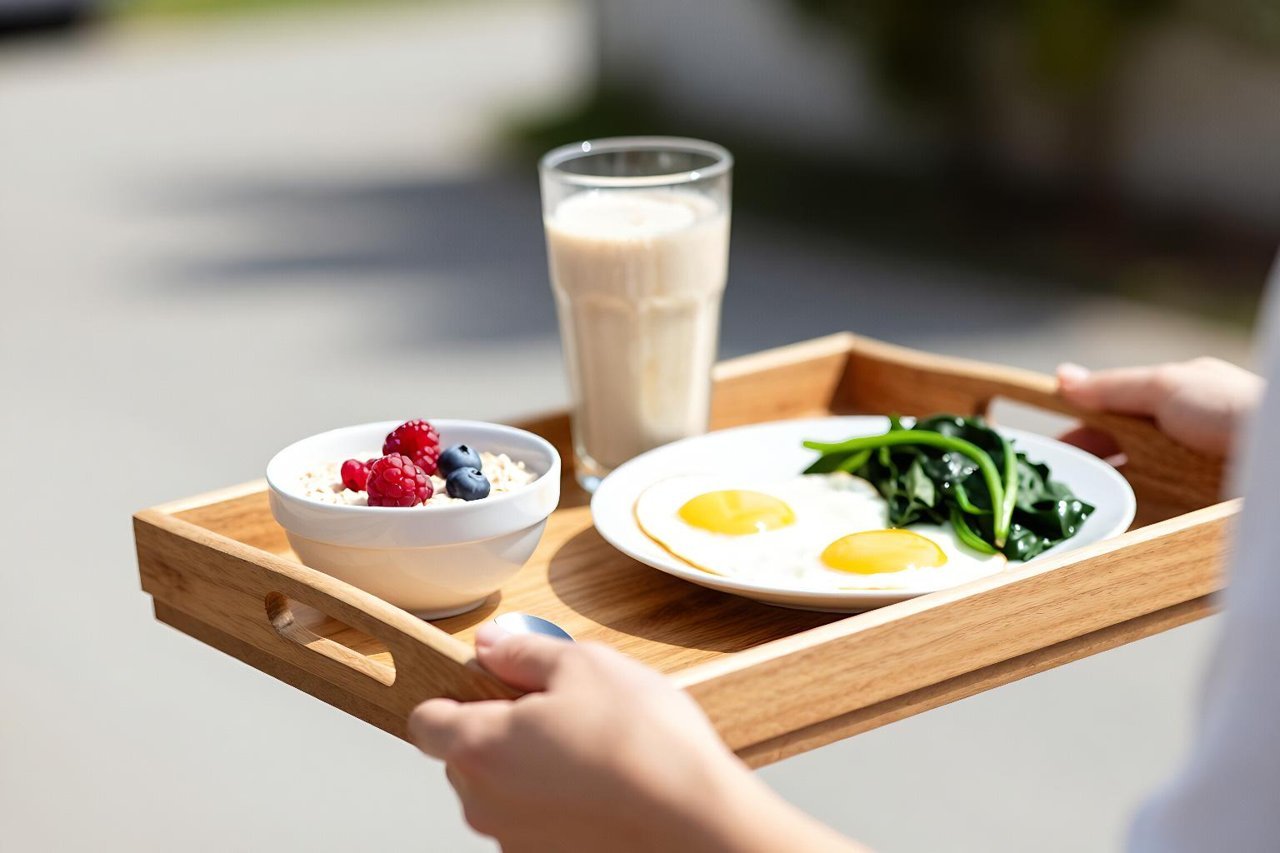
Eggs remain the benchmark for sustained fullness. Two eggs cooked in a teaspoon of olive oil, add a handful of spinach and a slice of whole-grain toast: about 330 calories, 19 grams of protein, and a serious dose of choline, vitamin D, and lutein. Eggs have high-quality protein that helps keep your appetite in check until lunch.
The trade-off is time and attention. You have to be awake enough not to burn the thing. It only takes eight minutes, but those minutes require you to stand near the stove. If you meal prep, consider baked egg muffins: whisk a dozen eggs with frozen peppers and feta, pour into muffin tins, and roast for about twenty minutes. Reheat one in the microwave for forty seconds. You get the same egg benefits with less morning effort. It is a useful trick to know when you want more protein without rotating through another smoothie. Those principles also apply beyond breakfast. High protein meals that hit 40 grams per plate show you what it looks like when protein becomes the centerpiece of the meal.
Savory Grain Bowls: Breakfast Without a Sugar Spiral
Most mornings in America are sweet: oats, granola, fruit, syrup. But a healthy breakfast can be as savory as lunch, and often satisfying when you have leftover cooked grains in the fridge. A warm bowl of quinoa, farro, or leftover brown rice, loaded with sautéed greens, some tofu or shredded chicken, kimchi, and a runny egg is a genuinely filling, low-effort meal once you do the work once or twice a week.
It takes less than ten minutes if the grain already exists. Microwave the grain, warm the protein, add a handful of arugula and drizzle with olive oil. The outcome lands between 400 and 500 calories with protein, carbs, and fat in a balanced ratio. The lone downside is the obligation: you need to cook grain ahead of time, which overnight oats don’t require. If you have leftover dinner grains, no extra recipe is necessary. It simply repurposes and reduces food waste.
Run a Five-Day Breakfast Experiment
Rather than adopting any single formula forever, treat the next week as a controlled trial. Assign Monday to smoothies, Tuesday to overnight oats, Wednesday to eggs, Thursday to a savory grain bowl, and Friday to whichever you enjoyed most on previous days. Then, at the same time each morning, make two notes. First, rate your hunger at 10:30 a.m. on a scale from one to ten. Second, notice whether you are thinking about food minutes later. A breakfast that keeps you happy until noon likely contains enough protein and fiber, regardless of which chef-inspired recipe made it.
The goal of a healthy breakfast isn’t to win an aesthetic prize or to match someone else’s overnight oat bowl. It’s to find a repeatable meal that lets you start your day without a crash. To keep rules from turning healthy eating into a second job, borrow tactics from healthy eating without the overwhelm and implement only what works for you. After one week, pick your two best mornings and alternate them in a weekly rotation. If you notice you are stuck, rerun the trial. That is a plan you can actually repeat, and the only breakfast recipe that truly matters is the one you keep.


