
Table of Contents
A bowl of honey granola, a banana, and a glass of orange juice. Add it up and you’re looking at roughly 60g of sugar and about 9g of protein. That’s a breakfast that will have you opening a desk drawer at 10:30 looking for something, anything, to eat. Nobody pours that bowl on purpose thinking they’re sabotaging their morning. The problem is that most breakfast advice is vague. “Eat breakfast.” “Choose wholegrain.” “Go low fat.” None of it survives contact with a real Tuesday.
What follows are the specific mistakes that show up again and again in otherwise sensible kitchens, plus the fixes that actually change how you feel by mid-morning.
Mistake 1: Trusting the front of the packet
“High in fibre.” “Made with real fruit.” “Natural energy.” These phrases describe ingredients, not outcomes, and they sit on some of the sweetest things in the cereal aisle.
Where the health halo hides
- Granola: typically 12–15g of sugar per 50g. A “serving” is 45g. Most people pour 100g, which is a 500-calorie bowl before the milk.
- Flavoured yoghurt: vanilla, honey and fruit-on-the-bottom pots regularly hit 20g of sugar each. Plain Greek yoghurt plus fresh fruit lands under 8g.
- Bottled smoothies: fruit puree with the fibre stripped out, no protein, and nothing to chew. It’s juice wearing a wellness costume.
- “Protein” cereal bars: often 6g of protein against 25g of carbohydrate. That ratio won’t hold you past the commute.
A quick filter that cuts through all of it: look at protein per 100 calories. Under 5g and you’re eating a snack that has been marketed as a meal. Over 8g and you’re in decent territory.

Mistake 2: Under-eating protein by a mile
Two slices of toast with peanut butter gives you roughly 11g of protein. A fruit-and-oat smoothie gives you about 5g. Neither is enough to keep hunger quiet for four hours. Aim for 25–30g at breakfast, which is the range where most people notice a genuine difference in appetite and focus.
Quick protein maths for a rushed morning
- 2 large eggs: 12g
- 150g Greek yoghurt: 15g
- 100g cottage cheese: 11g
- 100g firm tofu: 12g
- 30g whey or pea protein powder: 20–24g
- 40g cheddar: 10g
Combine two of those and you’re there without cooking anything complicated. If you want to see how far this can go, these high-protein recipes that hit 40g a plate show the maths working at the other end of the day.
Mistake 3: Still fearing fat
The low-fat era left a lot of people eating dry toast and fat-free yoghurt with a scoop of sugary jam. Fat slows digestion and helps you absorb vitamins A, D, E and K, which is exactly why a slice of avocado on your eggs keeps you fuller than the same calories from cereal. Half an avocado, a tablespoon of olive oil, a small handful of walnuts, or full-fat yoghurt in sensible amounts all earn their place. Fat doesn’t make you fat. A chronically unsatisfying breakfast that leads to a 10am pastry does.
Mistake 4: Collecting recipes instead of building a routine
Most people have forty breakfast recipes saved and cook none of them, because on a Wednesday at 7:15am you don’t want a project. You want something you can make on autopilot. The useful shift is deciding on a method rather than a dish. Blending, soaking, frying or assembling each serve a different kind of morning, and knowing which one is yours removes the daily decision entirely. Once the method is fixed, you can rotate fillings forever without thinking about it.
If time is the real blocker, this step-by-step ten-minute build is worth an actual read rather than a bookmark you’ll never reopen.
Mistake 5: Drinking breakfast and calling it a meal
Smoothies aren’t the villain. A smoothie made of banana, mango, orange juice and oat milk is a dessert with a blender in it. Chewing matters more than people expect, because the mechanical act of eating is part of what signals fullness. A liquid breakfast slides past that signal.
The fix is structural: build the smoothie on a protein base (Greek yoghurt, protein powder, silken tofu), add a fat source (a spoon of tahini, peanut butter, or ground flax), and pour it into a bowl with something to chew on top, like a few nuts or a spoon of seeds. If that sounds like too much work, these fast, genuinely tasty breakfast ideas are a better starting point than a blender full of fruit.
Mistake 6: Force-feeding yourself at 6:45am
“You must eat within 30 minutes of waking” is one of the more persistent myths going. It came from sports nutrition research on athletes training twice a day. If you work a desk job and eat dinner at 8pm, you’re not in that situation.
If you’re genuinely not hungry at 6:45, waiting until 9:30 and eating properly is better than choking down dry cereal at dawn, which tends to kill any enthusiasm for breakfast by Thursday. The meal is what matters, not the clock. What isn’t fine is skipping it entirely and then eating a croissant in a meeting because you’re shaking.
Mistake 7: Hoping fibre happens by accident
Most breakfasts land around 2–3g of fibre. Getting 8–10g is the difference between a smooth morning and one spent wondering if you’ve had enough coffee. It rarely happens by luck.
Easy places to add fibre
- One tablespoon of chia or ground flax stirred into yoghurt: about 5g
- 100g frozen raspberries, microwaved for 30 seconds: about 6g
- Half a tin of black beans added to scrambled eggs: about 7g
- 40g rolled oats: about 4g
- Swap white toast for wholegrain rye: roughly double the fibre per slice
Mistake 8: Having a weekend personality and a weekday personality
Sunday you make shakshuka with sourdough and feel like a person who has their life together. Wednesday you eat a cereal bar standing over the sink. That gap is where most healthy eating plans quietly die, and it isn’t a willpower problem. It’s a preparation problem.
The fix is batching something that reheats well: a tray of egg muffins, a pot of steel-cut oats, a jar of soaked chia. Ten minutes on Sunday buys you four mornings. If the whole thing feels like too much, this practical guide to eating well without the overwhelm is built for exactly this trap.
Mistake 9: Never checking the feedback
Breakfast is the one meal where you get a clear result within four hours. That’s a gift. For one week, write down what you ate and one word for how you felt at 10:30: steady, foggy, starving, fine. Patterns appear fast. Oats alone and you’re ravenous by 10. Oats with protein and fat and you’re not. That single data point is worth more than any list of rules, including this one.
Three breakfasts that already fix all of the above
If you’d rather skip the diagnosis and go straight to the answer, these three cover the protein, fat and fibre boxes without any cleverness required.
- The fry: a three-egg omelette with a handful of spinach and 30g feta, one slice of rye, and 20g of almonds. Roughly 32g protein, 8g fibre, 480 calories.
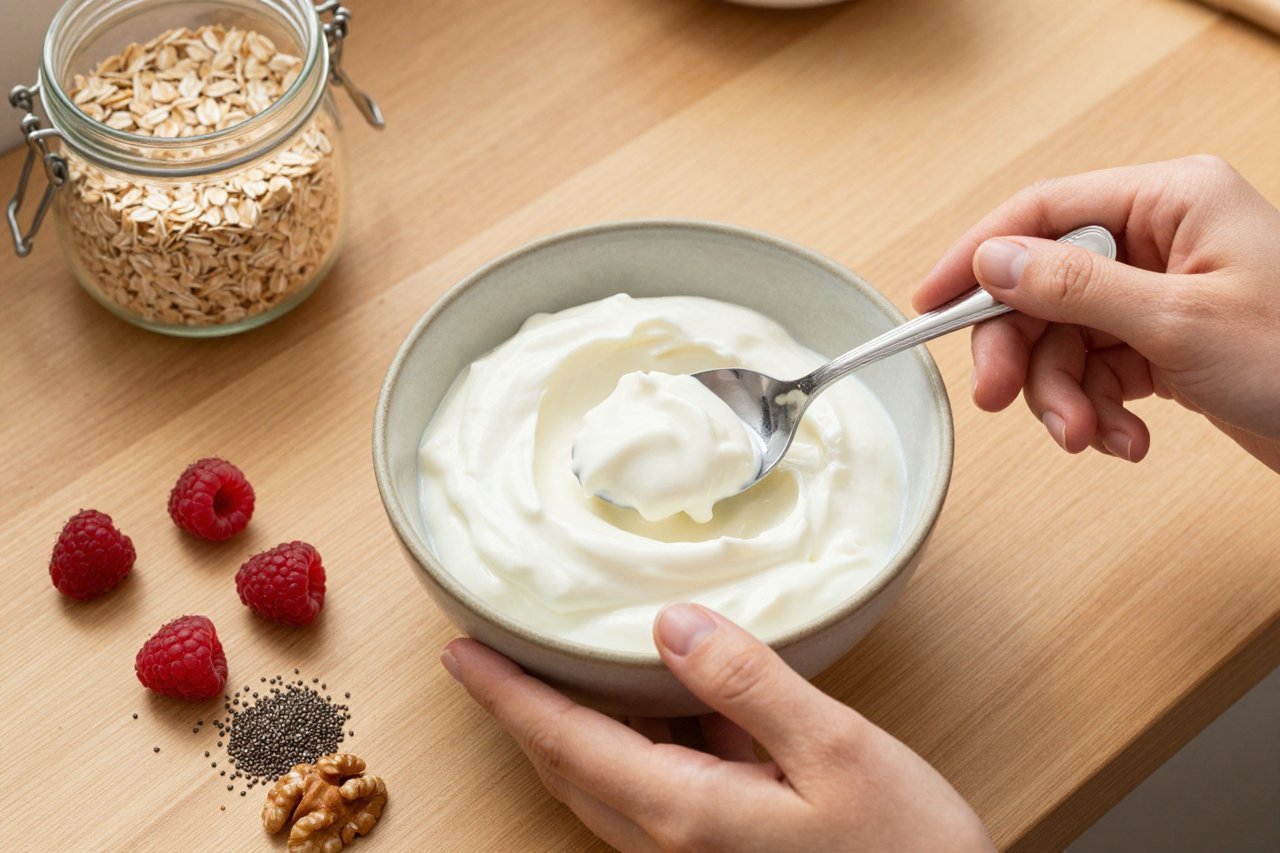
- The assemble: 200g Greek yoghurt, 40g oats, a tablespoon of chia, 80g raspberries, 15g walnuts. Roughly 28g protein, 12g fibre.
- The soak: overnight oats with 30g protein powder, a tablespoon of ground flax, and a spoon of peanut butter. Roughly 30g protein, 9g fibre, and zero cooking.
Pick one. Eat it five mornings in a row. Track how 10:30 feels. Then change a single thing and watch what happens. That loop, run for a month, will teach you more about your own body than any breakfast list you’ll ever read, and you’ll end up with two or three recipes you actually make without thinking about them.


