
Table of Contents
In 2023, a team of researchers read words from a scroll that had been turned to carbon by the eruption of Mount Vesuvius in AD 79. They never opened it. Using high-resolution X-ray scans taken at a particle accelerator near Oxford and a machine-learning model trained on cracked papyrus, they pulled a single Greek word out of the rolled-up lump: porphyras, meaning purple. A scroll that had spent two thousand years as a charred cylinder suddenly had a voice again.
That moment captures where archaeology and ancient discoveries stand right now. The questions are old ones. How did people live before cities, writing or metal? What did they believe about death? Why did some societies hold together while others fractured? The methods answering those questions are startlingly new, and they are arriving faster than most textbooks can keep up with.
The Tools Have Changed More Than the Ruins
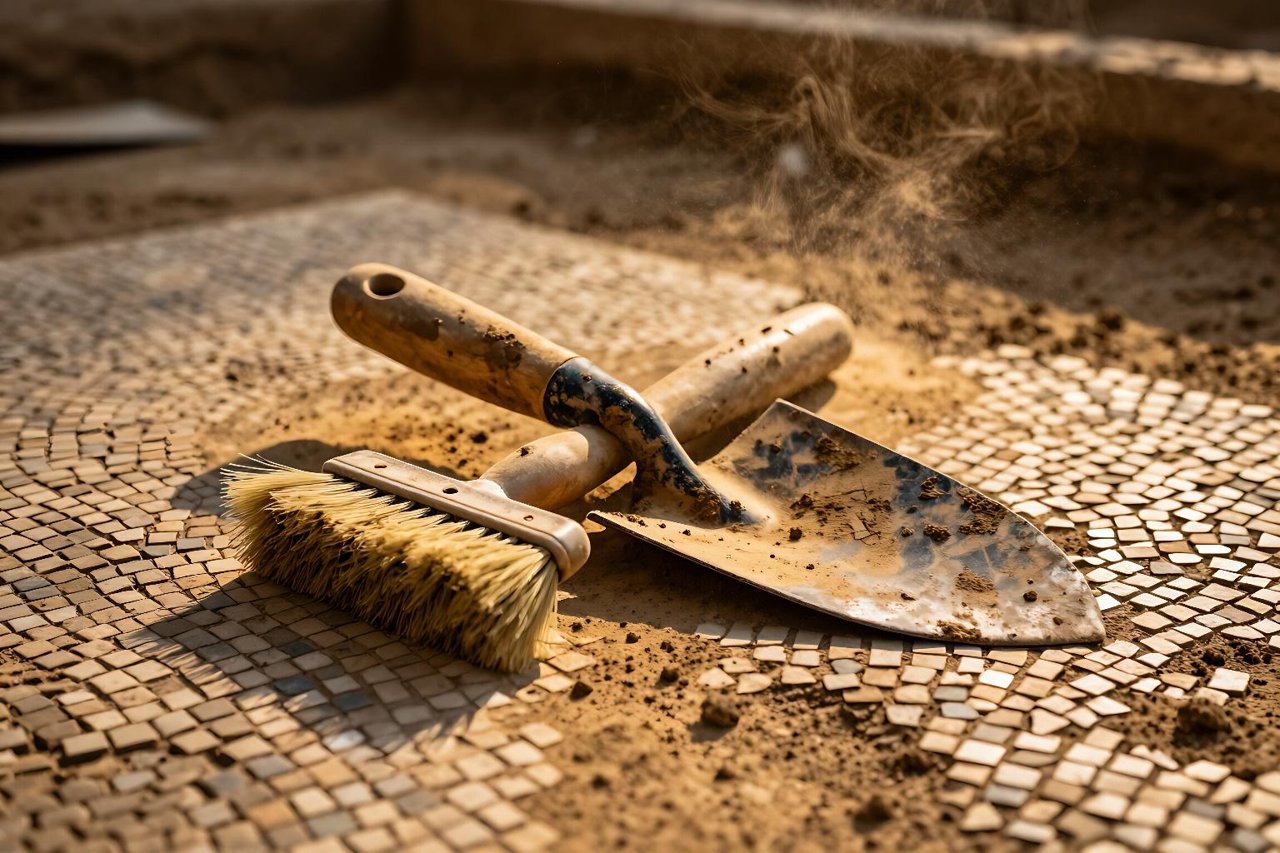
A trowel and a sieve still matter. Everything around them has shifted. In 2018, archaeologists using airborne laser scanning, known as LIDAR, stripped away the jungle canopy in Guatemala’s Mirador Basin and mapped roughly 60,000 previously unknown structures, including causeways, reservoirs and defensive walls. The same technique redrew parts of Cambodia around Angkor and revealed buried medieval field systems under Irish farmland.
Ground-penetrating radar, magnetometers and soil chemistry now let teams decide where to dig before a spade touches earth. That matters more than it sounds, because excavation destroys the context it is meant to record. Every trench is a one-time offer.

Ancient DNA turned bones into libraries
A single finger bone from Denisova Cave in Siberia, unearthed in 2008, yielded a complete genome in 2010 from a human species no one knew existed. Since then, genetic material has been recovered from 30,000-year-old teeth, from cave sediment, and from skeletons too degraded for any other identification method to work. Svante Pääbo received the 2022 Nobel Prize in Physiology or Medicine for building that field from scratch.
Machine learning is reading books we cannot open
The Herculaneum papyri were carbonised so thoroughly that early attempts to unroll them shredded the pages. Now the text comes out sideways, through scanning and pattern recognition. The 2023 Vesuvius Challenge paid out $700,000 to teams that recovered passages from an unopened scroll, and the first letters came from a 21-year-old student. It belongs to the same family of breakthroughs as the wider run of mind-blowing scientific discoveries that reshaped our world, the kind that rarely arrive with a single eureka moment.
Discoveries That Broke the Timeline
Some finds do not just add detail. They knock the framework loose.
Göbekli Tepe, in southeastern Turkey, was built around 9500 BC by people who had not yet domesticated grain. Massive carved limestone pillars, some weighing 16 tonnes, were raised and then deliberately buried. For decades, the standard story said complex religion followed farming. Göbekli Tepe suggested the order might be reversed.
In 2021, researchers dated fossil human footprints at White Sands in New Mexico to between 21,000 and 23,000 years ago, pushing evidence of people in North America back several thousand years earlier than most models allowed. In South Africa, the Rising Star cave system produced Homo naledi in 2013, a species with a small brain and a mix of primitive and modern features. On the Indonesian island of Flores, Homo floresiensis turned up in 2003 standing about a metre tall. Pieces like these are why round-ups of the archaeological discoveries that rewrote history keep needing fresh editions.
What’s Underwater Is Redrawing the Map
Dry land is only part of the picture. Thonis-Heracleion, an Egyptian port city swallowed by the Mediterranean, was located in 2000 and has since given up ships, statues and coins. The Antikythera mechanism, pulled from a Greek wreck in 1901, turned out to be a geared astronomical calculator built more than 2,000 years ago, and no one has found anything comparable from the ancient world.
The Black Sea preserves shipwrecks with eerie precision, because deep water there holds almost no oxygen. Vessels have been found with masts and rigging still standing after a thousand years. Marine work of this kind feeds directly into the bigger scientific project of ocean discoveries that are rewriting the story of our planet, and it is a reminder that coastlines today are nothing like coastlines in the past. Sea levels have moved by more than 100 metres within the span of human occupation.
Ordinary Lives Leave the Best Evidence
Gold masks get the headlines. Middens get the answers. A rubbish heap is a record of what people ate, threw away, repaired, burned and lost, and it accumulates without anyone curating it.
- Latrine and sewer deposits from Roman cities contain seeds, fish bones and parasites that reveal diet and disease street by street.
- Dental calculus traps plant microfossils and proteins, showing what someone actually chewed in their final years.
- Isotope ratios in tooth enamel can pin down where a person grew up, which is how we know Roman Britain was full of migrants.
- Coprolites, fossilised faeces, have produced intact gut bacteria and even DNA from extinct animals.
- The Vindolanda tablets, thin wooden leaves from a fort near Hadrian’s Wall, carry birthday invitations, requests for beer and complaints about roads.
That attention to daily life is why the subject tends to stick with people long after they read about it. The distant past still shapes ordinary routines, from the seven-day week to the layout of the streets outside your door.
Who Owns the Past?
Excavation has never been politically neutral. The Benin Bronzes, looted by British troops in 1897, have been returning to Nigeria in stages since 2022. Greece has campaigned for the Parthenon sculptures for two centuries. The 1970 UNESCO convention set a global standard against trafficking, though enforcement remains uneven.
Seventy years of archaeological work, seen honestly, also produced its share of damage: sites dug without proper recording, artefacts removed from communities that never consented, Indigenous graves opened as specimens. Community archaeology, where local people help set the research questions, has grown in response. Britain’s Portable Antiquities Scheme, which records finds made by metal detectorists rather than confiscating them, is one imperfect but workable model.
Keeping track of this side of things matters as much as tracking the spectacular finds, which is why following sustained archaeology news coverage beats waiting for a viral headline.
How to Read a Headline About a New Discovery
A few habits will keep you from being misled. Ask whether the claim has been peer reviewed or is simply a university press release, because the two are not the same thing. Check the dating method: radiocarbon, luminescence, stratigraphy and dendrochronology all carry margins of error, and a range of 300 years is normal for deep prehistory. Look at what was found in context, not just the object itself, since a golden cup without its surrounding layers tells you very little. Then watch for the word ‘rewrites’, which often means ‘adds a small complication to an existing model’.
The most reliable signal is repetition. When three independent teams, working with different techniques on different sites, converge on the same answer, that is when a genuine shift has happened. Everything else is a promising lead, and there are thousands of those, which is roughly the point. The ground still holds far more than it has given up.


