
Table of Contents
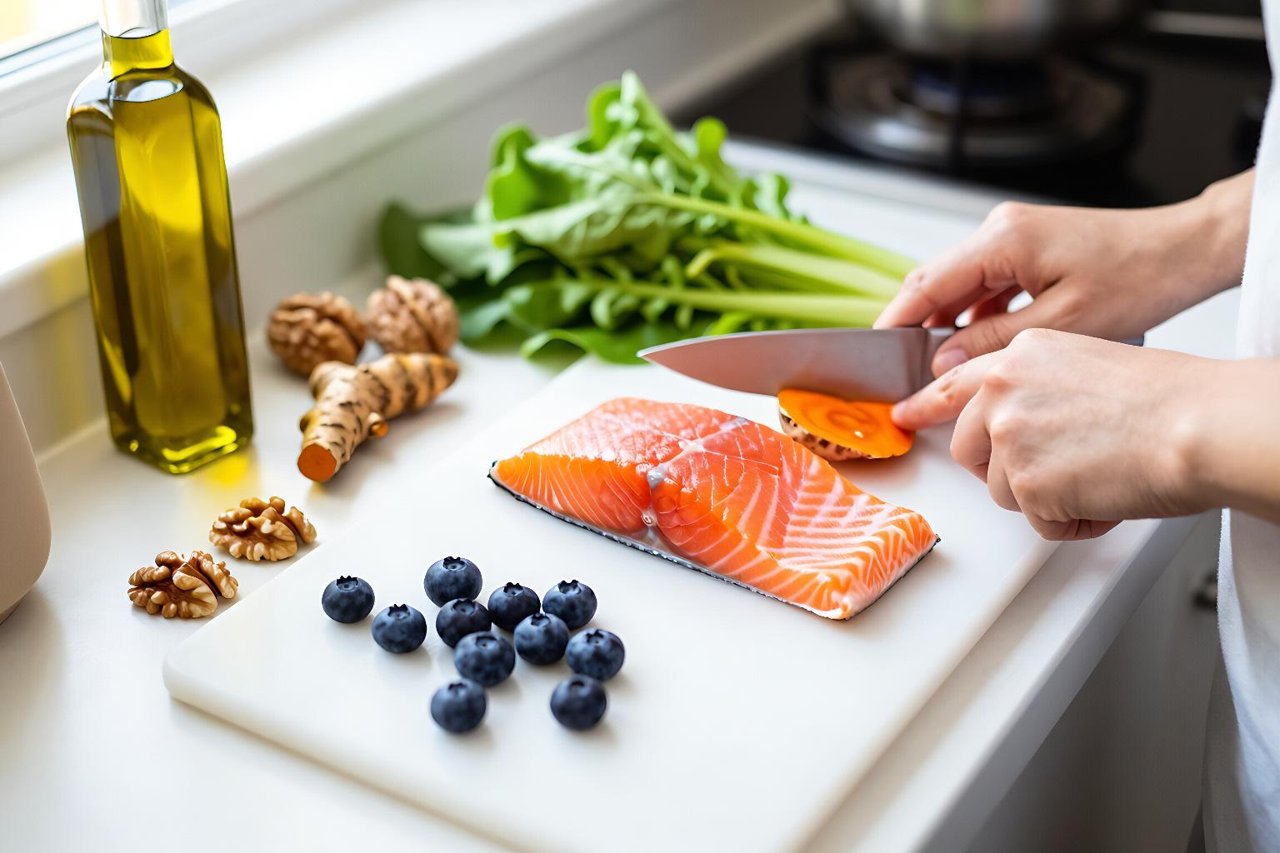
Berries on your porridge, salmon on Tuesday, a turmeric latte at 3pm. That reads like a solid anti-inflammatory week. It can still be a week where nothing much changes, because inflammation responds less to individual hero foods than to the pattern they sit inside.
Most people who tell me they’re “eating anti-inflammatory foods” are making at least three of the mistakes below. None of them are dramatic. All of them are fixable, usually without giving up anything you actually like. If you want the wider context first, the complete guide to reducing inflammation naturally covers the biology; this piece is about the practical traps.
1. You’re adding good foods instead of swapping for them
A handful of walnuts scattered over a diet built on white bread, processed meat and two litres of fizzy drinks is a rounding error. This is the single most common mistake I see: treating anti-inflammatory foods as a supplement to the status quo rather than a replacement for part of it.
Displacement is the actual mechanism. You eat roughly 35 meals and snacks a week. Every slot that moves from refined and processed towards vegetables, beans, fish, nuts and olive oil changes your average intake, and the average is what your body is responding to. Adding a teaspoon of flaxseed to a bowl of sugary cereal doesn’t move the average. Swapping the cereal for Greek yogurt, berries and the flaxseed does.

Try this accounting for one week: write down your five most repeated meals. Not the impressive ones, the repeated ones. Then change the weakest of the five. One meal, made permanently better, beats a fridge full of new ingredients you use twice.
2. You assume more of a good thing is better
Turmeric is the classic example. A teaspoon of the spice in a curry, cooked with black pepper and some fat, is a sensible food habit. Four curcumin capsules a day at 1,000mg each is a pharmacological experiment, and it comes with real downsides: stomach upset, a genuine interaction risk with blood thinners, and a nudge towards gallstone trouble in people prone to it.
The supplement shortcut
Whole foods come with fibre, polyphenols, vitamins and thousands of compounds nobody has isolated yet. A capsule gives you one of them, usually at a dose far higher than food could deliver. If you’re on anticoagulants, blood pressure medication or have a liver condition, run any high-dose extract past a pharmacist before you start.
The single hero food
Drinking celery juice every morning while sleeping five hours a night and eating a pastry at 11am is not a strategy. Anti-inflammatory eating is a team effort across a week, and the science-backed workhorses are unglamorous: oily fish, leafy greens, berries, olive oil, beans, nuts, whole grains. The six foods with the strongest evidence behind them are a better starting point than any trending powder.
3. You buy the label instead of the food
“Anti-inflammatory” isn’t a regulated claim. Neither is “detox”, “clean” or “immunity boost”. The words on the front of the packet are marketing; the ingredient list on the back is information.
Some real examples of products that trade on a healthy halo while working against you: a flavoured yogurt with 14g of sugar per pot, granola at 20g of sugar per 100g, agave syrup marketed as a natural alternative (it’s roughly 85% fructose, which is not a win), gluten-free biscuits that are simply biscuits without gluten, and “keto” snack bars with 12g of sugar alcohols that leave you bloated.
- If the first three ingredients include sugar, syrup, glucose-fructose or a refined flour, it’s a treat regardless of the label.
- Gluten-free is essential for coeliac disease and irrelevant to inflammation for almost everyone else.
- “No added sugar” doesn’t mean low sugar. Check the carbohydrate figure.
- A product with 40 ingredients is doing something different to a product with six.
The same principle decides whether most anti-aging food advice succeeds or fails: real food, plainly cooked, beats a cleverly packaged substitute nearly every time.
4. You blend, juice and sip what should be chewed
A smoothie made from two bananas, a mango, three dates and a splash of orange juice delivers somewhere north of 60g of sugar into the bloodstream in about ninety seconds, with almost no protein or fat to slow it down. The fruit was healthy. The format wasn’t.
Whole fruit comes packaged with fibre that slows absorption and feeds your gut bacteria. Blending breaks some of that structure; juicing throws most of it away entirely. That doesn’t make smoothies evil, it makes them something to build properly: one or two portions of fruit maximum, a source of protein (Greek yogurt, kefir, a scoop of plain protein powder), a source of fat (ground flaxseed, a tablespoon of almond butter), and enough thickness that you eat it with a spoon rather than drink it.
5. You cook the goodness out of it
Battered, deep-fried salmon is not the same food as salmon baked with lemon and olive oil. Neither is a plate of vegetables boiled for fifteen minutes until grey. Cooking method changes what ends up on your fork.
Two clarifications, because there’s a lot of noise here. Olive oil is fine for normal home cooking, including roasting at 200°C; the smoke-point panic has been oversold, and extra virgin olive oil holds up better than its reputation suggests. Repeatedly reheating the same oil for frying is a different and more legitimate concern.
Charring is the other grey area. A little browning on roasted vegetables is flavour, not a problem. Blackened toast, heavily charred meat and burnt edges are worth avoiding, since those contain acrylamide and other compounds you’d rather not eat regularly. Steam, roast, sauté, grill gently at moderate heat, and stop short of cremation.
6. You cut out so much that the diet gets worse
Fear of nightshades, lectins, gluten, dairy and grains pushes a lot of people from a normal diet down to about twelve foods inside a month. That’s rarely an improvement. A diet of chicken, courgette and olive oil is anti-inflammatory on paper, and in practice it’s low in fibre, short on calcium, socially exhausting and abandoned by week six.
Restriction only makes sense when it’s targeted. If tomatoes give you reflux, cut tomatoes, not all nightshades. If you suspect dairy, test dairy alone for two weeks. Nobody benefits from an elimination diet they can’t explain the reason for, and choosing the right framework matters more than choosing the strictest one, as this comparison of Mediterranean, keto and AIP approaches makes clear.
Fibre is the number people sacrifice first and miss most. Aim for around 30g a day. Beans, oats, lentils, berries and vegetables get you there; a twelve-food diet won’t.
7. You fixate on omega-6 and miss the actual gap
The omega-6-to-omega-3 ratio argument has been repeated so often it’s become folklore. Yes, most Western diets are heavy in seed oils and light on oily fish, but obsessing over ratios while eating almost no fish is solving the wrong problem.
The practical target is simple: two 140g portions of oily fish a week (salmon, mackerel, sardines, herring), a small handful of nuts most days, olive oil as your main cooking fat, and fewer ultra-processed foods, which is where most of the industrial seed oil in your diet actually hides. Tinned sardines on toast counts. It costs about £1.
8. You expect a fortnight to undo a decade
Change is real, but it’s on a schedule you don’t control. Gut symptoms often shift in two to three weeks. Joint stiffness and skin complaints are slower and less predictable. Markers like CRP and IL-6 usually need eight to twelve weeks of consistent change before they move meaningfully. And you can’t feel your CRP, which is why people quit on day nineteen convinced nothing is happening.
Track things you can actually observe instead:
- Morning stiffness, timed in minutes rather than described as “better” or “worse”.
- Waist measurement, taken at the same point once a fortnight.
- Bowel habits and bloating, scored simply out of 10.
- Energy at 3pm, which is more informative than energy at 7am.
The two inputs people forget
Two glasses of red wine a night do more inflammatory work than a punnet of blueberries undoes. The resveratrol story was built on doses far beyond what a glass contains, and alcohol at that level disrupts sleep architecture, raises gut permeability and adds 14-plus units a week. If you want the polyphenols, eat grapes.
Sleep is the other one. Short sleep reliably raises IL-6 and CRP in controlled studies, and it makes you hungrier for exactly the foods you’re trying to eat less of. Chasing seven and a half hours will do more for your inflammation profile than any single ingredient.
What a reasonable week actually looks like
Not a perfect week. A repeatable one: 30g of fibre daily, two portions of oily fish, beans or lentils four times, five portions of vegetables and fruit across the day, a 30g handful of nuts, olive oil as the default fat, and coffee or green tea instead of the afternoon biscuit. Roughly 80% of meals hitting that pattern, with room for a Friday takeaway.
If you want a structure for building it without overhauling your life in one weekend, the five-step method for eating more anti-inflammatory foods is designed for exactly that, and it starts with what you already eat.
The change worth making this week
Skip the supplement aisle and the smoothie cleanse. Pick the meal you eat most often, the one that’s currently a bowl of cereal, a supermarket sandwich or a Tuesday night pasta with jarred sauce, and rebuild just that one. Swap the cereal for yogurt, berries and oats. Swap the sandwich for tinned fish, wholemeal bread and a bag of salad. Add a tin of lentils and a bag of frozen spinach to the pasta and cut the sauce in half.
Do it for three weeks before adding anything else. One meal, changed permanently, is worth more than twenty ingredients you buy once and forget at the back of the cupboard. That’s the whole trick, and it’s the one nobody puts on a label.


