
Table of Contents
In the Dordogne, deep inside Lascaux, there is a chamber the researchers call the Hall of the Bulls. Four aurochs stride across the limestone in black outline, the biggest of them more than five metres from nose to tail. The paintings are around 17,000 years old. Nobody has lived in that cave since the Ice Age, yet the floor still holds the hollows where the painters set their stone lamps.
That is the easy part to describe. The hard part is the question every visitor asks in the first thirty seconds: what did it mean? The honest answer is that we do not know, and we probably never will with certainty. But we know a great deal more than we did fifty years ago, and much of what we know has come from asking living descendants of rock artists rather than from guessing at prehistoric minds.
Two very different kinds of mark
The term covers a wide range of things, and the distinctions matter because they were made in different ways for different purposes.
- Pictographs are painted or drawn with pigment: ochre, charcoal, kaolin, blood binders. Lascaux, Chauvet and the shelters of Bhimbetka in India are pictograph sites.
- Petroglyphs are cut into the rock surface by pecking, abrading or scratching. The panels at Alta in Norway and the vast fields of Murujuga in Western Australia are petroglyphs.
- Cupules and grooves are the simplest marks of all, small ground hollows whose function is still argued over. Some may have been held in the hand for hours at a time.
- Finger fluting happens where soft calcite lets a finger leave a permanent line. At Rouffignac in France, many of the traced lines were made by children.
The dates keep pushing backwards
What has changed most in the last twenty years is the chronology. Scratched ochre at Blombos Cave in South Africa carries a cross-hatched design and dates to roughly 73,000 years ago. A figurative scene in the Leang Karampuang cave in Sulawesi, showing a pig with human-like figures around it, was dated in 2024 to at least 51,200 years. Chauvet’s lions and horses are about 36,000 years old. Lascaux is a relative latecomer at 17,000.

Those dates dismantle an old assumption that art began in Europe and spread outwards. It now looks as though image-making was part of human behaviour long before anyone reached the Dordogne, and it turns up independently on several continents. Several finds behind that shift are covered in this account of the archaeological discoveries that rewrote human history, and they read like a series of polite demolitions of the textbooks.
Four explanations that keep coming back
Interpretation has swung between schools, and each of them captures something real.
Hunting magic
The oldest modern theory, popularised by the Abbé Breuil, held that painters made images of animals to gain power over them, sometimes spearing or wounding the figures to pre-enact a kill. It fits some panels well. It fits badly with the fact that many painted species were not eaten: lions, rhinos, bears and owls appear at Chauvet and Lascaux in numbers that no larder would justify.
The shaman’s journey
David Lewis-Williams and Thomas Dowson argued from the 1980s that many panels record trance experience. Their evidence is the recurrence of patterns the human nervous system produces in altered states, like grids and zigzags, plus the half-human, half-animal figures known as therianthropes. In this reading the rock face is a membrane, and painted animals sit on the other side of it.
Maps, memory and teaching
Some panels look less like scenes than like notations. Track sequences, hoofprints, waterholes, and animals drawn in the order they are found in the landscape can all encode practical knowledge of where to go and when. A cluster of marks that looks random to a visitor may be a route remembered by someone who walked it every season.
Belonging
Hand stencils are the most personal traces in the whole corpus, and analysis of hand sizes at several sites shows that a substantial proportion belong to children and adolescents. Rock art was often an act of presence, a way of saying I was here, with these people. The same impulse sits behind the effort poured into ancient stone circles and the communities that raised them, where the labour is the message.
What the San panels actually say
In the Drakensberg and Cederberg, the eland is the dominant animal, and a route into its meaning opened through an unlikely source: 1870s notebooks. Wilhelm Bleek and Lucy Lloyd interviewed |a|kunta, a San man from the northern Cape who had been imprisoned in Cape Town, and recorded thousands of pages of his language, stories and beliefs. Reading the rock art alongside those transcripts changed everything.
The eland emerged as an animal of rain and spiritual power, the focus of a trance dance in which healers took on its potency. Many painted figures bleed from the nose, a detail that describes the physical experience of trance rather than injury. The images are not decoration and not illustration of stories. They are, in a real sense, instruments.
A map and a memory aid across continents
Similar readings have opened up elsewhere. At Ubirr in Arnhem Land, paintings in the X-ray style show internal organs next to barramundi and kangaroos, useful for teaching anatomy as well as hunting. The rock art of the Arabian peninsula, including the dense panels at Jubbah, records lions, ostriches and a wetter climate that vanished thousands of years ago, a set of environmental records that belongs with the wider story of the Middle East as a crossroads of empires and climates. In the Sahara, cattle herders left images of herds in regions now too dry to graze.
The European caves sit inside a longer human story too, one shaped by migration and Ice Age conditions. If you want the surrounding context of who was moving where, this history of Europe from its earliest settlers onward fills in the gaps the paintings leave.
How do you date a painting?
You cannot radiocarbon-date rock itself, so researchers date the things around the art. Charcoal in pigment can be measured directly. Organic binders sometimes survive. Where a painted surface has been sealed under a film of mineral crust, uranium-thorium dating of that crust gives a minimum age, which is how the Sulawesi figures were pinned to 51,200 years. The technique can only tell you the art is older than the crust, so results are stated as minimums.
Relative dating helps too. Where figures overlap, the one on top is later, which lets a sequence be built from a single panel. A shelter used for thousands of years often accumulates a visible argument between generations.
What is being lost
Some of the oldest surviving art is finer than a fingernail and sits on open rock. On Murujuga, a peninsula in Western Australia holding well over a million engravings, industrial emissions have been accelerating the erosion of the rock surface. At Petroglyph National Monument in New Mexico, urban expansion and occasional vandalism threaten panels that survived centuries of weather. In the Sahara, shifting sand and heat are enough on their own.
Conservation has an awkward side. Sealing a cave protects the art and removes it from the world, and heavy visitor traffic changes the air chemistry. Lascaux has been closed to the public since 1963; visitors tour a replica instead.
How to look at a panel properly
Most people see rock art badly the first time. It is faint, flat, and competing with modern scratches. A few habits make a real difference.
- Go in low, raking light, early morning or late afternoon. Pigment that looks absent at noon appears in relief.
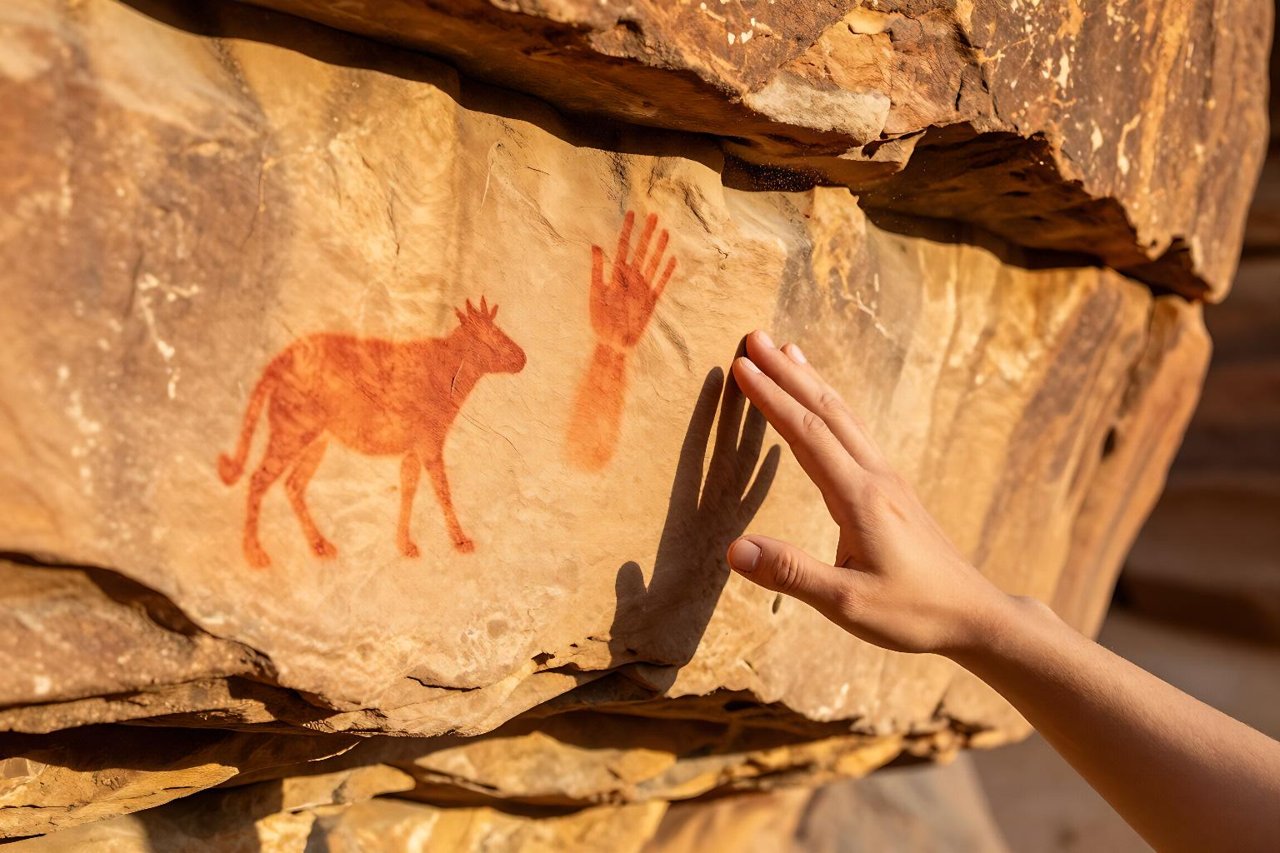
- Never touch the surface. Skin oils and sunscreen damage pigment and accelerate weathering.
- Carry binoculars for panels high on overhangs, where figures are often better preserved than at arm’s reach.
- Step back before stepping close. Many compositions only resolve at six or eight metres, once the individual animals line up into a scene.
- Look for superimposition and note which figures sit on top of which. That stacking is the closest thing to a timeline you will get.
Guided walks at places like Ubirr, Alta or the Cederberg are usually worth the cost, not because the guide has a definitive answer, but because they can point out the fainter marks and explain whose country you are standing on. Ask who made the art and who still holds it as significant, rather than only what it looks like. The answer to that question is where the meaning actually lives, and it is usually closer to the present than visitors expect.


