
Table of Contents
The story starts with a well. In March 1974, farmers in Lintong, Shaanxi, were digging for water when they pulled up fragments of a terracotta head. Archaeologists arrived within weeks. By the end of the year they were staring into Pit 1: a buried army of life-sized soldiers standing in formation, silent for more than 2,000 years in service to the tomb of Qin Shi Huang. Few finds in the world are that cinematic. Fewer still come from a hole dug for drinking water.
That pattern repeats across the continent. Asia’s ground is unusually crowded with the past, and much of it is only a spade, a roadworks project, or a dry season away from being exposed.
Why Asia Keeps Producing the Biggest Finds
Part of it is sheer scale. Asia covers roughly 30 percent of Earth’s land and holds 48 countries, running from the Levant to the Japanese archipelago. Part of it is timing. Several of the world’s earliest pottery traditions, rice domestication, bronze casting industries, writing systems, and long-distance maritime trade networks all developed here, often well before their counterparts elsewhere.
Then there is the preservation lottery. Deserts in Xinjiang and Saudi Arabia mummify wood and textile. Waterlogged rice paddies in the Yangtze delta hold organic material for millennia. Monsoon soils of the Ganges plain swallow mud-brick cities whole, then give them back. For a continent whose influence reached almost everywhere, the deep and tangled history of Asia is written more densely into its soil than most people realise.

China: Bronze Faces and Jade Cities
Sanxingdui
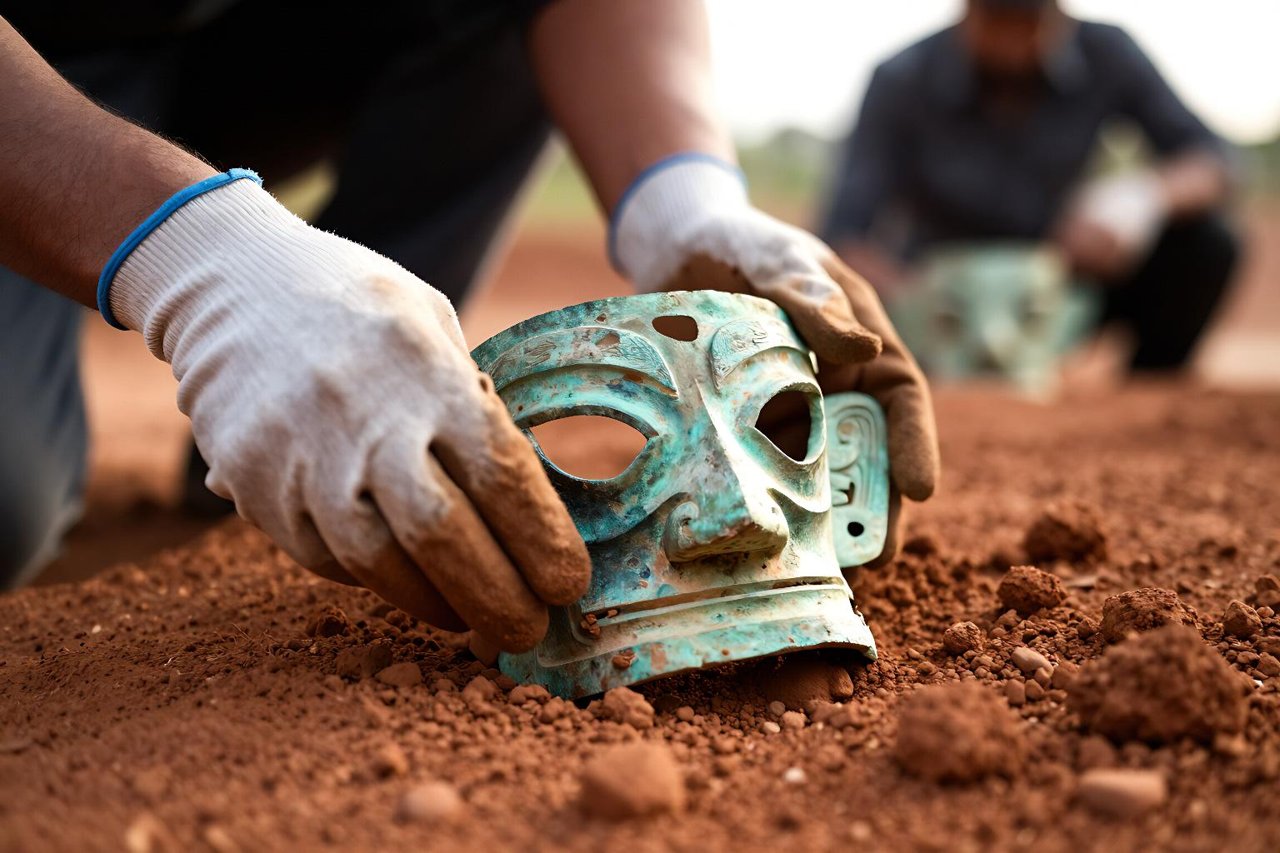
In 1986, workers at a brick factory near Guanghan, Sichuan, uncovered two sacrificial pits filled with bronze, gold, jade, and hundreds of elephant tusks. The masks that came out of them are genuinely strange: broad, angular faces with eyes pushed forward on cylindrical stalks, ears flaring out like wings. One complete bronze tree stands 3.96 metres tall. Six more pits opened between 2020 and 2022 produced yet more material, including gold foil masks and a bronze figure with a serpentine body.
Dating puts the pits around 1200 to 1100 BCE, contemporary with the Shang dynasty capital at Anyang. The style, though, is nothing like Shang work. Sanxingdui suggests a second, fully developed bronze civilisation in the Sichuan Basin that had its own iconography and its own ritual vocabulary.
Liangzhu
Five thousand years ago, communities near modern Hangzhou were carving jade cong tubes with precision that still puzzles modern craftspeople, using abrasives and patience rather than metal tools. They also built an enormous water management system of dams, levees, and canals, plus an earthen city wall. Elite burials contain hundreds of jade objects; ordinary graves hold a handful of pots. Liangzhu made UNESCO’s list in 2019 and quietly reset the timeline for complex society in East Asia.
Jiahu
In Henan, archaeologists recovered bone flutes from graves dating to roughly 7000 BCE. Some are still playable and produce recognisable scales. They are among the oldest musical instruments ever found anywhere.
The Indus Valley and Its Unread Script
Mohenjo-daro was identified in 1922 by R. D. Banerji during work on a Buddhist stupa mound in Sindh. Beneath the stupa lay a city of grid streets, covered drains, and standardised baked bricks cut in a strict 4:2:1 ratio. Its Great Bath, a waterproofed basin about 12 by 7 metres, may be the earliest known public ritual structure of its kind.
The problem is the writing. Roughly 4,000 inscribed objects survive, mostly small seals with short strings of signs. Nobody has deciphered the Indus script, and without a bilingual text, nobody is close. Every few years a claim appears, then quietly fails peer review.
- Rakhigarhi, in Haryana, is the largest known Indus site. Ancient DNA from a burial there, published in 2019, showed no Steppe-related ancestry in that individual, feeding a long-running argument about migration and continuity in South Asia.
- Keeladi, in Tamil Nadu, has produced brick structures, spindle whorls, and potsherds with graffiti marks since excavations began in 2015, pushing evidence of urban craft production in the south back to around the sixth century BCE.
- Sinauli, in Uttar Pradesh, yielded coffin burials and solid-disc-wheel carts dated to about 1900 BCE, a combination found nowhere else in the region.
The Hominins Who Lived Further East Than Expected
Asia is no longer treated as a footnote to African human origins. It is a major chapter. A jawbone found in Baishiya Karst Cave on the Tibetan Plateau, 3,280 metres above sea level, was identified in 2019 as Denisovan through ancient protein analysis, dating to about 160,000 years ago. On Luzon, foot bones and teeth from Callao Cave became Homo luzonensis in 2019. On Flores, the metre-tall Homo floresiensis turned up at Liang Bua in 2003.
Each of these finds complicates the tidy version of the long story of human evolution that most of us learned at school. Our family tree had branches in places nobody expected, and some of those branches survived much later than the textbooks assumed.
Angkor and the Cities Under the Canopy
In 2015, a LiDAR survey of the Angkor region revealed what ground teams had missed for a century: a vast grid of roads, canals, and residential mounds extending far beyond the walled temple complex, plus an entire previously unmapped city on the Phnom Kulen plateau. The jungle had been hiding infrastructure, not just ruins. It is one of the clearest demonstrations of how lost cities get rediscovered, often by accident or by a change in the technology rather than a change in the ground.
Elsewhere in Southeast Asia, the Plain of Jars in Laos holds thousands of carved stone vessels across some 90 sites, dated roughly 500 BCE to 500 CE, and still nobody knows exactly what they held or why. Ban Chiang in Thailand gave up painted pottery and bronze artefacts that helped push the region’s metallurgy much earlier than early scholars were willing to accept.
What the Sea Gave Back
The Nanhai One, a Song dynasty merchant ship that sank off Guangdong around 800 years ago, was raised in 2007 inside a purpose-built steel caisson, essentially lifting a block of seabed and ship together. More than 180,000 objects have since been recovered from it. Off Sumatra, fishermen snagged the Belitung wreck in 1998: a ninth-century Arab dhow carrying over 60,000 pieces of Tang ceramics, including Changsha bowls packed in neat stacks. For a fuller picture of what survives underwater and why, ancient shipwrecks hold cargoes that land sites never do.
Anatolia, Arabia, and the Central Asian Corridor
Göbekli Tepe, in southeastern Turkey, was recognised as monumental in 1995 when Klaus Schmidt began excavating. The T-shaped limestone pillars, carved with foxes, snakes, and vultures, were raised around 11,600 years ago by people who had not yet invented pottery or farming. Saudi Arabia has since produced hundreds of mustatils, rectangular stone walls roughly 7,000 years old, spotted first on satellite imagery. In northern Afghanistan in 1978, Viktor Sarianidi opened six graves at Tillya Tepe and recovered around 20,600 gold ornaments from a Bactrian nomadic burial ground.
Some of this heritage has been lost. The Bamiyan Buddhas were destroyed in 2001. Others survived by luck, including the Tillya Tepe gold, hidden in a bank vault through years of conflict.
How the Toolkit Changed the Dig
The finds of the past two decades are not simply a result of more digging. They come from instruments.
- LiDAR strips away vegetation digitally and exposes landscape-scale construction.
- Ancient DNA and paleoproteomics identify species and populations from fragments too small to classify by eye.
- Strontium and oxygen isotope analysis tracks where people and animals actually grew up, exposing migration and trade routes.
- Satellite imagery and drones find sites in deserts and steppe without a single trench.
A bag of bone dust that would have been discarded in 1970 can now be a headline in 2025.
What the Next Decade Is Likely to Hand Us
Three things look promising. First, sediment DNA from cave floors in Siberia, Tibet, and Laos may give us Denisovan genomes without a single new skeleton. Second, Central Asia is still dramatically under-excavated. Uzbekistan and Turkmenistan sit on Silk Road cities that have barely been touched with modern methods. Third, Saudi Arabia is pouring money into archaeology through the AlUla region, and the results are already appearing in journals at a rate that surprises specialists.
The unresolved ones are just as compelling. The Indus script remains unread. Nobody has explained Sanxingdui’s iconography to general satisfaction. And rising sea levels threaten coastal sites from the Persian Gulf to the Mekong delta faster than teams can record them. If the last fifty years taught us anything, it’s that the most interesting discoveries in Asia have tended to arrive from directions nobody was watching.


