
Table of Contents
In 1709 a well-digger named Antonio Ambrosio was sinking a shaft near the Italian coast when his pick struck marble. He had hit the stage wall of Herculaneum’s theatre, and with it a Roman town sealed under roughly twenty metres of volcanic mud since AD 79. Forty years later, engineers tunnelling through the same deposit started hauling statues out of the ash at Pompeii. Nobody had forgotten these cities existed. Farmers had been ploughing over them for generations. What was missing was any sense of how much survived down there.
That gap between knowing and seeing runs through the whole story of lost cities discovered by archaeologists. Some were never forgotten, only buried. Others survived as rumours in Greek and Roman texts, as odd rectangular shapes pilots noticed in the jungle canopy, or as a line in a colonial chronicle that somebody finally decided to take seriously. The forgotten metropolises that vanished from history rarely disappear without leaving a trace. They just leave one that nobody recognises for a few hundred years.
The cities buried in plain sight
Pompeii is the textbook case, and it still deserves the attention. When Giuseppe Fiorelli took over the excavations in the 1860s, he worked out that the hollow pockets in the ash were the shapes of bodies that had decayed inside hardened material. Pumping plaster into those voids produced casts of people in their final seconds. It was one of those technical leaps that changes what archaeology can say, and it happened in a town that had been partly exposed for a century.
Herculaneum has been harder and stranger. The eruption that buried it carbonised wood, food and papyrus scrolls, which is why a single villa on its outskirts has produced an entire library nobody can yet read in full. Excavators have been pulling charred scrolls out of that building since the 1750s. Two and a half centuries later, researchers are still arguing about how to open them without destroying them.

Akrotiri, the Bronze Age town under the Aegean
Spyridon Marinatos started digging at Akrotiri on Santorini in 1967, guessing that a Minoan settlement lay under the pumice. He was right. What emerged was a multi-storey town with drainage channels, upper floors, storage jars of olive oil and wall paintings of fishermen and boxing children. The inhabitants seem to have cleared out before the eruption around 1600 BC. Almost no bodies have been found, which is its own kind of puzzle.
Angkor: a city that was never really lost
The story that Henri Mouhot ‘discovered’ Angkor in 1860 is one of the most persistent myths in popular archaeology. Khmer people lived around the temples the entire time. What Mouhot did was broadcast the site to a European audience that had largely ignored it.
The real discovery came 150 years later, and it came from the air.
What the lasers found
Between 2012 and 2015, a consortium using airborne LiDAR scanned hundreds of square kilometres of forest around Angkor. LiDAR works by firing hundreds of thousands of laser pulses per second at the ground and filtering out the vegetation in the returned data. Under the jungle, the survey revealed street grids, canals, dykes and entire unwalled settlements that ground surveys had no chance of mapping. One of the biggest finds was Mahendraparvata, an early Khmer capital spread across the plateau of Phnom Kulen. Archaeologists had known fragments of it for years. The scan showed the city.
Machu Picchu and the hunt for a different city
Hiram Bingham reached Machu Picchu in July 1911 with a local farmer, Melchor Arteaga, as his guide. A family was living there and cultivating the terraces. Bingham was actually looking for Vilcabamba, the last Inca stronghold, and he spent years convincing himself that this was it. It wasn’t. Machu Picchu appears to have been a royal estate, built and abandoned within about a century.
The episode is a useful reminder that the ‘discoverer’ is often the person who arrives with a sponsor, a camera and a book deal rather than the first outsider to see the stones.
Found by accident, found from orbit
Some of the most important sites turned up because someone was looking for something else entirely. Ruth Shady began working at Caral in the Supe Valley of Peru in the 1990s while studying settlement patterns, and the site turned out to be one of the oldest urban centres in the Americas, with platform mounds and sunken plazas dating to around 2600 BC. Mohenjo-daro came to light in 1922 when R. D. Banerji investigated a Buddhist stupa and found a Harappan city under it, complete with grid streets and covered drains.
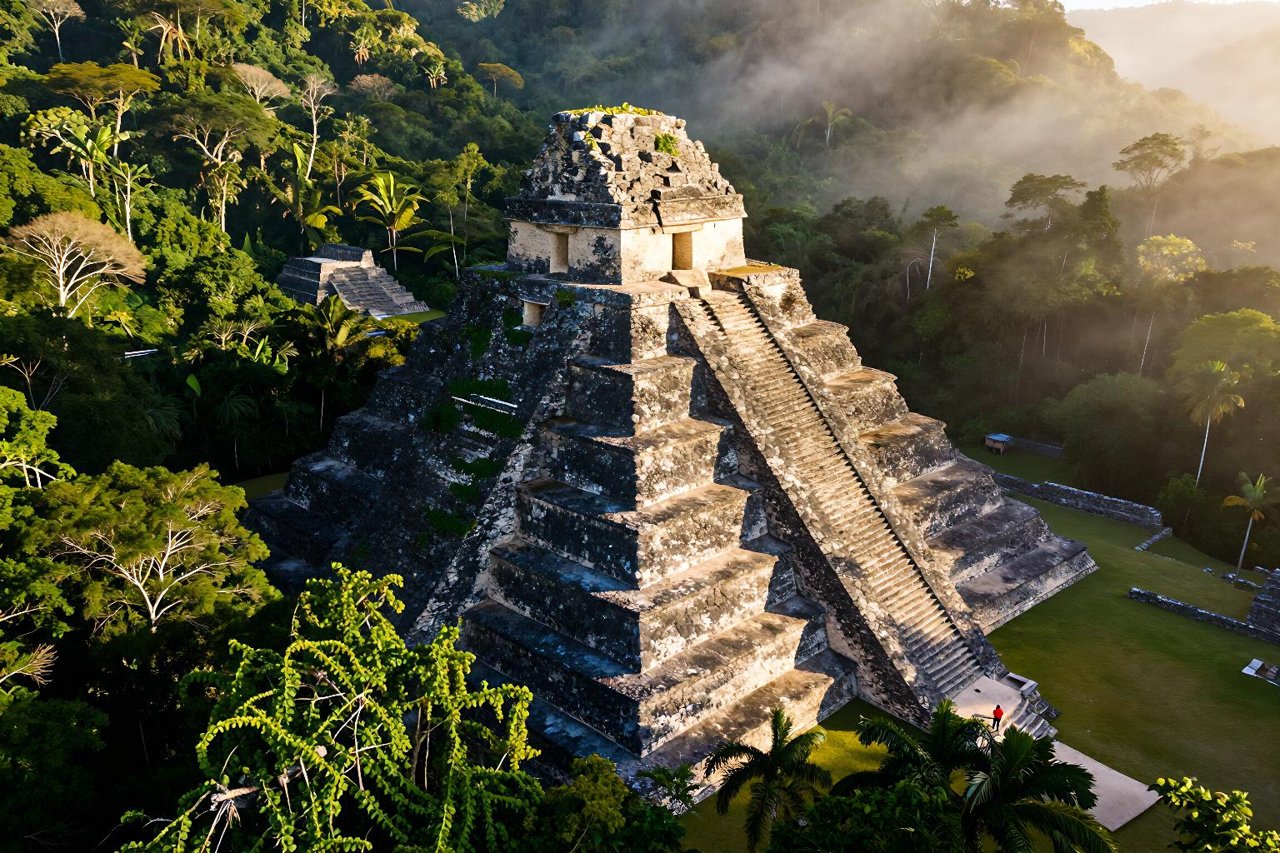
Then there’s the pair of Maya sites that made headlines in the same decade for opposite reasons. Sak Tz’i’, a small but long-lived kingdom known from inscriptions elsewhere, was located in 2018 on a cattle ranch in Chiapas after two archaeologists followed up a lead from a local landowner. And in 2020, a team led by Takeshi Inomata announced Aguada Fénix in Tabasco, a raised platform roughly 1,400 metres long, built around 1000 BC, and found because they flew a LiDAR survey over a landscape that looks almost flat from the ground.
The cities under the sea
Water hides things even better than jungle. In 2000, Franck Goddio’s team was surveying Abu Qir Bay off the Egyptian coast when they located Thonis-Heracleion, a port city that had been swallowed by subsidence and rising sea levels. Divers have since mapped temples, dozens of shipwrecks and colossal statues lying in silt. The city was mentioned by Herodotus and had been written off as semi-legendary.
Greece has its own version. Helike was said to have been destroyed by earthquake and tsunami in 373 BC, and for centuries scholars treated the account as moralising literature. Excavations in the Gulf of Corinth from 2001 found the city’s remains under lagoon sediment. The deep ocean still holds plenty of unexplained structures and wreckage, and shallow coastal shelves are arguably the most promising unexplored frontier in the field.
Grave robbers as accidental explorers
Ciudad Perdida in Colombia was found in 1972 by looters who followed a trail up the Sierra Nevada and started pulling gold out of stone platforms. By the time archaeologists arrived, much of the portable material was gone. What remained was extraordinary: a city built around 800 AD on a mountainside, with more than 250 terraces and a staircase of some 1,200 stone steps climbing to the ridge. The local name is Teyuna.
A similar pattern repeats across continents. Tomb raiders find, archaeologists document, and the site is usually poorer for it. Some of the most dramatic ‘discoveries’ in the literature are really rescue operations.
Why a city gets lost at all
Abandonment is rarely a single dramatic event. Most of these places drifted out of use and then out of memory over a few generations.
- Water moving. Rivers change course, harbours silt up, coastlines subside. A port that loses its harbour loses its reason to exist.
- Climate shifts. Drought, or the opposite, can make an agricultural surplus disappear and take the city with it.
- Forest and sand. Tropical growth swallows stone in a couple of decades. Desert wind buries masonry just as fast.
- Political collapse. When the capital moves or the trade network breaks, the population leaves. Nobody maintains the buildings, and the roofs come down first.
- Deliberate erasure. Some cities were sacked and then quarried for building stone by the people who came next.
The civilisations that left their cities behind tend to leave the same three things: water infrastructure, religious architecture, and rubbish. Middens are unglamorous and enormously informative.
What happens after the headline
Press releases love a lost city. Reality is messier. Lagash in southern Iraq made global news in 2023 after a team excavated a tavern and a batch of pottery; the site had been known to archaeologists since the 1950s and had been badly looted after 2003. That doesn’t make the work unimportant. It makes the framing misleading.
Protection is the harder problem. Ciudad Perdida is now reached by a multi-day trek that draws thousands of hikers a year, which funds local communities and also wears down the paths. Angkor’s groundwater is being depleted by nearby hotels. Underwater sites like Thonis-Heracleion sit in fishing lanes. Every discovery creates a new conservation obligation, usually without a matching budget.
The next lost city is probably already in the data
LiDAR archives from Central America, Southeast Asia and the Amazon are enormous and largely unprocessed. Researchers have published papers describing tens of thousands of previously unrecorded Maya structures sitting in scans that were collected for other purposes. Droughts expose new ground in Iraq and Turkey every few years. Melting ice is opening up landscapes in the Altai and the Yukon that nobody has surveyed properly.
What tends to rewrite the textbooks isn’t a gold mask or a royal tomb. It’s a drainage channel in the wrong place, or a road that runs somewhere no road should. The archaeological discoveries that actually changed how we understand the past were mostly ordinary objects found in contexts that didn’t fit. Expect the next one to arrive the same way: quiet, specific, and initially ignored.


