
Table of Contents
In October 2023, a computer science student named Luke Farritor fed a thin slice of carbonised papyrus into a machine-learning model and watched a word surface: πορφύρας, porphyras, purple. The scroll had been unreadable since Mount Vesuvius buried it in AD 79. Within months, a $700,000 prize had been split and roughly 2,000 characters of lost Greek philosophy had been pulled out of a lump of ash.
That is the flashiest example of artificial intelligence in archaeology doing something genuinely new, but it is not the most common one. The quieter work is happening in survey archives, museum storerooms and hard drives full of magnetometry data. It is changing what a dig season even looks like.
Machines That See Through the Canopy
LiDAR had already rewritten Maya archaeology before AI entered the picture. In 2018, the PACUNAM survey flew lasers over about 2,100 square kilometres of the Petén jungle in Guatemala and revealed something close to 61,000 structures, including raised roads, defensive walls and terraces that no one had mapped. The bottleneck was never the flying. It was sorting the billions of returned points into ground, tree and building.
That is where machine learning earns its keep. Point-cloud classifiers trained on labelled data can strip away vegetation returns far faster than a technician clicking through a 3D viewer, and newer models go further, flagging candidate platforms and causeways for a human to check. The same kind of pattern-spotting that powers tools built to discover zero day vulnerabilities can pick out a faint rectangular shadow under a maize field.

The Nazca desert produced a striking result in 2024. Researchers at Yamagata University, working with IBM, trained a model on aerial imagery of known geoglyphs and asked it to scan the whole plateau. It turned up 303 previously unrecorded figures, close to doubling the known total, and field surveys confirmed the vast majority. One of the new figures is a 22-metre-wide killer whale holding a knife.
Reading What No One Could Read
The Vesuvius Challenge got the headlines, but epigraphers were already testing the idea that a model can fill in gaps. Ithaca, a deep neural network built with DeepMind and researchers in Venice, was trained on around 78,000 damaged Greek inscriptions. Given a text with letters missing, it restored passages with roughly 72% accuracy and dated inscriptions to within 30 years about 71% of the time. Used alongside a human scholar, the hit rate climbed higher still.
What makes this useful rather than gimmicky is that Ithaca also proposes where a stone came from. Drop in a fragment of an unknown inscription and it will rank likely regions, which turns a vague museum label into a research question.
Storerooms Full of Unlabelled Pots
Most excavated material never gets published. A Mediterranean museum might hold tens of thousands of pottery sherds, and the specialists who can identify a Roman amphora handle by eye are thinning out. ArchAIDE, an EU-funded project led from the University of Pisa, built an app that photographs a sherd and matches it against typologies, giving field teams a first-pass identification before anything reaches an expert.
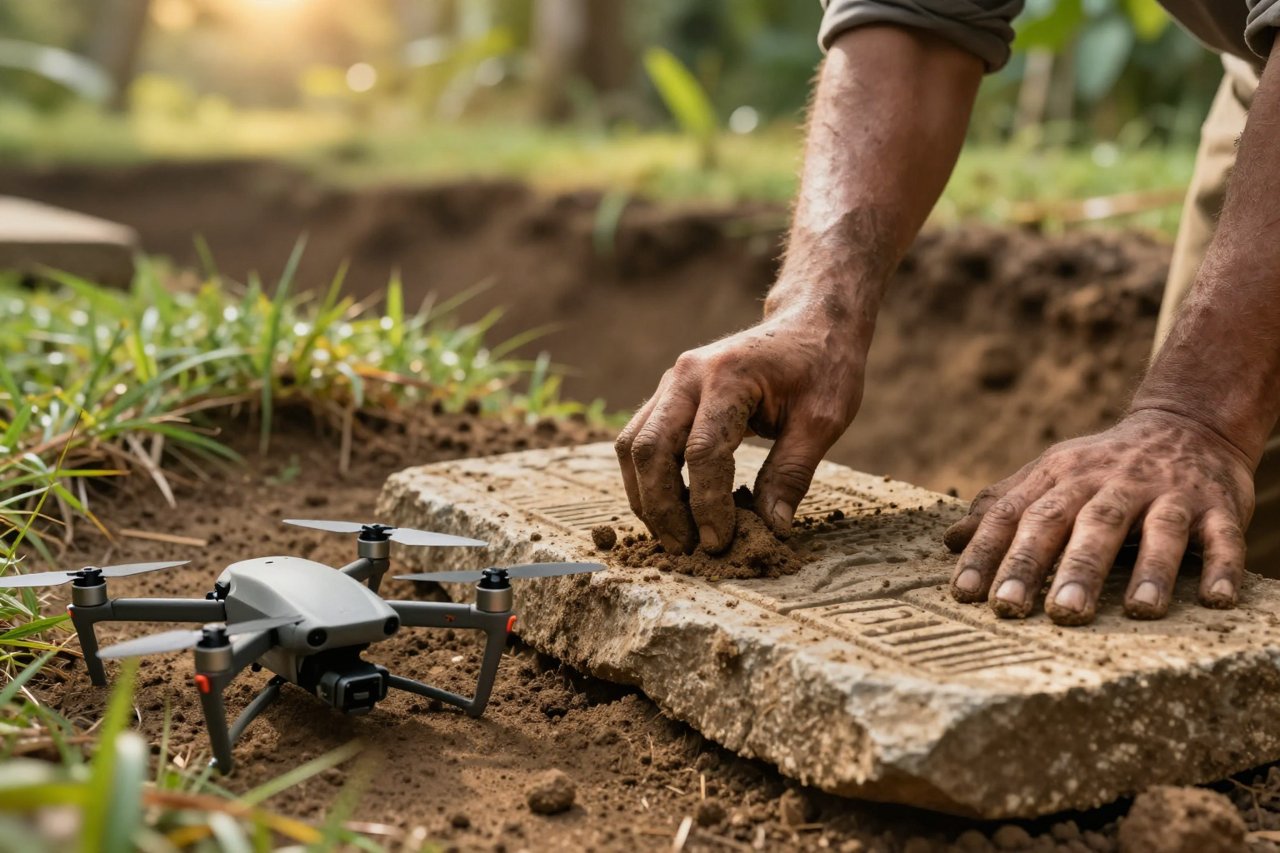
The same logic applies to small finds that fall through the cracks. A carved rock that might be an ancient Roman board game can sit in a tray for decades because nobody had the hours to work out what the markings meant. Image classifiers trained on published comparanda make that first identification cheaper, and cheaper means it actually happens.
Watching Looters, Predicting Sites
Satellite monitoring has become a practical tool for heritage protection. Researchers have trained models on high-resolution imagery from Egypt and Syria to spot the telltale craters of fresh looting pits, then passed alerts to antiquities authorities within weeks rather than years. In Iraq, predictive models built from known site distributions have produced risk maps highlighting where unrecorded settlements are most likely to lie, which helps planners avoid them.
Predictive modelling of site location is older than the current AI boom, going back to the 1980s in some regions. What has changed is the volume of input data, from soil chemistry to historic maps, and the ability to test a model against held-back survey results before trusting it.
Where the Models Fail
Training data carries old biases
A model learns what it is shown. Digitised collections skew heavily toward classical Mediterranean material, well-funded European excavations and English-language publications. Feed that into a classifier and it will be confident about Roman sigillata and useless on West African ceramics. A few high-profile projects have promised to correct this; fewer have published the audits to prove it.
Nobody can dig 3,000 trenches
A model that flags 3,000 candidate features is not automatically helpful. Fieldwork is expensive, permissions are slow and every anomaly needs a human decision about whether it is worth the money. Explainability matters here, not as an abstract virtue but because a survey director needs to know why a shape was flagged before committing a team to it.
Publishing locations is publishing targets
Precision has a dark side. A model that pinpoints unrecorded sites in a conflict zone can be read by looters as easily as by archaeologists, and some teams now deliberately degrade coordinates in public outputs. Institutions are working out how to handle this, and the broader argument over unprecedented restrictions on OpenAI has a direct parallel in heritage data, where the question of who gets access is not theoretical.
What Good Collaboration Actually Looks Like
The projects that work tend to share a shape: an archaeologist defines the question, a computational specialist builds something testable, and both appear on the paper. Pure computer science teams parachuting in with a model and no field validation produce confident nonsense. Archaeologists who buy an off-the-shelf package and trust the output produce the same thing more cheaply.
Funding bodies are starting to ask for data management plans and code repositories in grant applications, which helps. So does teaching. A handful of departments now run short courses in Python and statistics for archaeology students, and the number of people who can read a confusion matrix alongside a stratigraphic section is rising.
Museums and heritage agencies face the same adoption problem as any other organisation, and the basics of what enterprise leaders need to get right apply here too, just with smaller budgets, older catalogues and a public that expects to see the results. The realistic target is not a machine that replaces the specialist. It is a machine that clears the tedious 80% so a specialist can spend their time on the part that needs a person: judgement, context and the willingness to say the model is wrong.
The Herculaneum scrolls are a good test case. The algorithms read the letters, but the reading only meant something because papyrologists, classicists and a few thousand competitors argued over every reconstruction. The tools got sharper. The argument still needs humans in the room.


