
Table of Contents
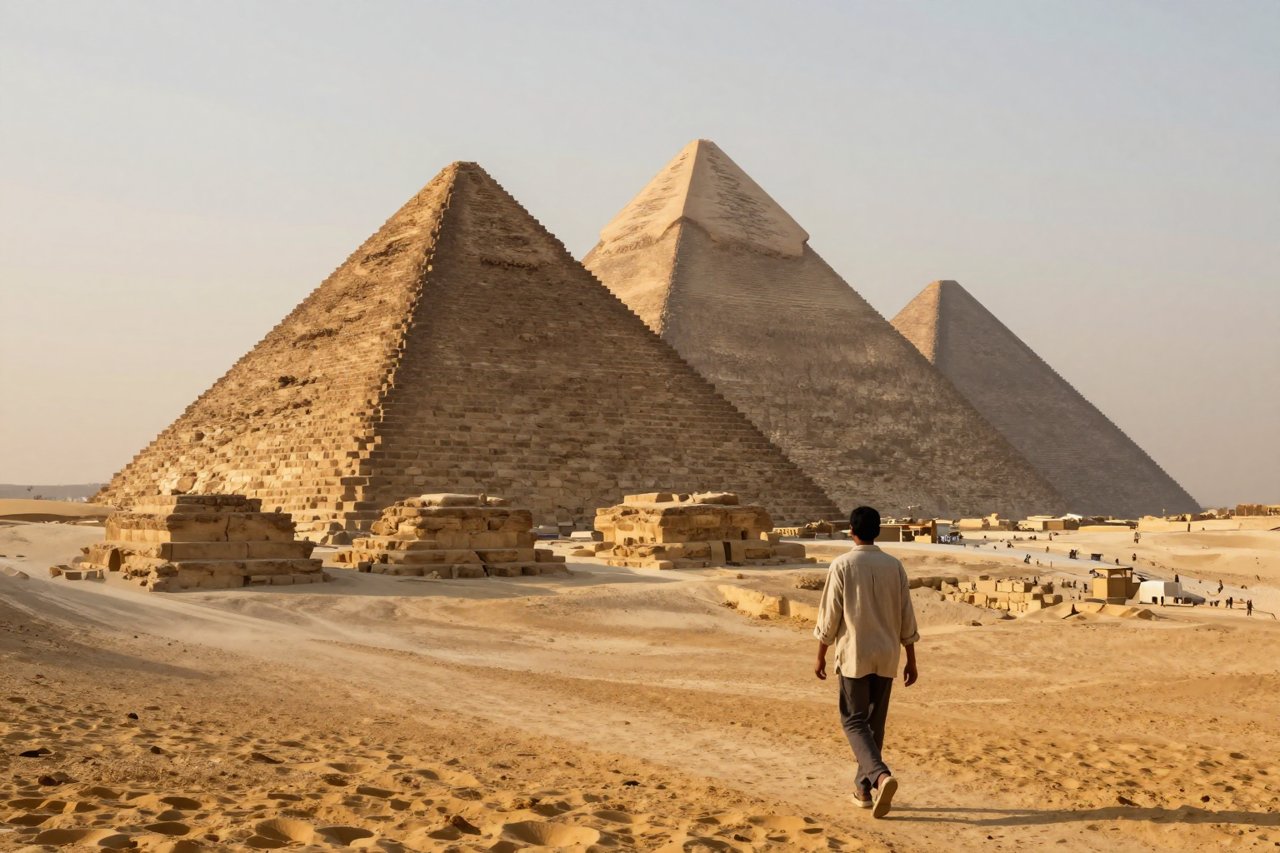
Stand on the Giza plateau at six in the morning, before the buses arrive, and the numbers stop being abstract. The Great Pyramid rose 146.6 metres when it was finished around 2560 BC, and it stayed the tallest structure on Earth for roughly 3,800 years. Nobody used a crane. The blocks were cut with copper chisels, dragged on sledges, levered into place by crews working in teams with names like “Vigorous Gang.” The harder achievement was invisible: a state that could feed, house and direct tens of thousands of people for decades without collapsing.
That state is the real story. Ancient Egyptian civilization ran, with interruptions, for about three thousand years, a span longer than the gap between Julius Caesar and the present day. It produced the first national bureaucracy we can read in detail, a calendar close to the one on your wall, surgical notes describing the brain, and a writing system that sat unread for fourteen centuries.
A Civilisation Built on a Flood
Herodotus called Egypt the gift of the Nile, and for once the cliché is exact. Rain in the Ethiopian highlands pushed a flood downriver every summer, and when it drained away it left black silt that could carry two or three harvests a year. Beyond that green ribbon lay desert. Almost every Egyptian lived within a few kilometres of the water.
Flooding was also a management problem. Too low meant famine; too high drowned the villages. So the state cut nilometers into the riverbanks, staircases marked with graduations, and read the peak to set that year’s tax rate. Priests logged the height annually for centuries. If you want to grasp how a river valley built a civilisation that still haunts us, start with the flood records rather than the tombs.

Three Thousand Years, Condensed
Egyptologists slice the timeline into kingdoms and intermediate periods, but the rhythm matters more than the labels: strong central rule, breakdown, reunification. A rough spine:
- Early Dynastic (c. 3100–2686 BC). A king called Narmer unites Upper and Lower Egypt. Hieroglyphs appear already fully formed, which tells us earlier experiments were probably written on perishable material.
- Old Kingdom (c. 2686–2181 BC). The pyramid age. Djoser’s step pyramid at Saqqara comes first, then Giza under Khufu, Khafre and Menkaure.
- Middle Kingdom (c. 2055–1650 BC). Literature flourishes, armies push into Nubia, and pharaohs start presenting themselves as shepherds of their people rather than remote gods.
- New Kingdom (c. 1550–1069 BC). Empire. Thutmose III campaigns deep into the Levant, Hatshepsut rules as a female king, Akhenaten tries to make the sun disc Aten the only god, and Tutankhamun’s tomb survives intact until Howard Carter opens it in 1922.
- Late Period to Cleopatra (664–30 BC). Persian governors, then Macedonian kings. Cleopatra VII was the last pharaoh, and one of the few of her dynasty who bothered to learn Egyptian.
Egypt is early, but it is not the earliest. This breakdown of the oldest civilizations in human history, ranked by the evidence, is a useful corrective to the assumption that everything began on the Nile.
Scribes, Taxes, and the First Great Paperwork
Hieroglyphs were not a mystical code. They were an administrative tool with roughly 700 signs in regular use, and boys started scribe school around age five, copying model letters and tax lists until their handwriting satisfied a master. Papyrus made the system portable; a single sheet could carry a contract, a receipt, or a complaint about a neighbour’s goat.
The best window into ordinary bureaucracy comes from Deir el-Medina, the village where the tomb workers lived. Archaeologists have recovered thousands of potsherds and limestone flakes covered in everyday notes: sick days, requests for beer, a wife’s complaint that her husband had taken up with a laundress, and, in year 29 of Ramesses III, the earliest recorded labour strike, when the crews downed tools because their grain rations were weeks late.
Death Was a Building Project
Egyptian religion is often reduced to a fixation on the afterlife. In practice it was a set of engineering and economic obligations. Mummification took about seventy days, with the organs stored in four canopic jars and the body packed in natron salt. Tombs were stocked the way you’d pack for a long trip, and the Book of the Dead supplied spells for the journey, including the famous weighing of the heart against the feather of Ma’at.
Scale followed status. Khufu’s pyramid alone consumed an estimated 2.3 million blocks, and the logistics of quarrying, hauling and feeding the workforce are still argued over. The construction techniques, the shifting theories about ramps, and the reasons these structures have outlasted every empire that followed them are explored in detail in how the Egyptian pyramids were built and why they endure.
What Ordinary Egyptians Did All Day
Most people farmed. The daily diet leaned hard on emmer wheat bread and beer, both so full of grit from grinding stones that skeletons show flattened, worn teeth by middle age. Houses were mudbrick, roofed with palm beams and reed matting, painted white inside to bounce the light. Women could own property, draw up their own marriage contracts, initiate divorce, and serve as priests in temples. Some ran businesses; one New Kingdom woman, Iry-Nefer, is recorded hiring a wet nurse on a written contract.
Medicine was more empirical than the reputation suggests. The Edwin Smith surgical papyrus, copied around 1600 BC, describes head injuries case by case and notes that the brain has convolutions and that the heart communicates with the limbs through vessels. The Ebers papyrus from roughly the same era mixes genuine remedies with incantations, which is roughly what you’d expect from a tradition that treated illness as both physical and spiritual.
So was the calendar. Twelve months of thirty days plus five extra days gave 365 days, only a quarter-day short of the solar year, which meant the civil calendar drifted slowly against the seasons. Egyptians noticed, and priests kept a separate astronomical count to know when to plant.
The Mysteries That Refuse to Close
Some questions have real answers now. The 2013 discovery of papyri at Wadi al-Jarf, on the Red Sea coast, gave us the logbook of an official named Merer, who recorded boat crews hauling fine Tura limestone to Giza for the Great Pyramid’s casing. That is about as close to a construction invoice as we are likely to get.
Others stay open. Nobody knows exactly how the blocks were raised, why the Sphinx’s face is so eroded compared with its body, or where the water came from to fill the Osireion at Abydos. Several of these puzzles, including the odd blank spots in Egypt’s early record, are covered in this roundup of unsolved archaeological mysteries that still keep researchers up at night.
How It Ended, and What Refuses to Die
Egypt stopped being ruled by Egyptians in 30 BC, when Octavian took Alexandria after Actium and Cleopatra and Antony were both dead within days of each other. It became a Roman province, then a Byzantine one, then an Arab one. The temples closed. The priests who could read hieroglyphs died out, and within a few generations the script was a puzzle even to the people living beside the monuments.
It took a French officer at Rosetta in 1799, and then twenty-three years of grinding work by Jean-François Champollion, to break it. He cracked the code in 1822 partly by guessing that cartouches enclosed royal names and cross-checking them against Greek on the same stone. Once the writing came back, so did the voices: tax demands, love poems, medical notes, a father writing to complain about a son’s behaviour at school.
The civilisation’s echo is more present than most people realise. Egypt’s administrative habits shaped later Mediterranean states; this account of how the first great powers rose, ruled and lost everything traces how much of that machinery was copied or reinvented elsewhere. Our 24-hour day, the 365-day year and the practice of setting taxes from recorded measurements all carry Egyptian fingerprints. And roughly every decade, a dig at Saqqara or Luxor turns up something that forces the textbooks to be rewritten again.


