
Table of Contents
The granite blocks are stacked so tightly you can’t slide a knife blade between them. No mortar, no cement, no iron tools used to shape them. Roughly 900,000 of those stones were carried from nearby hillsides and laid into walls that still stand eleven metres high, seven centuries after the masons walked away.
That is Great Zimbabwe: the biggest stone construction in sub-Saharan Africa and the centre of a trading state wealthy enough to pull Chinese porcelain into the African interior. It is also the subject of one of the most stubborn acts of historical denial of the modern era.
A capital of dry-stone walls on the highveld
The ruins sit about 30 kilometres southeast of modern Masvingo, on the edge of Zimbabwe’s highveld. The name comes from the Shona dzimba-dza-mabwe, roughly “houses of stone”, or the older dzimba-hwe, “venerated houses”. Whoever coined it was pointing at exactly the right thing.
The Great Zimbabwe civilization grew through the twelfth and thirteenth centuries and peaked between about 1300 and 1450, when somewhere between 10,000 and 18,000 people lived inside and around the walls. Granite was the obvious building material, since the whole region is granite country. The masons exploited natural fractures in the rock, splitting blocks along existing seams instead of cutting them.

The Hill Complex
On an eighty-metre granite kopje above the valley, the builders fitted walls directly onto and around the boulders, so the masonry and the natural rock read as a single structure. This was probably where the ruler held court and where ritual activity took place. Some of the passages between walls are narrow enough that you have to turn sideways.
The Great Enclosure
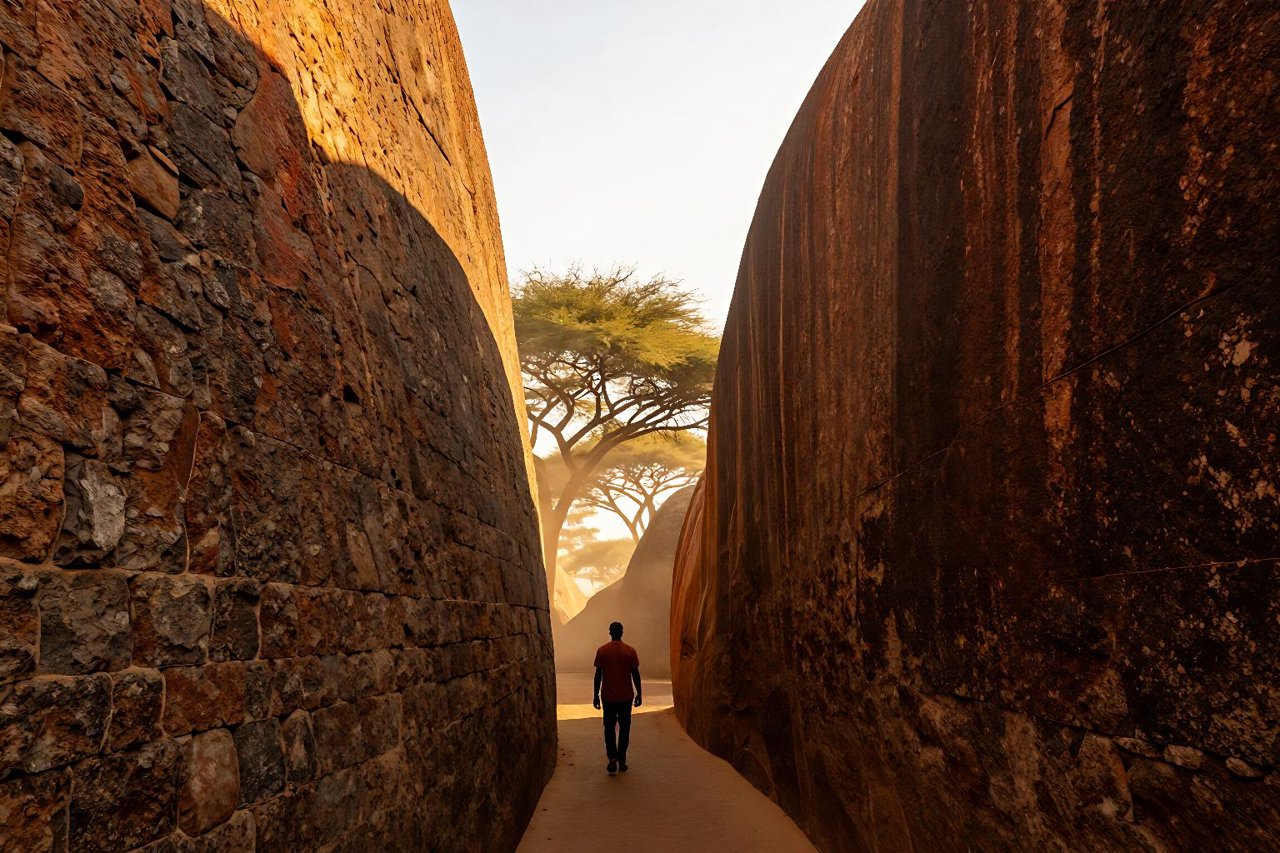
The Great Enclosure is the showpiece. Its outer wall runs about 250 metres around, stands eleven metres tall and is five metres thick at the base, decorated with chevron and herringbone courses of stone. Inside sits the conical tower, a solid granite cone roughly nine metres high that most archaeologists read as a symbolic grain bin. A second wall runs parallel to the outer one, leaving a corridor about a metre wide that visitors still squeeze through today.
The Valley Complex
Down the slope, more than a hundred smaller walled enclosures spread across the valley, the housing of ordinary residents. Many had internal walls and deliberate doorways, which shows that everyday architecture followed a shared set of conventions. This was not a scatter of huts behind a palace; it was a city with rules about how space worked.
Great Zimbabwe is nowhere near as old as the first cities of Mesopotamia or Egypt, and the ranking of the oldest civilizations in human history is a different story entirely. But its masonry is every bit as considered as anything built elsewhere in the same centuries.
What the gold actually bought
The wealth behind those walls came from the interior. Gold from the plateau, ivory, copper and cattle moved east to the Swahili coast, down to the port of Sofala and on to Kilwa, then out across the Indian Ocean. Excavations have turned up:
- Ming dynasty Chinese celadon and porcelain from the fourteenth and fifteenth centuries
- Persian and Arabian ceramics carried in from the Gulf
- Thousands of glass beads traded from India
- Copper ingots and gold wire worked on site
- Cowrie shells, iron tools and locally smelted metal
A city more than 1,500 kilometres from the sea was plugged into the same commercial system as Cairo, Gujarat and Guangzhou. Great Zimbabwe also fits into a longer pattern of African states that traded and built at real scale; there is a solid overview of that wider set in this piece on forgotten African civilizations that built cities, scripts and their own coinage.
The fight over who built it
When the German explorer Carl Mauch reached the ruins in 1871, he went straight to the Old Testament and declared the walls the work of Phoenicians and the Queen of Sheba. That guess hardened into official policy. British South Africa Company officials and amateur antiquarians spent decades insisting the ruins must be the work of a “lost white race” — Phoenician, Sabean, Arab, anything but Shona.
It fell apart under trowels. In 1905 the archaeologist David Randall-MacIver examined the site and concluded the ruins were “unquestionably African in every detail”. In 1929 Gertrude Caton-Thompson excavated properly and reached the same verdict after finding locally made objects at every level of occupation. She published, was ridiculed in the local press, and turned out to be right. The Rhodesian administration still kept the African origin of the ruins out of school textbooks and censored official guidebooks into the 1960s.
Modern methods have only sharpened the picture, and the techniques now being applied to sites like this are covered in how lasers, drones and drought data are rewriting the archaeology of lost civilizations. Great Zimbabwe was inscribed as a UNESCO World Heritage Site in 1986, and when the country won independence in 1980 it took the name of the ruins for itself.
Cattle, sorghum and soapstone birds
Daily life at Great Zimbabwe ran on cattle and grain. Herders kept large herds on the surrounding grasslands, farmers grew sorghum, millet and finger millet, and smiths worked iron and gold in workshops inside the settlements. The wealthier households ate more beef; the archaeology shows cattle bones piling up in the elite areas.
Carved soapstone birds are the site’s most famous artwork. Eight are known, each roughly 30 to 40 centimetres tall and mounted on a metre-long soapstone monolith, and they stood on the Hill Complex where they were probably connected to royal or religious ritual. Several were carried off during the colonial period; one ended up in Cecil Rhodes’s Cape Town estate, another in a Berlin museum. A stylised version of the bird has been on Zimbabwe’s national flag since 1980.
Why the city emptied
Great Zimbabwe was largely abandoned by about 1450, with only patchy occupation afterwards. No single cause explains it, and the evidence points to several pressures arriving at once: too many people and too many cattle on fragile land, hillsides stripped of timber for building and for iron smelting, soil washing away, and the gold trade shifting north as new routes opened.
Political weight moved too. The Mutapa state rose in the Dande valley to the north and took over much of the trade network, and later Portuguese traders on the coast were dealing with Mutapa kings rather than with the old stone capital. The city’s descendants kept building in the same style elsewhere, just on a smaller scale.
Walking the ruins today
The site is easy to reach from Masvingo and makes a genuinely good day out, though it asks for patience and water. The path climbs from the car park up to the Hill Complex, drops down into the Great Enclosure, and then wanders through the valley enclosures. The site museum holds the soapstone birds and the imported ceramics, which makes the trade story much easier to picture than any diagram.
Go early. The granite soaks up heat, and the light on the walls is at its best in the first two hours after opening. Guides are licensed and worth the fee, though the standard tour moves fast; the quieter pleasure is standing in the narrow passage of the Great Enclosure on your own and looking at courses of stone that nobody has had to repair in 700 years. If that appeals, there are plenty more forgotten monuments around the world that nobody queues for, and this one belongs near the top of the list.


