
Table of Contents
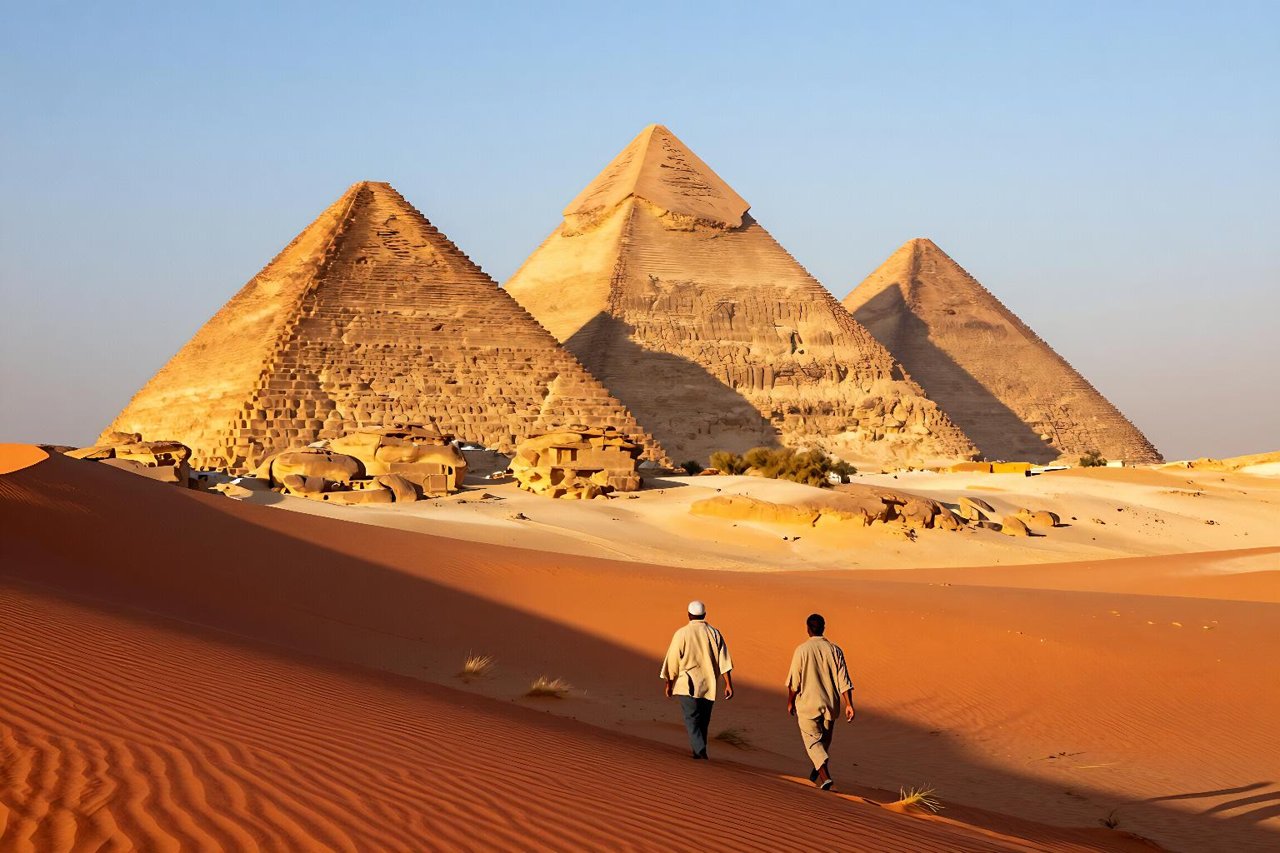
Drive northeast from Khartoum for a few hours and the desert starts filling with pyramids. They are steeper than the ones at Giza, smaller, and almost empty of visitors. Roughly 200 of them stand in clusters around Meroë, the royal cemetery of a state that most school syllabuses skip entirely.
That state was the Kingdom of Kush. It controlled the Nile Valley south of Egypt for well over a thousand years, governed Egypt itself for most of a century, dealt with Rome as an equal, and produced one of the handful of writing systems invented anywhere in Africa. Its pyramids are a UNESCO World Heritage Site. Its queens turn up in Greek and Latin sources by name. It still gets a footnote in most Western history books.
Where Kush sat, and why the Nile paid for it
Kush stretched along the Nile from about the first cataract at Aswan down to the sixth, near modern Khartoum. That is northern Sudan today, a corridor of river broken by rapids and granite gorges, with gold-bearing desert on both sides. Egyptian scribes were writing the name Kush by the Middle Kingdom, around 2000 BC, usually for the country beyond their southern border.
The Nile was the road. Goods moved north by boat and by donkey caravan, and the cataracts acted as a natural customs barrier: anyone heading for Egypt had to unload, portage and pay. The kingdom’s centre of gravity shifted over the centuries, from Kerma near the third cataract, to Napata near the fourth, to Meroë between the Nile and the Atbara River. Each capital sat where farmland, grazing and trade routes overlapped.

Kerma: the first Kushite kingdom
Kerma was a city before it was a name. From roughly 2500 BC it grew into a walled urban centre with workshops, granaries and a population in the thousands, trading ivory, ebony, gold and cattle northwards into Egypt. Its rulers were buried in enormous earthen tumuli, some with dozens of retainers laid around them, a practice that shocks modern readers and puzzled early excavators.
The deffufa
The city’s signature monument is the western deffufa, a mudbrick temple that once stood around 18 metres high on a base nearly 50 by 25 metres. It is built from millions of mud bricks, not stone, which is why it is less famous than it should be and why the annual rains have been eating it for four thousand years. Kerma’s pottery, thin-walled beakers with black tops and red bodies, is distinctive enough that archaeologists can date a site from a single rim sherd.
Kerma belongs in any honest reckoning of the oldest civilizations in human history, ranked by what the evidence actually shows, even if it rarely appears in those lists. Egypt ended the experiment around 1500 BC, when Thutmose I pushed south and turned Kush into a province for the next five centuries. Egyptian temples went up at Soleb, Amara and Jebel Barkal. Egyptian garrisons stayed. Kushite princes were educated in Egyptian courts.
The century Kush ruled Egypt
Egypt’s own collapse gave Kush its opening. Around 730 BC a king named Piye marched north from Napata with an army of archers and horsemen, took Thebes, then Memphis, then the Delta. He recorded the campaign on a granite stela at Jebel Barkal, and it is one of the more human documents to survive from antiquity: Piye complains about horses left unfed by besieged Egyptian garrisons, and worries that his soldiers have been eating fish, which he considered ritually impure.
His successors ruled as Egypt’s 25th Dynasty. Taharqa built at Karnak, restored temples at Kawa and Kerma, and was buried at Nuri under the largest pyramid ever raised in Sudan. The dynasty ended not by Kushite weakness but by Assyrian invasion; Esarhaddon and then Ashurbanipal battered their way to Memphis and Thebes, and by 656 BC the Kushite kings had withdrawn south for good.
Egypt’s later conquerors came from further east still. The Persians who took the country in 525 BC were a different order of opponent, and the story of how a small highland kingdom became the ancient world’s superpower explains why Kush never seriously pushed north again.
Meroë: iron, cotton and caravans
After a disastrous Egyptian raid under Psamtik II around 593 BC, the Kushite court shifted south to Meroë, a site with better rainfall, better grazing and a direct line to the Red Sea. Royal burials moved there from about 300 BC, and the pyramids grew smaller, sharper and far more numerous.
Meroë was a manufacturing town as much as a palace. Excavators found slag heaps the size of football pitches, evidence of iron smelting on a serious scale, though recent research suggests output was smaller and more seasonal than the old ‘Birmingham of Africa’ label implies. Cotton was woven, cattle were herded in huge numbers, and the city’s reservoirs and hafirs held water through the dry months.
What went out along the trade routes
- Gold from the Eastern Desert mines, controlled through the Wadi Allaqi region
- Ivory, ebony and leopard skins heading north to Egypt and the Mediterranean
- Ostrich feathers and live elephants, much prized by Ptolemaic armies
- Slaves, grain and cattle moved between the Nile Valley and the Red Sea ports
- Pottery, glass and olive oil coming the other way, along with Roman wine and bronze
Meroë kept up temples to Amun and Isis and added its own lion-headed god, Apedemak, whose shrines at Naga and Musawwarat es-Sufra show a religious life that was Egyptian in vocabulary and firmly Kushite in accent.
The kandakes, and the Roman head under a doorway
Kushite royal women held power in their own right, and Greek and Latin writers called them by the title kandake. One of them, Amanirenas, fought Augustus’s Rome. In about 25 BC her forces hit Aswan and Philae, and among the loot they carried home was a bronze head of the emperor himself.
Rome retaliated under the prefect Petronius, marching as far as Napata before withdrawing. The war ended around 20 BC with a treaty that was unusually generous to Kush: no tribute, and a border that stayed roughly where it had been. The bronze head of Augustus was found in 1910, buried beneath a temple threshold at Meroë so that everyone entering would walk over the emperor’s face. It is now one of the most photographed objects in Sudanese archaeology.
Later kandakes, Amanishakheto and Amanitore among them, built temples, palaces and reservoirs, and their portraits appear with the queen shown at the same scale as the king beside her.
A script nobody can read
Meroitic writing appeared around the second century BC in two forms, a formal hieroglyphic version for temple walls and a fast cursive for everything else. It has about 170 signs. Scholars can transcribe the sounds accurately enough to read names like Amanitore, and they can follow the formula on offering tables for the dead. They cannot read the sentences.
There is no bilingual inscription, no Meroitic Rosetta Stone, and the language it records has no close living relative. Every few years someone announces a decipherment, and every few years the field quietly declines to accept it. Among the forgotten African civilizations that built cities, scripts and their own coinage, Kush is the one whose books shut themselves.
How the kingdom ended
Kush declined slowly through the third and fourth centuries AD. The Red Sea trade that had fed Meroë shifted towards the rising power of Aksum. Wells silted. Desert pushed into grazing land. Royal burials stopped, and the city thinned out.
Around AD 350 an Aksumite king, Ezana, left an inscription describing campaigns against a people called the Kas; the usual reading is that this marks the final blow. What replaced Kush was not chaos but three successor kingdoms, Nobatia, Makuria and Alwa, which ran the Nile Valley as Christian states for centuries and held off Arab armies with archers famous for shooting for the eyes. The long arc of that story sits inside the wider sweep of the history of Africa, from humanity’s cradle through the golden empires to independence.
What survives, and what is still missing
The pyramids at Begrawiya, the royal cemeteries at Nuri and El-Kurru, the temple complex at Jebel Barkal and the ruins at Naga and Musawwarat are all visitable, though travel to Sudan has been badly disrupted since 2023 and some sites and museum collections have suffered damage and looting. The Sudan National Museum in Khartoum holds the collections that give the kingdom its faces: bronze heads, granite statues, offering tables carved with script.
What is missing is the writing. Somewhere in that corpus is a tax record, a letter, a complaint about a neighbour. A Meroitic inscription long enough and bilingual enough to break the code has not been found, and until it is, most of what we know about the Kingdom of Kush comes from its buildings, its bones and the people who wrote about it without much sympathy. The pyramids get photographed. The script sits there, readable in sound, unreadable in meaning, waiting.


