
Table of Contents
The Carthaginian Empire was never an empire in the way Rome was. It had no legions marching under a single emperor, no grand colonnaded forum at its heart, and no ambition to paint the map one province at a time. What Carthage built instead was a commercial web across the western Mediterranean: ports, treaties, colonies, and fleets that moved silver, olive oil, purple dye, and soldiers wherever money could be made. For nearly three centuries it was the richest power in the region. Then it ran into Rome.
Carthage began as a colony. According to tradition, Tyrian settlers founded the city in 814 BC on the coast of modern Tunisia, led by a queen named Dido (or Elissa). The story of Dido and the oxhide is legend, but the date is close to what archaeology suggests. The settlers came from the Phoenician civilization, the seafaring traders who spread alphabet letters and harbor techniques from the Levant to the Atlantic. Carthage inherited their instincts: find a good anchorage, make a deal, and keep the sea lanes open.
A Colony That Outgrew Its Mother Cities
Carthage sat on a promontory with easy access to both a sheltered bay and the fertile Medjerda valley. That combination mattered. The city could feed itself, trade with inland Berber communities, and launch ships without depending on a distant homeland. When Tyre fell to Alexander the Great in 332 BC, Carthage was already strong enough to stand alone. By then it controlled a string of settlements along the North African coast, parts of Sardinia, the Balearic Islands, and footholds in Sicily and Iberia.
This was not direct rule in the Roman sense. Carthage usually preferred influence to occupation. Local elites kept power, paid tribute or traded on favorable terms, and supplied recruits when Carthage went to war. The system was flexible, cheap, and profitable. It also meant that when a region rebelled or a mercenary army felt underpaid, the whole structure could shake.

The Machinery of Carthaginian Trade
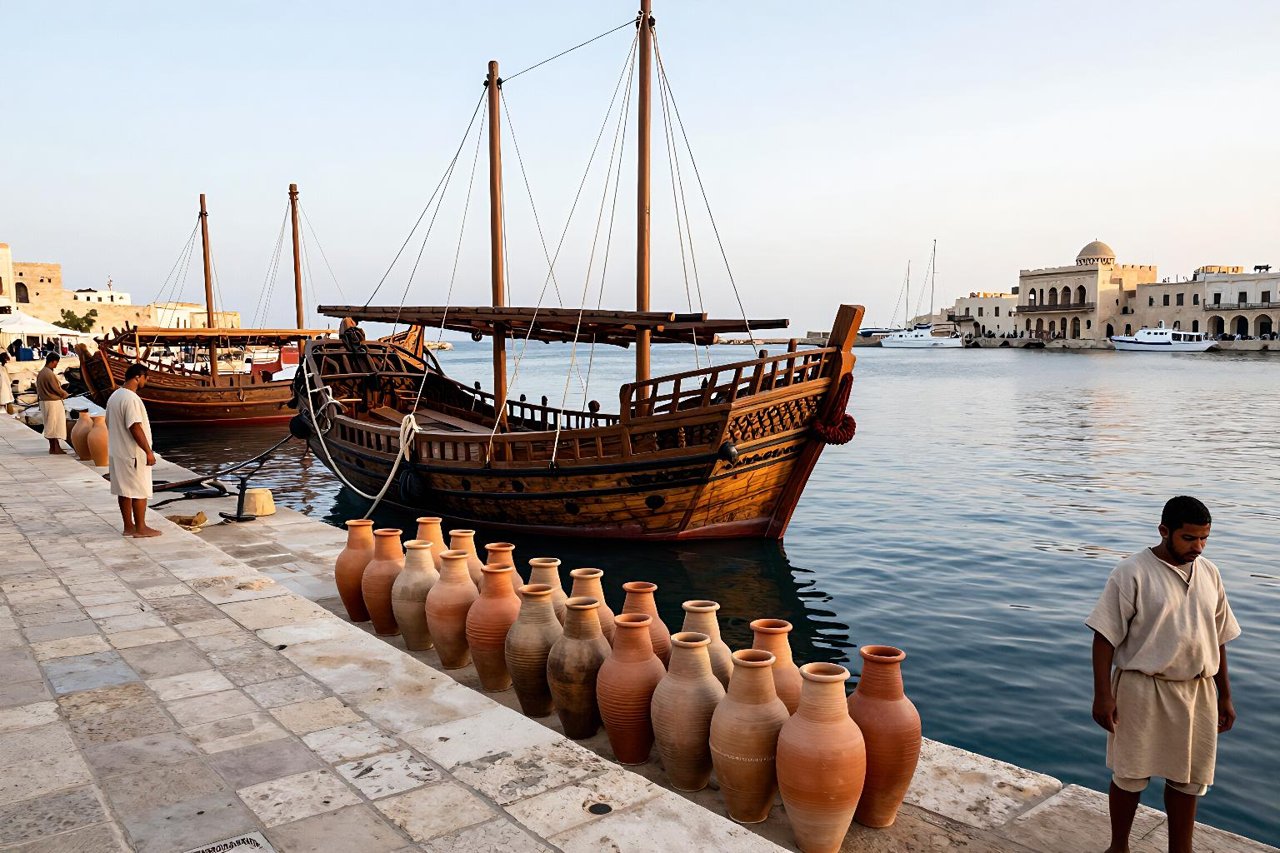
Carthage’s wealth came from movement. Its harbors were engineered for it. The circular military harbor, the cothon, could shelter warships behind a guarded entrance, while the rectangular commercial harbor handled merchant traffic. Warehouses stored grain, wine, and oil. Dockworkers repaired hulls and sorted cargo. A ship might leave Carthage with pottery and finished goods, pick up silver in southern Iberia, exchange it for tin somewhere along the Atlantic routes, and return with raw materials for workshops.
The range of goods was wide:
- Purple dye and textiles, the luxury product associated with Phoenician cities.
- Silver from Iberian mines, especially around Gadir (modern Cádiz).
- Olive oil, wine, and grain from North African estates.
- Tin, copper, and other metals moved through Atlantic and Mediterranean routes.
- Ceramic amphorae, used to ship and store almost everything liquid.
- Mercenaries, recruited from Numidia, Iberia, Gaul, and the Balearic Islands.
The skills of Phoenician seafarers gave Carthage an edge in navigation and shipbuilding. Carthaginian captains knew the winds, the shoals, and the market prices at the far end of the route. Treaties with Rome, the first around 509 BC and another in 348 BC, show a power confident enough to limit rivals’ access to its waters. Carthage did not need to conquer the Mediterranean. It needed to control the points where trade passed through.
Armies of Mercenaries and Generals
Carthage’s military looked strange to Greek and Roman observers. The city did not rely on a mass levy of citizens. It hired professionals and drew on allied contingents. Numidian cavalry provided speed and local knowledge. Balearic slingers threw stones with frightening accuracy. Libyan infantry formed the dependable core. War elephants, probably African forest elephants, added shock and intimidation, though they could panic and trample their own side as easily as the enemy.
The system worked brilliantly when a talented general held it together. The Barca family, especially Hamilcar Barca and his son Hannibal, turned Carthage’s mixed army into a weapon. Hannibal’s campaign in the Second Punic War remains a masterclass in improvisation. He marched from Iberia through southern Gaul and crossed the Alps in 218 BC with a force that included elephants. He beat Roman armies at the Trebia, Lake Trasimene, and Cannae, where his double envelopment killed tens of thousands of legionaries in a single afternoon.
Why Hannibal Did Not March on Rome
Victory at Cannae did not bring the war to an end. Hannibal lacked siege equipment and a secure supply line to Carthage. Rome refused to negotiate and slowly cut away his allies. The war dragged on in Italy, Spain, and Sicily. Eventually Scipio Africanus carried the fight to North Africa and defeated Hannibal at Zama in 202 BC. Carthage lost its fleet, its overseas territories, and a huge indemnity. The commercial empire was finished as a military power.
Rome, Carthage, and the Punic Wars
The three Punic Wars span more than a century. The First (264–241 BC) was fought largely over Sicily and turned Rome into a naval power. The Second (218–201 BC) produced Hannibal’s march and Rome’s desperate response. The Third (149–146 BC) was a siege with an ugly end. Roman senator Cato the Elder reportedly ended every speech with “Carthago delenda est,” Carthage must be destroyed. Whether or not he said it every time, the mood in Rome had hardened.
In 146 BC, Scipio Aemilianus took the city after a brutal siege. Carthage was razed, its population killed or enslaved, and its territory became the Roman province of Africa. The story that the Romans plowed salt into the fields is a later invention, but the destruction was real. Carthage as a political power ceased to exist.
Government, Religion, and Daily Life
Carthage was governed by two annually elected magistrates called suffetes, a senate of leading families, and a popular assembly that could be called on in disputes. Aristotle compared the Carthaginian constitution favorably with Greek city-states, noting its mixed elements and stability. In practice, wealthy merchant families held most influence. Trade networks and political power overlapped because the same families financed ships and voted on treaties.
Religion centered on Baal Hammon and Tanit, with temples, processions, and offerings. The tophets, open-air sanctuaries containing cremated remains of infants and animals, have sparked fierce debate. Ancient Roman and Greek writers accused Carthaginians of child sacrifice. Some modern scholars accept that ritual child sacrifice occurred in extreme cases, while others argue the tophets were cemeteries for stillborn or young children and that the sources are hostile propaganda. The evidence is fragmentary, and the argument continues.
Daily life in Carthage was cosmopolitan. Greek pottery, Etruscan metalwork, Iberian silver, and African grain all passed through its markets. The city had workshops, shipyards, temples, and multi-story houses. Its hinterland produced olives and wheat on a scale that later fed Roman armies. The Phoenician alphabet and language, Punic, remained in use long after the city’s fall, surviving in inscriptions and everyday speech across North Africa.
Carthage After the Fall
The site was not abandoned forever. Julius Caesar refounded Carthage as a Roman colony, and Augustus made it the capital of Roman Africa. It grew into one of the largest cities of the western empire, with bath complexes, aqueducts, and a massive circus. Later it passed to the Vandals in 439, then to the Byzantine Empire in 533, and finally fell to Arab armies in 698. Modern Tunis stands nearby, and the archaeological site preserves the harbor outlines, cisterns, and the Antonine Baths.
The Carthaginian Empire left fewer monuments than Rome but a deep mark on trade, navigation, and military history. Hannibal’s campaigns are still studied in war colleges. Punic inscriptions still turn up in North African soil. And the city’s rivalry with Rome became a template for every later clash between a commercial power and a land-based empire. Carthage lost, but the question it posed, whether wealth and sea power could match discipline and manpower, has never really gone away.


