
Table of Contents
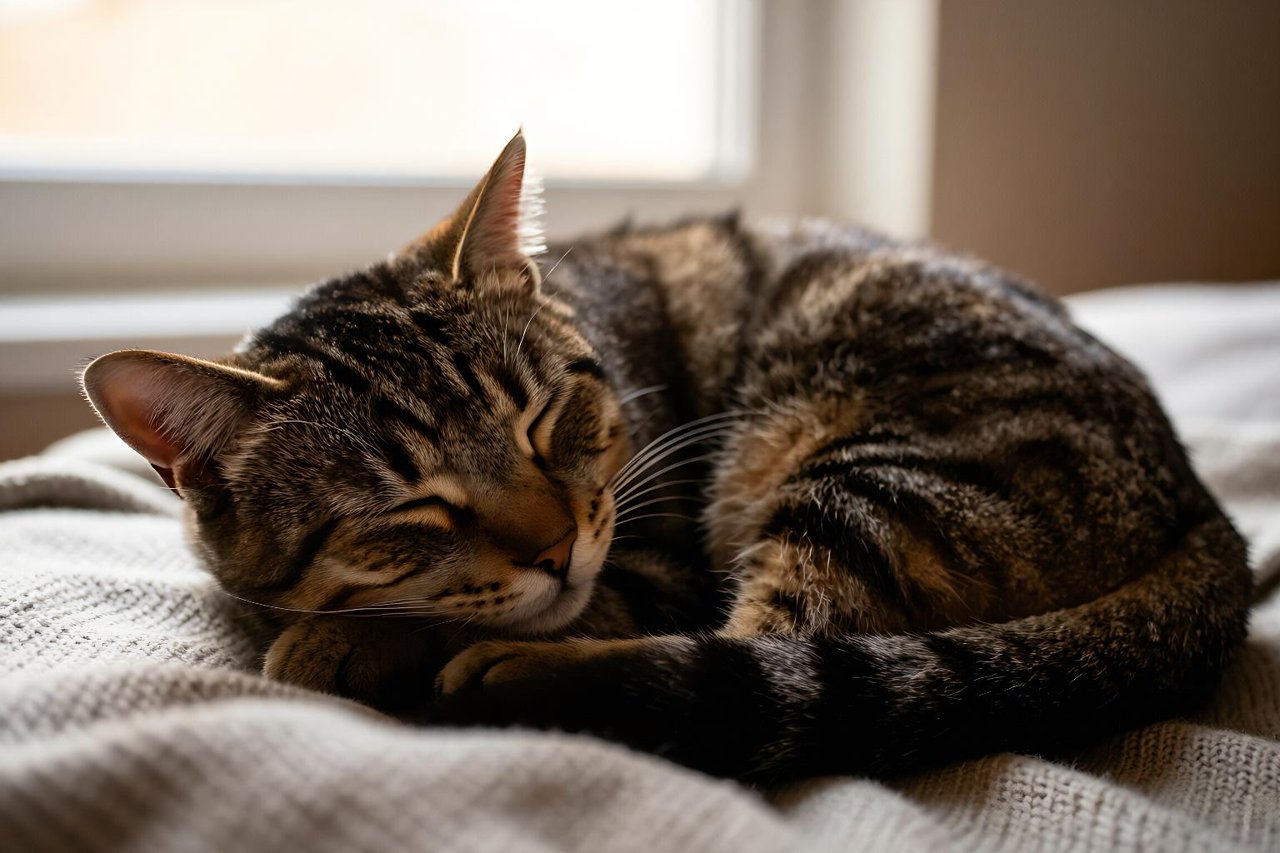
At some point tonight, a warm weight will land on your chest, circle twice, and settle. You’ll adjust an arm. You’ll surrender a corner of the duvet. And if you’re like most cat owners, you won’t move for the next three hours.
Being a mattress with a pulse isn’t a bad job. The habit is worth understanding, though, because a cat that sleeps on you is doing several things at once: regulating its body temperature, borrowing your nervous system, and making a quiet claim about which creature in the house it trusts most.
You Are a 38°C Radiator That Breathes
A cat’s thermoneutral zone, the band of temperatures where it doesn’t have to burn extra calories just to stay warm, sits roughly between 30°C and 38°C. Humans sit below that. Your skin runs around 33°C, your core closer to 37°C, and a duvet over the top turns the whole arrangement into a heated cushion with a heartbeat.
Left to itself, a cat will find the boiler cupboard, the top of the fridge, or a patch of sun on the landing. Given the option, it picks you. In homes where researchers have tracked where cats actually rest, warmth beats softness almost every time. A hard windowsill in full sun outperforms a memory-foam bed in a chilly room. A bony human knee outperforms both.

This is also why the habit intensifies in winter and eases in July, and why a cat that normally ignores you will suddenly appear on your lap the moment you sit under a blanket.
Sleeping in Contact Is a Survival Habit
Cats are famously light sleepers, and there’s a reason for it. A cat that goes into deep sleep alone is a cat that can be caught out. Sleeping pressed against another animal is a shared alarm system: two sets of ears, two noses, one early warning.
The payoff shows up in the sleep itself. Cats that feel secure drop into REM sleep faster and stay there longer. When your cat flops onto its side beside you, chin up, legs loose, tail twitching through a dream, that isn’t laziness. It’s a nervous system choosing to stand down in your company. Cats rarely do that with someone they haven’t decided is safe.
You Smell Like Home
Cats lean on scent far more than sight. They have scent glands in their cheeks, chin, paw pads and along the tail, and they spend a good part of the day pressing those glands onto doorframes, chair legs and, yes, you. Rubbing against your ankle isn’t just affection. It’s a two-way exchange: your cat leaves its smell on you and collects yours in return.
Your worn jumper, your unwashed pillow, the t-shirt you dropped on the floor last night: those are the strongest concentrations of your scent in the house. That’s why a cat will ignore a £60 bed and sleep in a laundry basket. It’s also why they choose your chest over the identical patch of mattress 30cm to the left. Same warmth, but one of them smells like you.
Your Breathing Is Doing Something to Them
A resting human heart beats 60 to 100 times a minute and breathes 12 to 20 times. A cat’s resting heart rate is 140 to 220. Compared with their own internal rhythm, ours is slow, steady and extremely soothing.
Kittens fall asleep in a pile, nose to flank, listening to the heartbeat and breathing of their mother and littermates. That association doesn’t fade. An adult cat settling on your chest is, in a small way, returning to the conditions it was born into. Slow your breathing deliberately and you may notice the cat’s eyes close a little faster.
What the Sleeping Position Actually Tells You
Cats are specific about how they arrange themselves, and the spot they choose is a decent read on their mood:
- Curled on your chest, head near your face. Maximum trust and maximum warmth. The face-to-face placement also lets a cat monitor your breathing, which is why some cats settle there when you’re ill or asleep.
- Wedged between your legs or tucked against your side. Contact without vulnerability. The cat wants to be part of the group but keeps its limbs free and its exit route open.
- On your head or the spare pillow. Warmth plus the highest concentration of your scent, with a good view of the room. Popular with cats who like to supervise.
- At the foot of the bed. Affectionate but independent. Close enough to belong, far enough to leave quickly.
- Back pressed against yours. The most underrated compliment in cat body language: your cat is refusing to watch its own back because it assumes you’ll do it.
Sometimes It’s Habit, Age, or Aching Joints
Not every visit is a declaration of love, and that’s worth saying plainly. Cats are creatures of routine, and if a cat has slept on your legs every night since it was six months old, it may simply be doing what it has always done.
Age shifts the maths too. A cat over ten is more likely to seek out soft, warm, elevated surfaces, and arthritis in the hips and spine makes a firm mattress preferable to the floor. If a cat that used to sleep on the sofa arm suddenly wants to be on you every night, consider whether it is cold, stiff, or feeling vulnerable.
Temperament plays a part as well. The more sociable and people-focused breeds, such as the clever, interactive cat breeds that treat their owner as a colleague rather than a landlord, tend to want physical contact at night. So do the smallest ones: a petite cat with a high surface-area-to-volume ratio loses body heat faster and will seek out a warm body sooner than a big, heavily furred breed.
It’s One of Several Ways Cats Claim You
Sleeping on you belongs to a wider set of behaviours that cat owners often misread. The same instinct that puts a cat on your chest at 2am also produces the slow blink, the head-butt to your chin, the follow-you-to-the-bathroom routine, and the carefully deposited mouse on the doormat that is really a gift, not a warning. None of it is sentimental in the way humans mean it. All of it is social. Your cat has filed you under family.
When the Habit Changes, Pay Attention
A sudden increase in clinginess is one of the more reliable early signals that something is off. Cats mask discomfort instinctively, the same way dogs hide when they are sick and quietly withdraw rather than ask for help. Watch for a cat that starts sleeping on you after years of independence, that presses its forehead into you and stays there, that stops jumping up onto the bed, or that sleeps noticeably more than usual. Those changes deserve a vet visit rather than a celebratory post about how affectionate the cat has become.
Making It Work for Both of You
You don’t have to choose between a cat and a full night’s sleep. A few small adjustments tend to settle the arrangement.
Keep the bedroom around 18°C, warm enough for you, cool enough that the bed stays the best heat source in the room. Place a soft cat bed on the bedside table or a chair pulled close to the bed, and put a worn t-shirt inside it so your scent does the recruiting. Many cats will take the substitute once it’s warmer than the floor and closer than the sofa.
If you have a cat that treats your ribcage as a landing pad, a folded blanket laid across the foot of the bed creates a defined spot. Cats respond better to being redirected than to being moved off, and a cat that has its own warm patch next to you rarely bothers claiming yours.
Burn off some of the evening energy, too. A cat that has spent 20 minutes chasing a wand toy before bed settles faster and deeper. The right hunting-drive toys make a genuine difference to night-time restlessness, and a tired cat is a cat that sleeps through until your alarm instead of at 4.40am on your windpipe.
For older cats, add a low, heated pad to a favourite spot and keep the joints moving with gentle play. For allergy sufferers, wash bedding weekly, keep the cat off the pillow itself, and accept that the duvet is now shared property. You will lose that argument anyway.


