
Table of Contents
Most plants can’t run. They can’t hide, migrate, or fight back in any obvious way. So instead they’ve spent hundreds of millions of years engineering workarounds — curling into tight balls, burying themselves underground, drinking fog, and in one case sitting patiently for decades waiting for the forest around them to catch fire.
The seven species below are among the strangest problem-solvers in the plant kingdom. Each one has a survival strategy you’d expect from a science fiction writer rather than a photosynthesising organism rooted to a single spot.
1. The Resurrection Plant That Plays Dead Until It Rains
Selaginella lepidophylla grows in the Chihuahuan Desert, where rain can vanish for eleven months straight. When the soil dries, the plant doesn’t wilt — it folds. Its outer stems curl inward into a tight brown ball about the size of a fist, and the whole thing detaches and tumbles across the ground until it lodges somewhere.
In that state it can lose roughly 95% of its water content and still be alive. No metabolic activity, no photosynthesis, no visible sign of life for months or even years. Then it rains, and within three to four hours the ball unfurls and turns green, as if someone flicked a switch.

The trick is a sugar called trehalose, which stabilises cell membranes and proteins in a glass-like state as water disappears, preventing the cellular collapse that would kill almost anything else. Gardeners buy these plants as novelties and often confuse them with the true rose of Jericho (Anastatica hierochuntica), a completely unrelated mustard-family plant from the Middle East that performs a similar party trick.
2. Welwitschia: Two Leaves and 1,500 Years of Patience
Head into the Namib Desert along the coast of Namibia and Angola and you’ll find Welwitschia mirabilis, a plant so odd it got its own family. It produces exactly two leaves in its entire life. Not two leaves at a time — two leaves, full stop.
Those leaves never stop growing from the base while the tips erode away in the wind and sun, so an old plant’s leaves end up as a frayed, leathery tangle sprawled several metres across the gravel. The oldest known specimens have been carbon-dated at over 1,500 years, with some estimates pushing toward 2,000.
Welwitschia survives on fog more than rainfall. Its stomata can absorb water vapour directly from the coastal mist that rolls in off the Atlantic, and it runs CAM photosynthesis, opening its pores at night to cut water loss during the day. A taproot drives down three metres or more. It is, essentially, a plant that has decided to spend a millennium doing almost nothing very efficiently.
3. Tumbleweed: Farming by Rolling
Tumbleweed isn’t one species but a handful of Kali and Salsola plants, most famously Russian thistle. It arrived in North America by accident in the 1870s, mixed into flax seed brought by Ukrainian settlers to South Dakota, and spread across the continent in under fifty years.
When the plant matures and dries, the stem snaps at ground level and the whole bush goes mobile. Wind pushes it for kilometres, and every bounce and jolt shakes loose seeds from thousands of tiny pods. A single large plant can carry a quarter of a million seeds.
The seeds themselves are built for opportunism: they germinate within hours of the first decent rainfall, and the plant can flower and set seed in as little as six weeks. It’s a brute-force strategy — enormous seed output, total mobility, zero investment in staying put. It also makes tumbleweeds a genuine fire hazard and a notorious hay-fever trigger, which is the cost of success.
4. Mangroves: Desalination Plants With Legs
Mangroves grow with their feet in salt water, which should be lethal to most trees. They get around it with a stacked set of adaptations:
- Salt exclusion at the roots. Red mangroves filter seawater using a membrane barrier that blocks up to 97% of the salt before it ever enters the vascular system.
- Salt excretion through leaves. Black mangroves take the opposite approach, pumping excess salt out through glands on their leaf surfaces, which is why the leaves taste salty and often look crusted.
- Snorkels. Waterlogged mud contains almost no oxygen, so many species send up pneumatophores — vertical roots that poke above the surface and breathe.
- Vivipary. Seeds germinate while still attached to the parent, growing into cigar-shaped propagules up to 30 cm long before dropping. They can float in salt water for months, then root within 24 hours of hitting a mudbank.
The result is a tree that can colonise soft, salty, oxygen-starved ground no competitor wants, and shield coastlines from storm surge while doing it.
5. Strangler Figs: Killing the Competition, Slowly
A strangler fig starts life as a seed dropped by a bird into a crack high in another tree’s canopy. It germinates in the treetop with no access to soil water, so it sends roots down the host’s trunk, sometimes 20 metres, until they reach the ground.
Once anchored, the fig’s roots thicken and fuse into a lattice that tightens around the host. The fig’s canopy overtakes the host’s, cutting off its light. After decades, the original tree dies and rots away, leaving a hollow, free-standing fig cylinder where the host used to be. Some of these hollow trees are major tourist attractions in Australia and Central America.
The strategy is brutal but effective: the fig never has to compete for light from the forest floor, and it arrives already at canopy height. It’s also a keystone species, fruiting year-round and feeding more bird and mammal species than almost any other tropical tree.
6. Lithops: The Plants That Pretend to Be Pebbles
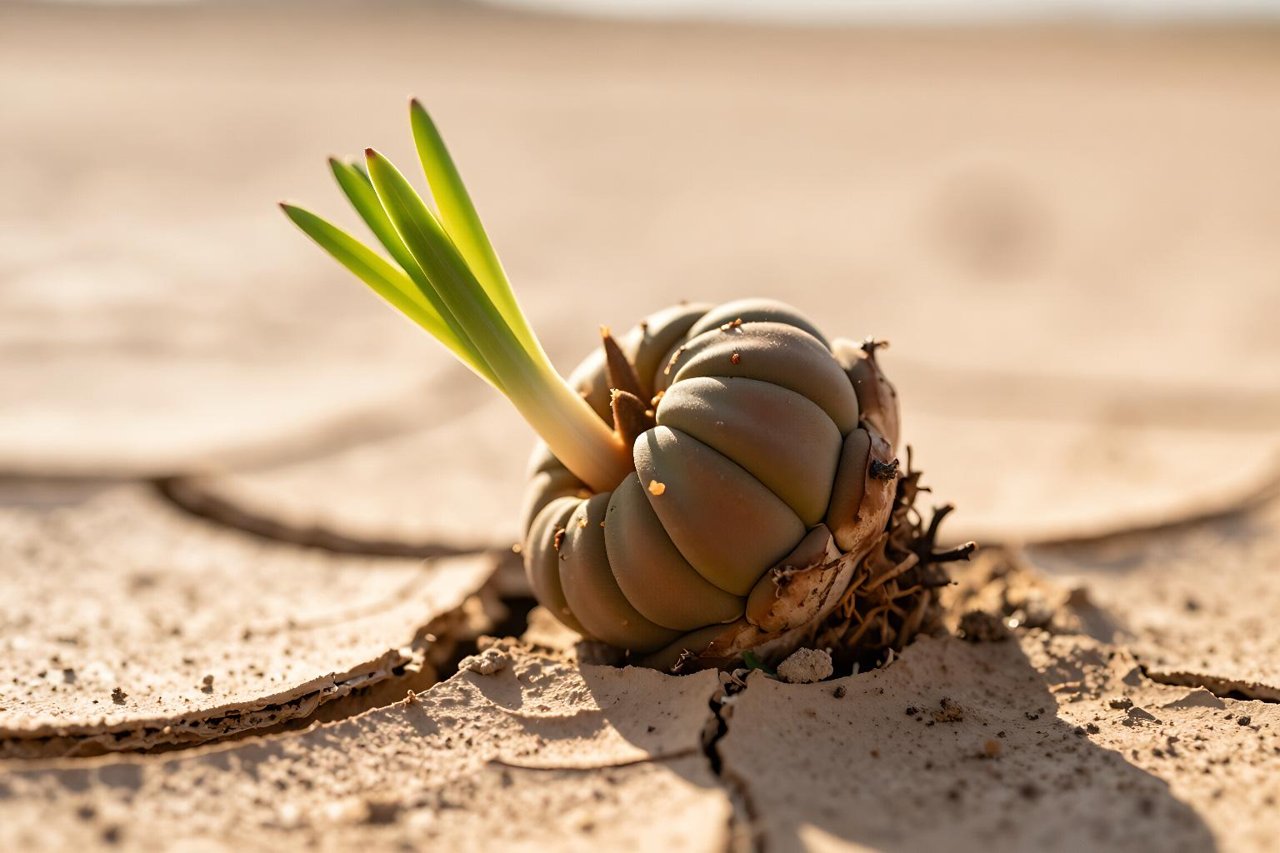
Lithops, native to Namibia, South Africa and Botswana, are the closest thing plants have to camouflage. Each one is a pair of fused, bulbous leaves with a fissure down the middle, and the whole structure sits almost entirely buried in gravel with only a flat top showing. The tops are mottled in greys, creams and rusty browns that match local quartz and limestone so closely you can stare straight at a colony and see nothing.
That flat top is also a window. Translucent cells called windows funnel light down into photosynthetic tissue buried safely below the soil surface, where temperatures stay far cooler than on the rock above. The plant drinks mainly from coastal fog, rerunning the same CAM photosynthesis trick as Welwitschia.
Each year a new pair of leaves grows from inside the fissure, absorbing the old pair for water and nutrients. Contractile roots can even drag the plant deeper into the soil if it gets exposed. Nothing about it looks alive, which is precisely the point.
7. Banksia and the Plants That Need to Burn
Some Australian plants have made fire part of their reproductive cycle rather than something to survive. Many Banksia species hold their seeds in woody follicles sealed shut on the cone, and those follicles will not open until they’re heated — for many species, somewhere around 50 to 70°C. A bushfire passes, the cones crack open over the following days, and seed drops onto cleared, ash-fertilised ground with no competition and no herbivores.
Other species go further. Seeds of many fire-adapted shrubs won’t germinate until they’re exposed to smoke, specifically to chemicals called karrikins, identified by researchers in the 2000s and named after the karri tree of Western Australia. Eucalypts keep dormant buds buried under the bark, ready to shoot new stems within weeks of a fire, and they regrow from lignotubers at the base.
The awkward part of this genius strategy is that these plants now depend on fire. Suppress every bushfire in a Banksia woodland for long enough and the cones stay shut, the seedlings never come, and the population slowly ages out with nothing replacing it. Their remarkable survival strategy is also their vulnerability — a reminder that specialisation cuts both ways.


