
Table of Contents
Most products start with a clear problem. These seven started with a different one. A wallpaper cleaner became a toy. A failed adhesive became an office staple. A heart drug changed bedroom conversations. The common things on this list were invented for unexpected reasons, and each story depends on a moment when someone ignored the label and paid attention to what the product actually did.
You have probably used several of them this week. Here are the origin stories behind seven familiar objects, plus the odd detours that made them famous.
- A soot-cleaning putty turned into a modeling compound.
- Textured wallpaper became shipping material.
- A weak glue became a bookmark that stuck.
- An angina drug found a very different market.
- A pharmacy tonic became a soda fountain favorite.
- A cold cream remover became a tissue for noses.
- A radar component became a kitchen appliance.
1. Play-Doh Was a Wallpaper Cleaner
In the 1930s, a Cincinnati company called Kutol Products made a pliable compound for cleaning soot and coal dust off wallpaper. It was a practical product for homes heated by coal. After World War II, coal furnaces declined, wallpaper became less common, and Kutol’s cleaning putty lost its market.
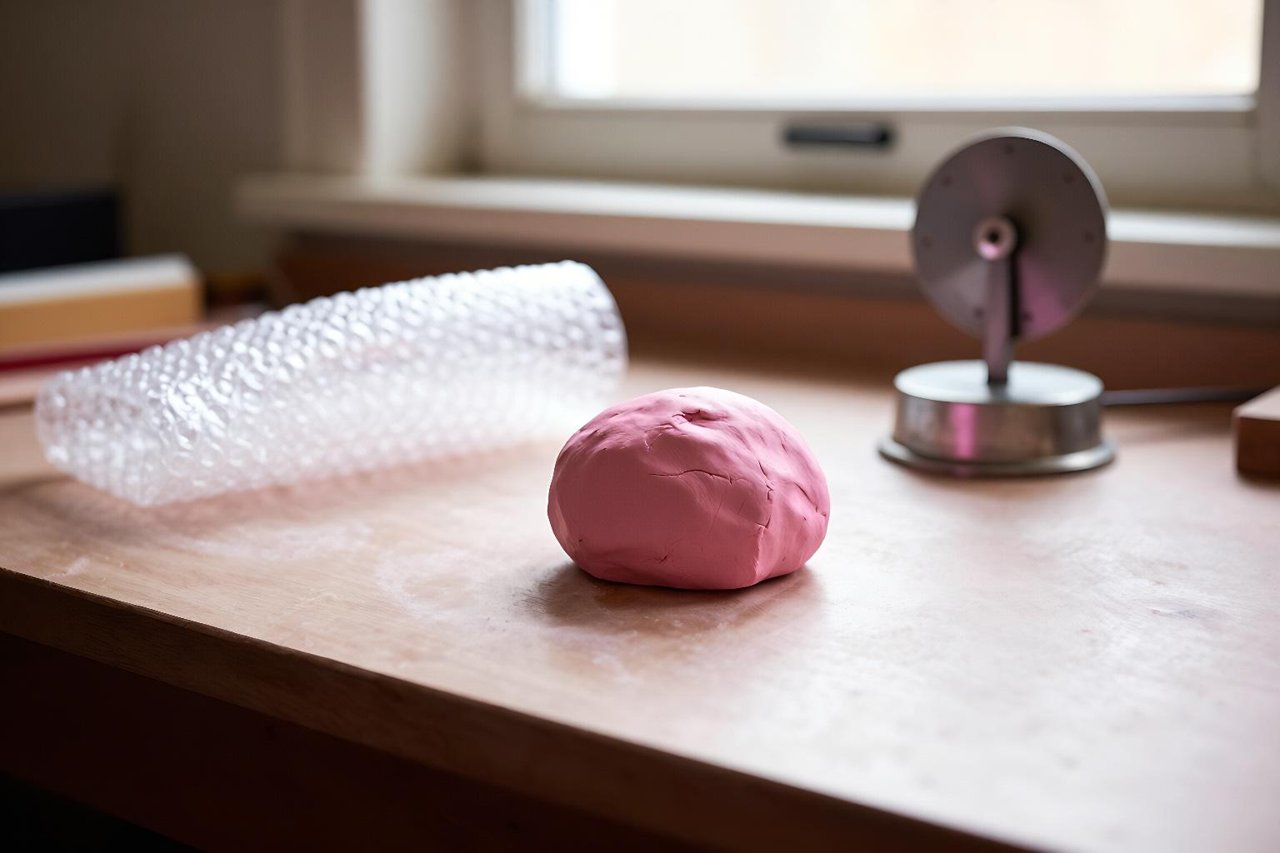
The rescue came from a nursery school teacher named Kay Zufall. She saw children using the soft compound as modeling clay and suggested selling it that way. Her brother-in-law, Joe McVicker, repackaged it as Play-Doh in 1956. A cleaner for walls became a toy for small hands. The formula was non-toxic and easy to shape, which helped. The name was new, the product was not.

2. Bubble Wrap Was Supposed to Be Wallpaper
In 1957, Alfred Fielding and Marc Chavannes tried to make a textured wallpaper. They sealed two shower curtains together, trapping air in a pattern of bubbles. The result did not look like wallpaper. It looked like a sheet of plastic blisters, and homeowners were not impressed.
The inventors tried other uses, including greenhouse insulation. That also failed to catch on. Sealed Air was founded in 1960, and early customers included IBM, which used the material to protect machines during shipping. The bubbles found their job in packaging. Today Bubble Wrap is so associated with shipping that the original wallpaper idea sounds like a joke. It was not a joke at the time. It was a failed product with a useful side effect.
3. Post-it Notes Came From a Weak Glue
In 1968, Spencer Silver, a chemist at 3M, was trying to make a stronger adhesive for aircraft construction. He ended up with the opposite: a low-tack glue that stuck to surfaces but peeled off cleanly. It was a failure by the original brief. The adhesive could be reused, but nobody knew what to do with it.
Six years later, Art Fry, another 3M scientist, sang in a church choir. He used paper bookmarks that kept falling out of his hymnal. He applied Silver’s weak adhesive to a bookmark and found it stayed put. The product was tested as Press ‘n Peel, and the first market test in 1977 did not go well. Free samples changed that. People tried the notes, stuck them to reports and desks, and asked where they could buy more. Post-it Notes launched nationally in 1980.
4. Viagra Began as a Heart Drug
Pfizer developed sildenafil in the late 1980s and early 1990s as a treatment for angina and high blood pressure. The drug was meant to relax blood vessels and improve blood flow to the heart. In early clinical trials, it did not perform well enough for that purpose.
The trial volunteers reported a side effect that had nothing to do with chest pain. Pfizer switched focus, ran new trials, and received FDA approval for erectile dysfunction in 1998. The drug became Viagra. A cardiovascular candidate turned into one of the most talked-about medications of its era. The science was serious; the marketing became a cultural event.
5. Coca-Cola Was a Patent Medicine
John Stith Pemberton, an Atlanta pharmacist, created the syrup for Coca-Cola in 1886. He marketed it as a medicinal tonic for headaches, nausea, and nervous complaints. It was sold at Jacobs’ Pharmacy for five cents a glass, mixed with carbonated water.
The drink was named for two ingredients: coca leaves and kola nuts. It was not invented as a casual soft drink for lunch. It was a pharmacy product in an era when patent medicines were common. Customers liked the taste, and the soda fountain side of the business took over. Asa Candler bought the rights and built the brand. The medicine label faded; the refreshment label stuck.
6. Kleenex Was Made to Remove Cold Cream
Kimberly-Clark developed a material called cellucotton during World War I for bandages and gas mask filters. After the war, the company needed consumer products. Kotex came first. In 1924, Kleenex arrived as a disposable cloth for removing cold cream.
Customers had other ideas. They blew their noses with the tissues. Kimberly-Clark noticed the behavior and changed the marketing. By the 1930s, Kleenex was being sold as a disposable handkerchief. A beauty product became a cold-season staple. The company did not invent the need; it noticed the need and followed it.
7. The Microwave Oven Was a Radar Lab Accident
In 1945, Percy Spencer was working with magnetrons at Raytheon. These were vacuum tubes used in radar equipment. While standing near an active magnetron, he noticed that a chocolate bar in his pocket had melted. He was not trying to cook anything.
Spencer and his team tested the effect with popcorn and an egg. The popcorn popped. The egg exploded. Raytheon patented the process and built the first microwave oven, the Radarange, in 1947. It was about 5.5 feet tall, weighed 750 pounds, and cost roughly $5,000. Restaurants and institutions used it first. Home models arrived later, once the technology got smaller and cheaper.
Why Accidental Inventions Keep Happening
These stories are not just charming trivia. They show how often a product’s fate depends on someone noticing a mismatch between the intended use and the actual behavior. Play-Doh was a bad wallpaper cleaner that made excellent modeling clay. Bubble Wrap was a bad wallpaper that made excellent cushioning. Viagra was a disappointing heart drug with a side effect that became the main event.
The second act usually starts with a user
In several cases, the inventor did not spot the winning use first. A teacher saw children playing with cleaning putty. A choir singer used weak glue to hold a bookmark. Consumers blew their noses with cold cream tissues. The market often writes the product brief after the launch.
Failure can hide a useful property
A weak adhesive is a failure if you want a permanent bond. It is a feature if you want a note that peels off. A melted chocolate bar is a nuisance in a radar lab. It is a clue if you pay attention. The useful property was there all along, just not under the heading anyone expected.
That pattern is worth remembering the next time a tool, a recipe, or a piece of software fails at its stated job. Look at what it does well before you throw it out. The next everyday object might be sitting in a workshop or a kitchen, waiting for someone to stop asking what it was supposed to be and start asking what it could become.


