
Table of Contents
Singapore has a law about chewing gum. England has one about handling salmon suspiciously. Switzerland has a rule that effectively makes it illegal to own a single guinea pig. None of these are medieval leftovers or internet myths, and several are enforced with fines big enough to ruin your weekend.
The top 7 bizarre laws that still exist around the world are more than pub-quiz fodder. Each one exists because something went wrong, or because a regulator decided the risk was worth writing down in the statute book. Here is what the rules actually say, where they came from, and what happens if you break them.
Plenty of them read like weird facts that sound fake but are actually true, right up until a magistrate fines you.
1. Singapore: No Gum for Sale, and Flush the Toilet
Singapore banned the sale and import of chewing gum in 1992, after discarded wads kept jamming the doors of the new MRT trains and costing the operator real money to clear up. Chewing gum is not illegal. Selling it, importing it or bringing it in to sell carries a fine of up to S$100,000 and two years in prison.

The pharmacist loophole
The ban is not total. Since 2004, therapeutic gum such as nicotine or dental gum can be bought from a pharmacist who takes your name, a concession written into the US-Singapore free trade agreement. Try to buy a normal pack at a convenience store and you will come up empty.
Then there is the toilet rule. Failing to flush a public toilet is an offence under Singapore’s public cleansing regulations, with a S$150 fine for a first offence and up to S$1,000 for repeat offenders. Those signs on the back of cubicle doors are not decoration.
2. England and Wales: Handling Salmon Suspiciously
The Salmon Act 1986 is a serious piece of fisheries legislation, which makes Section 32 all the more entertaining. It makes it an offence to handle a salmon in circumstances that give rise to a reasonable presumption the fish was illegally taken.
The wording sounds like a joke. The problem it solves is not. Through the 1980s, organised crews netted rivers at night and moved fish quickly through middlemen, so Parliament wrote a rule that catches everyone in the chain, from the van driver to the fishmonger, if the fish smells wrong in the legal sense. Convictions can bring a fine and, in serious cases, a custodial sentence.
3. Switzerland: Guinea Pigs Cannot Live Alone
Swiss animal welfare law requires social species to be kept in groups. Guinea pigs are herd animals and become genuinely distressed when isolated, so owning just one is treated as improper housing rather than an eccentric choice.
The Swiss have solved the practical problem in characteristically tidy fashion. Breeders rent out companion guinea pigs, and when one half of a pair dies, owners can arrange a short-term swap through a shelter so the survivor is never left on its own. Goldfish get similar treatment, since keeping a solitary one in a bare bowl runs into the same rules. Get it wrong and you are looking at an animal welfare penalty, not just a disapproving look over the garden fence.
4. Svalbard, Norway: No Dying, No Cats, Carry a Rifle
Longyearbyen, the main settlement on the Svalbard archipelago, has a small cemetery that stopped accepting burials in the 1950s. The ground is permafrost, so bodies do not decompose. When researchers exhumed victims of the 1918 flu from that graveyard in 1998, they found viral material still intact. Residents who become seriously ill are flown to the Norwegian mainland, and dying up there is heavily discouraged.
Two more local oddities. Cats are banned across Svalbard to protect nesting seabirds. And since 1995, anyone travelling outside the settlements has been legally required to carry a firearm, because polar bears are a live hazard rather than a postcard motif. The islands also host the Global Seed Vault and a cluster of research stations, which keeps Svalbard in science news more often than most places of 2,500 people.
5. Victoria, Australia: The Light Bulb Rule
You have probably seen the claim that changing a light bulb without a licensed electrician is illegal in Victoria. The truth is narrower and far more sensible. Swapping a bulb in an existing socket is fine. Installing or altering fixed wiring, including hard-wired light fittings, requires a licensed electrician under the Electricity Safety Act 1998.
Similar restrictions apply in Queensland and New South Wales, and across much of Europe. The rule earns a place here because the version people repeat online is one of the more successful bits of legal misinformation going, while the real version still catches out plenty of weekend renovators.
6. Germany: Do Not Run Out of Fuel on the Autobahn
Stopping on an Autobahn outside an emergency is an offence, and running dry counts as one you could have avoided. German traffic law treats an empty tank as a foreseeable problem, so expect an administrative fine of roughly €70, a towing bill, and an awkward conversation with your insurer about why you were parked in a live lane.
Germany has other quietly strange rules. The Autobahn has no general speed limit, but if you crash while travelling faster than the recommended 130 km/h, insurers can reduce or refuse part of the payout. Washing your car on a driveway with a hose is banned in many municipalities because of wastewater rules.
7. Venice, Italy: Do Not Feed the Pigeons
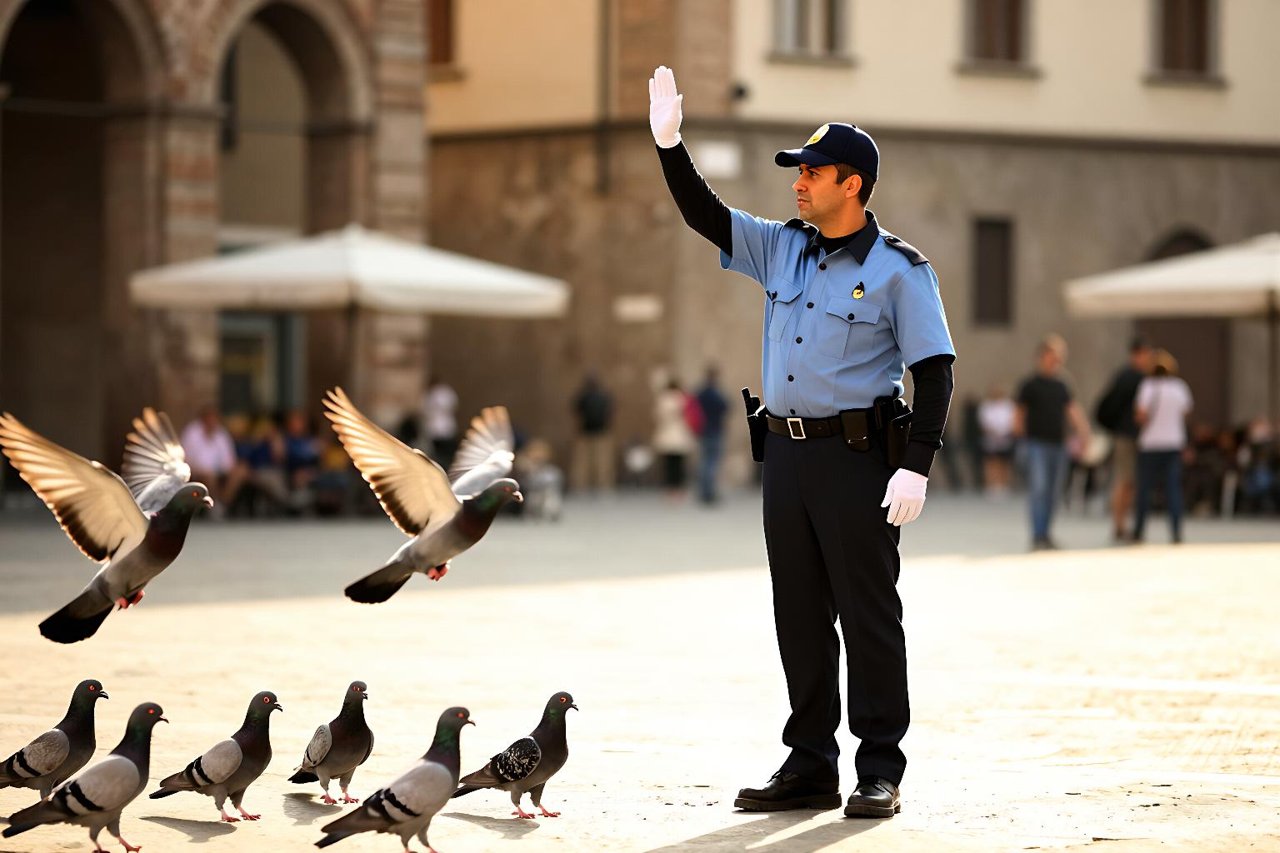
Venice banned feeding pigeons in St Mark’s Square in 2008, after the birds had worn through paving, monuments and the patience of conservationists. Fines start at €25 and climb towards €500 for repeat offenders, and the ban applies across the city rather than just the square.
The city has added more since. No sitting on the steps of the square, no picnicking on bridges, no leaving rubbish behind. Wardens do enforce it, and the penalties tend to land on tourists who assumed the rules were suggestions.
Other Curiosities Still on the Books
- Turin, Italy: a city ordinance requires dog owners to walk their pets at least three times a day, with fines for neglect.
- Bhutan: the sale of tobacco has been banned since 2010; visitors may import only strictly limited amounts.
- United Kingdom: wearing armour inside the Palace of Westminster has been prohibited since 1313, and the rule has never been formally repealed.
- Japan: companies must measure the waistlines of employees aged 40 to 74 under the 2008 “metabo” law, with targets of 85cm for men and 90cm for women.
- France: photographing the Eiffel Tower at night is restricted, because the light show is treated as a protected artistic work.
Why These Rules Never Get Deleted
Most strange laws survive for the same reason. Repealing them costs parliamentary time, and nobody wants to spend a session debating salmon handling when there are budgets to pass. Enforcement is selective, so a rule can sit dormant for decades and then catch one unlucky person, who ends up in a story that makes the whole statute look ridiculous.
Distance does the rest of the work. The same legal systems that fine a tourist for feeding a pigeon or a driver for an empty tank also handle the cases that genuinely reshape lives; when Bryan Kohberger pleaded guilty in the Idaho murders case, nobody in the room was thinking about chewing gum.
So read the signs. Singapore’s toilet inspectors act on complaints, Venice’s wardens patrol in the afternoon, and Svalbard’s polar bears have no interest in whether you find the rifle rule eccentric. These laws are funny right up to the moment they apply to you.


