
Table of Contents
A teak sideboard sat at the end of my street for three days with a piece of card taped to it. Nobody took it. On the fourth morning a dealer in a white van pulled up, loaded it into the back and drove off. I looked up the same model later: $900 on a vintage furniture site, in worse condition than the one he’d just taken for free.
That sideboard isn’t unusual. Most households are sitting on a handful of things worth real money that get binned, donated or skipped because nobody checked them first. These seven categories come up again and again, along with the details that separate a $5 item from a $500 one.
1. Old phones, cables and the drawer of mystery tech
Almost every house has that drawer. Three chargers for phones nobody owns, a tangle of cables, a handset from 2004. Most of it is worthless. Some of it isn’t.
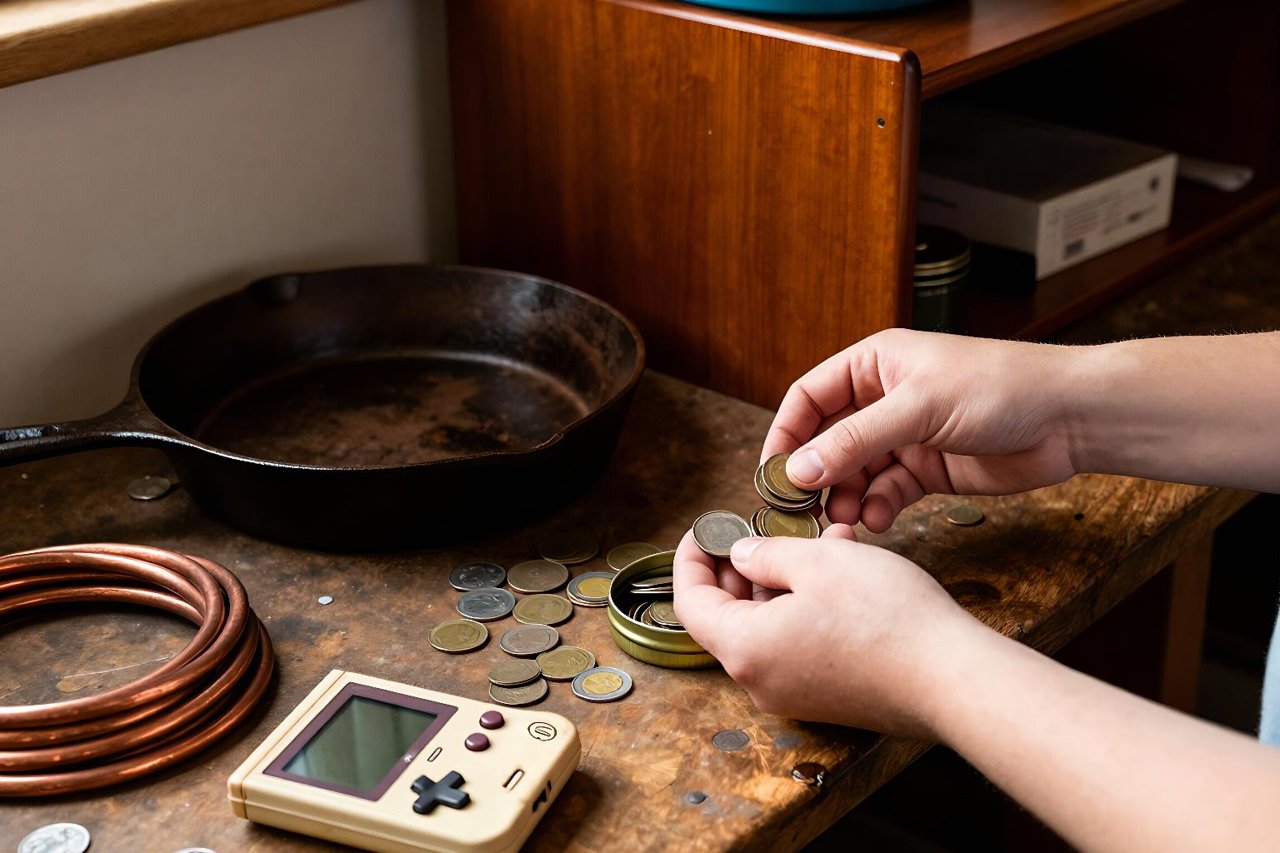
Boxed retro hardware is the big one. A working original Game Boy with its box and manual regularly sells for $120 to $200. Sealed first-generation iPods and early iPhones have gone for four figures at auction. Even loose Nintendo 64 cartridges, particularly RPGs and anything from the Mario Kart or Conker end of the shelf, move at $30 to $80 each.

What’s actually worth listing
- Handheld consoles with boxes, inserts and manuals
- Early Apple hardware, including original chargers and packaging
- Film cameras and lenses from the 1960s to 1980s
- Anything with gold-plated contacts, such as server boards and old hi-fi connectors
- Dials, knobs and switches from vintage audio gear
The cables themselves are worth less than people hope, though a scrap yard will take a bin bag of them for the copper inside. That brittle grey plastic around them has been quietly degrading for decades, the same slow breakdown traced in the century-long rise of microplastics, which explains why old cables crack and old cases turn sticky.
2. Coins and banknotes sitting in jars
Loose change is the quietest source of value in most homes. In the United States, any dime, quarter or half dollar minted in 1964 or earlier is 90% silver. A single pre-1965 quarter holds about 0.18 ounces of silver, which puts its melt value somewhere around $4 to $5 depending on the spot price that week. A coffee tin of them is a decent payday.
British coins follow a similar pattern. Silver minted before 1920 is sterling; coins from 1920 to 1946 are 50% silver. Old banknotes matter too, and withdrawn notes in crisp condition, especially early series with low serial numbers, sell well above face value.
Ancient coinage is a market of its own. The Kingdom of Aksum was striking gold, silver and bronze coins in the third century, a currency system built on the trade networks that made the empire rich. Genuine pieces still surface in inherited collections, and even common bronze examples find buyers.
3. Vintage clothing and textiles
Clothes get thrown out faster than anything else on this list. A Levi’s 501 made in the USA, red tab, single-stitch hem, can fetch $80 to $300. Waxed Barbour jackets sell used for $100 to $250 all day long, and they can be rewaxed for years. Then there are the 1990s band T-shirts, where an original Nirvana tour shirt has sold for over $10,000.
The label tells you more than the brand
“Made in England”, “Made in USA”, “Made in West Germany” and “Union Made” all suggest a garment old enough to be interesting. Single stitching along the hem of a T-shirt points to pre-1990s manufacture. Silk scarves should be checked for a rolled, hand-stitched edge, which is the difference between a $10 scarf and a $200 one.
Condition drives price, and smell is the first thing a buyer tests. Wool, down and silk hold odour for years, and a coat that has spent a decade in a house full of pets may never fully recover. I spent months working out why my house stopped smelling like cats with seven of them living in it, and the same rules apply here: air it, don’t wash it, give it time.
4. Solid wood furniture
Flat-pack has trained a couple of generations to assume all furniture is disposable. Solid wood is a different animal. Teak and rosewood sideboards from the 1960s, Ercol chairs, G-Plan ranges and Danish pieces with a maker’s stamp on the underside routinely sell for $400 to $1,500.
Check three things: weight, joints and the back panel. Solid wood is heavy. Dovetail joints mean a cabinet was built to last fifty years, not five. A stapled chipboard back usually signals something cheaper from the 1980s, though even those have a following now. Brass handles and original glass are worth selling on their own if the carcass is beyond saving.
5. Cast iron, copper and good hand tools
Cast iron is the most commonly binned valuable object in the kitchen. A vintage Griswold or Wagner skillet, made before roughly 1960, sells for $60 to $250 depending on size and finish. Le Creuset and Staub pieces hold 60% to 70% of their new price even with scuffed enamel, and the name is stamped on the base where nobody thinks to look.
Tin-lined copper pans bring $40 to $150 each. In the workshop, hand tools from before 1970 often outperform modern equivalents and sell accordingly: a Stanley No. 4 or No. 5 plane with a rosewood knob can fetch $50 to $150, and used Snap-on spanners go for close to new prices.
6. Vinyl, books and sports memorabilia
Records are only worth something when it’s the right pressing. A scratched copy of a common 1980s album is a $3 record. An original Blue Note jazz pressing, a first-run Beatles LP or anything on a small independent label can run into the hundreds. Collectors check the matrix numbers etched into the run-off groove, so do the same before you donate the lot.
Books follow the same rule. A book club edition is worth nothing no matter how old it looks. A true first edition with the correct number line, an unclipped dust jacket and no library stamps can be worth thousands, which is why those 1997 Harry Potter hardbacks keep turning up in charity shop boxes.
The memorabilia market is steadier than people think
Old fight programmes, ticket stubs and cigarette cards all sell, and boxing leads the field. Ongoing interest in the best heavyweight boxers ever keeps prices high on anything signed or programme-related from Ali, Louis, Marciano or Fury, and a single 1960s title-fight programme in decent condition can bring $150 or more.
7. Scrap metal and the pile at the kerb
Scrap is unglamorous and reliable. Bare bright copper pipe fetches roughly $3.50 to $4.50 a pound at a typical yard, brass taps and fittings around $2 a pound, and aluminium radiators less but enough to matter on a house clearance. A bucket of copper fittings pulled out of a dead boiler is often worth $40 to $60.
Glass is mostly worthless by weight, but specific pieces aren’t. Patterned vintage Pyrex mixing bowls sell for $40 to $150, and old embossed milk bottles with a local dairy name on the shoulder bring $5 to $20 each.
Before anything leaves the house, give it ten minutes. Search the maker’s name and any numbers stamped into it. Look for hallmarks on metal and check the underside or back for a maker’s mark. Weigh anything metallic before you decide it’s junk. That ten minutes is the whole difference between a kerbside pile and a few hundred dollars in your pocket.


