
Table of Contents
A new car sheds roughly 20% of its value the moment you sign the paperwork, and close to 40% within five years. On a $40,000 vehicle that’s around $16,000 evaporating into thin air, more than most owners spend on fuel, insurance, and servicing combined over the same stretch. So the more useful question isn’t “what’s the monthly payment?” It’s “what will this thing be worth when I’m finished with it?”
Analysis from iSeeCars, which tracks millions of used-car transactions, puts average five-year depreciation at about 39%. The models below lose 20% to 30%, and a handful of them trade used for close to their original sticker. Here’s what actually holds up, and the reasons behind it.
Why resale value beats a big discount
Dealers love to sell on rebates. A $4,000 cash-back offer feels like a win in the showroom, and it’s often a loss over the ownership period.
Run the numbers. Car A stickers at $32,000 with a $3,000 rebate, so you pay $29,000. After three years it’s worth 45% of sticker, or $14,400. Your cost of ownership: $14,600. Car B stickers at $32,000 with no rebate, but retains 70% of its value. It’s worth $22,400 at resale, so your cost is $9,600. Same price tag, roughly $5,000 difference in real money.

Heavy incentives also poison the used market for a model. If buyers know the car was discounted $6,000 new, they’ll expect a similar break used. Meanwhile, the brands that rarely discount, Toyota and Honda most obviously, keep their used prices propped up. It’s no accident those names dominate lists of the most popular car brands worldwide: volume keeps parts cheap and buyers confident.
Trucks and body-on-frame SUVs: the undisputed champions
Toyota Tacoma
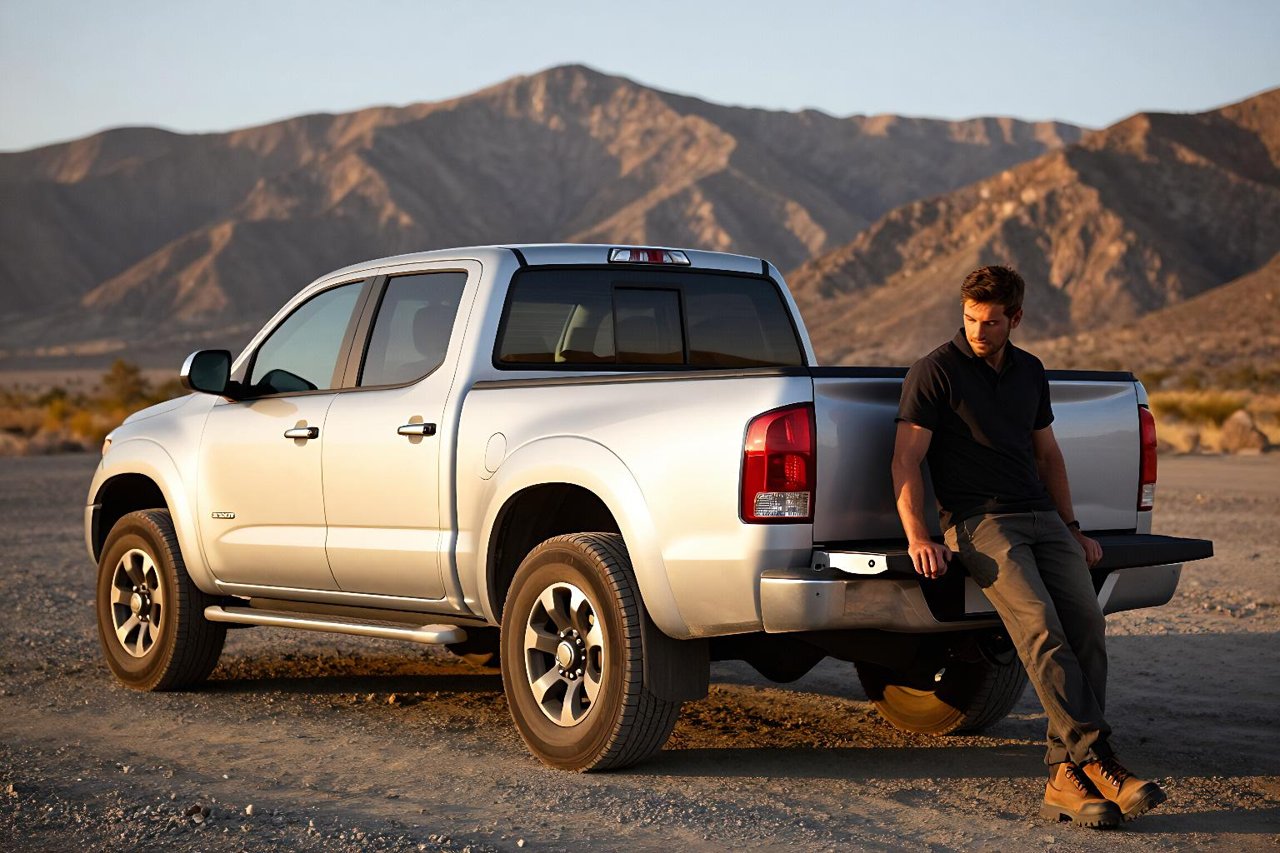
The Tacoma has led depreciation studies for years, holding around 80% of its value after five years, which is closer to a savings account than a vehicle. It’s body-on-frame, it’s been mechanically similar for ages, and there’s a permanent floor of demand from contractors, landscapers, and weekend overlanders who want a truck bed that takes a beating.
Toyota 4Runner
The previous-generation 4Runner went largely unchanged for 15 years and, as a result, held value like almost nothing else. The redesigned model carries the same formula: a truck frame, a naturally aspirated V6 (now a turbo four in some trims), and owners who keep them for 200,000 miles. Expect around 25-27% depreciation over five years.
Jeep Wrangler
Wranglers sit at roughly 24% over five years. The design barely changes, the removable roof and doors have no real rival, and the aftermarket is enormous. Buyers will happily pay near-new money for a five-year-old Jeep because it still looks current.
Ford Bronco
Production constraints kept Bronco prices inflated for years, and resale followed. It’s a less certain long-term bet than the Tacoma, but a two-door with the Sasquatch package and a manual gearbox will always find a buyer.
- Body-on-frame construction ages better than unibody in the eyes of used buyers
- Slow redesign cycles stop the older model looking dated overnight
- Work and hobby demand creates a floor that casual passenger cars don’t have
- Huge aftermarket support means worn parts are cheap to replace, so neglected examples get repaired rather than scrapped
Small cars that quietly punch above their price
The Honda Civic loses about 27% over five years. On a $24,000 sedan that’s around $6,500 of value gone, which is modest for the segment. The Corolla sits within a point of it, and the Subaru Crosstrek is close behind. These cars show up on every list of the best-selling cars in America for the same underlying reason: enormous buyer pools, cheap parts, and a reputation for not breaking.
The Mazda3 deserves a mention too. It depreciates a little faster than the Civic, but it starts cheaper and the interior feels a class above, so the net cost lands in similar territory. Manual-transmission versions of any of these hold value noticeably better than automatics, simply because so few are made.
SUVs with unusually flat depreciation curves
The Toyota RAV4 and Honda CR-V are the safe picks, both shedding around 30% over five years against a segment average closer to 40%. The Kia Telluride is the surprise entry; it arrived with genuine demand and dealer markups, and used examples still command strong money. The Lexus RX behaves like a Toyota with better leather and holds up similarly well.
If you’re shopping with children in the picture, the calculus gets more complicated because trim and seating layout start to matter as much as residual percentages. Our breakdown of the best family SUV of 2026 covers which configurations actually sell on quickly, and the picks in this guide to cars that survive real life with kids overlap heavily with the strong-resale list.
The fun stuff: sports cars and special editions
The Porsche 911 is the outlier of the entire market. A standard Carrera typically loses well under 25% over five years, and limited GT models have appreciated. Allocation scarcity does most of the work. On a smaller budget, the Subaru WRX, Toyota GR86, and Civic Type R all hold value better than their insurance premiums suggest, particularly unmodified examples with a manual.
One warning: electric vehicles are currently the weakest resale story in the industry. Rapid battery and software updates, plus repeated new-car price cuts, hammered used values for several popular models between 2023 and 2025. That’s great news if you’re buying used and bad news if you’re selling.
What quietly destroys resale value
- Fleet or rental history knocks 5-10% off a used valuation before anyone opens the door
- Odd colors are the classic mistake; white, black, silver, and gray outsell bright yellow or brown by a wide margin
- Modifications such as lifts, exhausts, and aftermarket wheels shrink the buyer pool dramatically
- Accident history on the vehicle report follows the car forever, even after a perfect repair
- Top trims with unpopular options like rear-seat entertainment and 21-inch wheels cost more new and return nothing at trade-in
- Missing service records read as neglect to a private buyer
How to buy with the exit already in mind
The steepest depreciation happens in years one to three, so a two- or three-year-old example of a strong-resale model is the sweet spot: someone else absorbed the worst of the drop and you still get modern safety kit. Our roundup of the best used cars under $10,000 is a good starting point if the budget is tight.
Stick to a popular color. Skip the panoramic roof if you live somewhere it will leak. Keep every receipt. Sell privately rather than trading in, since a dealer’s offer typically runs 10-15% below private-party value, and list a 4WD in autumn and a convertible in spring when demand spikes.
The small details that add $1,000 at trade-in
Two keys instead of one is worth real money, and so is a full service book with stamps rather than a folder of vague receipts. Original floor mats, an unmodified stereo, and a non-smoking history all get mentioned in the listing because they signal care. Matching tires from a known brand help too; a car sitting on four mismatched budget tyres tells a buyer the owner cut corners elsewhere.
Wash the engine bay before photos, fix the cracked tail light, and get the paint corrected if it’s swirled. None of it costs much, and all of it separates your car from the identical one listed $800 cheaper down the road. Resale value starts being built the day you buy, not the day you sell.


