
Table of Contents
Some dogs treat every delivery van as a personal emergency. Others sleep straight through it. If you share a wall with a neighbour, work night shifts, or live in a building where the hallway echoes, that difference matters far more than breed size or coat colour.
Barking is part inherited and part trained. Nobody can promise you a silent dog, because a dog that never barks at anything usually has a hearing problem. What you can do is stack the odds in your favour. The breeds below are wired quieter than most, and each one comes with a catch worth knowing before you fall for a photo.
What “Quiet” Really Means in Dog Terms
Barking gets all the attention, but dogs produce noise in at least four different ways, and a breed that’s silent in one column can be loud in another.
- Alert barking: the doorbell, the postman, a leaf. Most neighbour complaints start here.
- Howling: huskies, beagles, coonhounds. Rarely triggered, very hard to stop once it starts.
- Yodelling and whining: Basenjis and some Shibas. Not a bark, still audible through drywall.
- The Shiba scream: a sound that has convinced more than one vet they were being murdered.
So the useful question isn’t “does this breed bark?” It’s “how often does this breed feel the need to comment?” The dogs below rarely do.

Breeds That Genuinely Bark Less
Basenji
The one everyone names first, and for once the reputation holds. A Basenji’s larynx is shaped differently from other dogs’, so it can’t produce a true bark. It can yodel, though, and a Basenji yodel at 6am carries further than you would believe. Cat-like about grooming, stubborn about training, and definitely not the dog for someone who wants an obedient first pet.
Greyhound, Whippet and Italian Greyhound
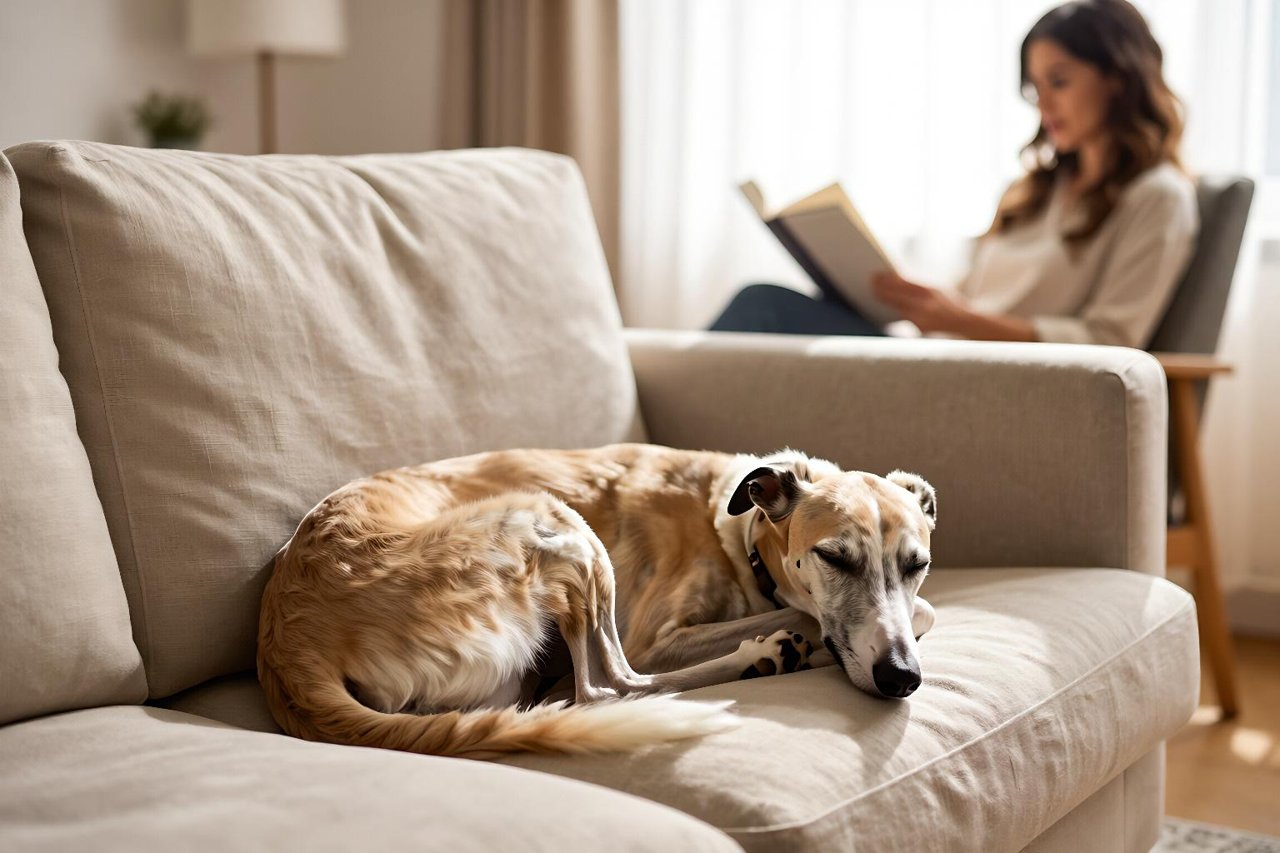
Sighthounds are professionals at doing nothing. A retired Greyhound sleeps 16 to 18 hours a day, wakes for a 20-minute walk, then returns to whatever soft surface you own. They bark rarely and usually only when startled. The couch-potato label is half true: they still need a fenced run every few days, because a Greyhound can hit 70km/h in a straight line. Italian Greyhounds are the same personality in a 4kg frame with considerably more fragile legs.
Borzoi, Saluki and Scottish Deerhound
These are quiet in a different way: aloof. A Borzoi will watch a stranger walk into the house without a single sound, which unsettles some people and delights others. Grooming is the real cost. Borzoi coats need serious weekly work, and Deerhounds shed far more than a dog that barely speaks has any right to.
Bullmastiff, Mastiff and Great Dane
Very large dogs tend to be slow to react. A Bullmastiff’s default setting is a deep sigh, and a Great Dane would rather lean on you than announce you. What you save in noise you pay for in scale. A Great Dane stands 70 to 80cm at the shoulder and eats accordingly, and a Mastiff can clear 80kg. Car space, crate size and vet bills all scale up with them.
Akita and Chow Chow
Both are famously reserved, both bark very little, and both are strong-willed enough that training has to start before they outgrow your ability to physically move them. Akitas are territorial and bond hard with one household. Chows sit closer to cats than dogs on the temperament spectrum, and that dense double coat is a weekly job, not a seasonal one. If you want a dog that watches the gate rather than shouting at it, these two fit, and the fuller picture of that trade-off is in these guard dog breeds that actually protect a home.
Rhodesian Ridgeback
Bred to track lions and hold them at bay, which explains the calm. A Ridgeback might bark a handful of times a week and saves it for something real. The catch is prey drive, a stubborn streak, and a genuine need for exercise. Bored Ridgebacks are also impressive escape artists.
Cavalier King Charles Spaniel
If you want a small, quiet dog for a flat, start here. Cavaliers bark at the door and not much else, weigh 5 to 8kg, and get along with cats, children and visitors. The honest downside is health. Mitral valve disease and syringomyelia are common enough that you should only buy from a breeder who tests for both.
The Trade-Off: Quiet Dogs Aren’t Automatically Easy Dogs
Silence and independence tend to travel together. Basenjis ignore recall. Borzois were bred to think for themselves at speed. Akitas decide whether your guest is a threat and don’t ask for a second opinion. A quiet dog is often simply a dog with strong opinions and no urge to share them.
Boredom is the other thing to plan for. A dog that doesn’t bark hasn’t stopped needing stimulation. Give a Border Collie nothing to do and it will redecorate your kitchen. Give a quiet sighthound nothing to do and it will sleep, which is convenient right up until you want engagement. Owners who work long days often do better with these breeds than with needy ones, and there’s a sensible breakdown of that in these breed picks for people who work full-time.
Keeping a Quiet Dog Quiet
Genetics set the volume dial. Environment turns it. A few things do most of the work.
- Cover the trigger, not the dog. Frosted film on a street-facing window cuts visual alert barking faster than any training cue.
- Teach “settle” as a job. Reward the dog for lying down while you cook or answer the door, before the noise starts.
- Walk before the lonely hours. A tired dog at 9am is a silent dog at 2pm.
- Never shout at a barking dog. From the dog’s point of view, you’ve just joined in.
- Knock on your neighbour’s door early. Most complaints escalate because nobody ever spoke.
Match the Breed to the Room, Not the Photo
A Greyhound on the third floor works if there’s a park and a lift. A Basenji on the same floor works only if you enjoy being argued with. If space is genuinely tight, these small breeds that thrive in apartments cover the size question alongside the noise one. For older owners, the priorities shift to lifting weight and leash manners, which is where these calm, manageable companions for seniors earn their place. And if the real constraint is time rather than noise, start with the low-maintenance breeds for people with real lives and filter for quiet from there.
Ask These Questions Before You Commit
Breed averages hide enormous individual variation. Two Greyhounds from the same litter can react completely differently to a doorbell. So when you meet a dog, at a breeder or a rescue, spend at least an hour there and listen.
Ask how the adult dogs in the house react when someone knocks. Ask what happens at feeding time, and whether the dog has ever triggered a noise complaint in a previous home. Ask to see the dam, because a nervous, noisy mother tells you something about what you’re buying. A good rescue will have already tested the dog in a foster home and can tell you whether it barks at the television or at the window.
Then sit quietly in the room for ten minutes and say nothing. The dog that wanders over, sniffs your shoe, and flops down at your feet is telling you more about your next decade than any breed profile can.


