
Table of Contents
In April 2023, Sofia Richie married Elliot Grainge at the Hotel du Cap-Eden-Roc in Antibes: three days, roughly 100 guests, a custom Chanel dress. You are almost certainly not commissioning a Chanel gown. But strip away the label and the postcode, and the structure underneath that wedding (a capped guest list, a compressed schedule, one deliberately designed visual moment) is available to anyone with a mid-range budget and a shared spreadsheet.
Celebrity weddings aren’t expensive because famous people get married. They’re expensive because a few specific decisions get pushed to an extreme: the headcount balloons, the venue is flown to, the peonies are out of season and arriving in refrigerated vans. Reverse that instinct, keep the rest, and you hold on to most of the polish. Here’s the order I’d actually do it in, with the trade-offs spelled out.
Step 1: Pick the one image before you pick anything else
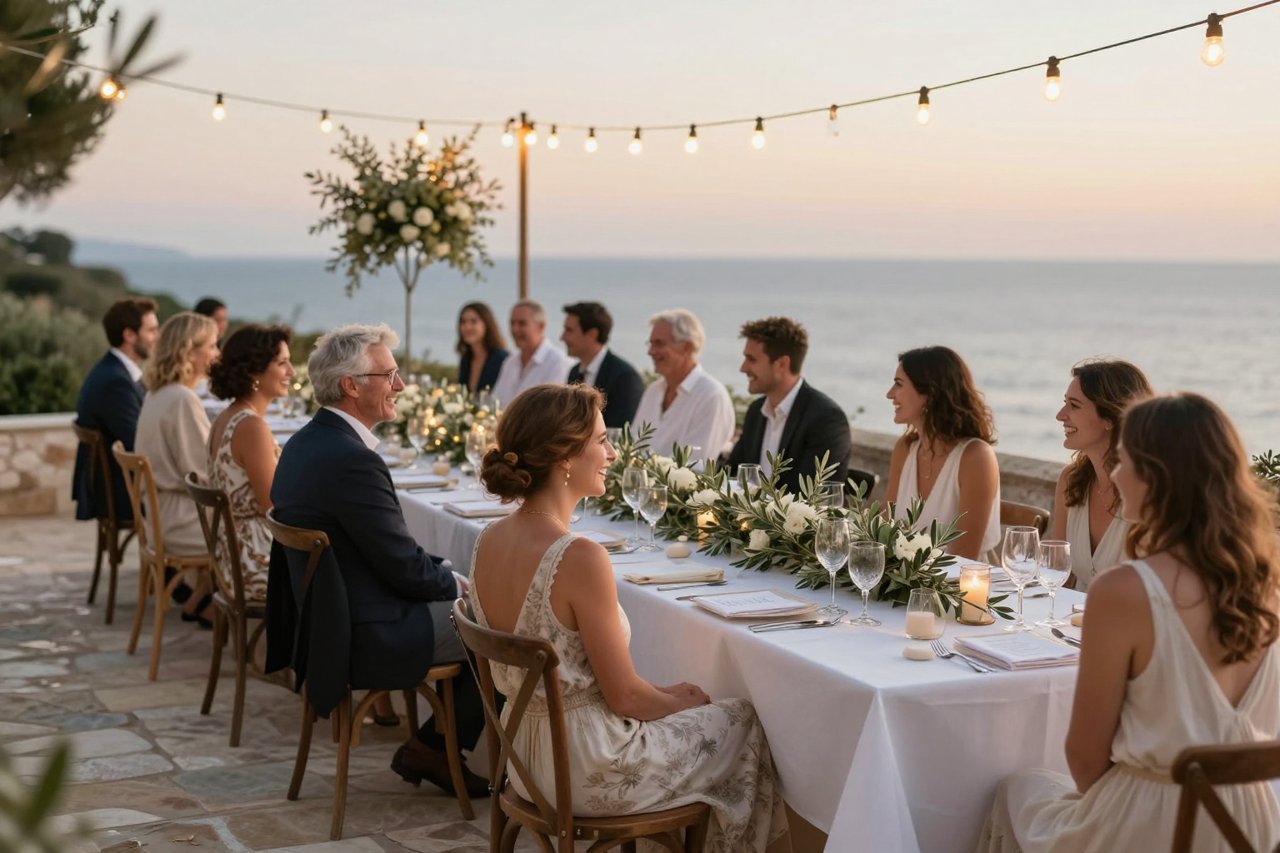
Ask what single photograph you want to exist in ten years. Not twenty. One. Priyanka Chopra and Nick Jonas gave themselves a palace courtyard in Jodhpur at dusk. Kourtney Kardashian and Travis Barker went for a Portofino harbour and a wardrobe by one designer. Different oceans, same idea: a scene, not a party.
Naming that image makes every later decision easier. A clifftop ceremony at 7pm with 60 people is a picture. A hotel ballroom at 4pm with 250 people and a DJ is a filing cabinet of group shots.

Step 2: Cut the guest list before you tour a single venue
This is where most budgets die. In the US, catering, staff and rentals typically land somewhere between $150 and $300 per head once you’ve added linens, the extra bar, and the table nobody planned for. Twenty “we should probably invite them” guests can cost more than your photographer earns in a month.
Celebrity couples get away with tighter lists because they frame them as intimate rather than thrifty, and that framing genuinely works. Richie’s wedding was roughly a third the size of a typical large American reception, and it photographed better for it.
Try two lists:
- List A: people you’ve spoken to in the last twelve months. Full invitation.
- List B: everyone else. Evening-only if your venue allows a split, or nothing at all.
- The parent test: if you’d feel awkward introducing them to your mother, they’re a List B.
Family politics will push back, and Hollywood families are the loudest version of that pressure, the same energy that fuels the rivalries and red-carpet politics of famous celebrity siblings. Hold the line anyway. A shorter list makes every other line item cheaper.
Step 3: Steal the schedule, because the schedule is free
The most useful thing to lift from a famous wedding isn’t the décor. It’s the running order, which costs nothing to copy and solves half the logistical chaos.
- Ceremony: 20 to 25 minutes. Two readings maximum. Nobody has ever wished a ceremony was longer.
- Cocktail hour: 60 to 90 minutes with one signature drink plus wine and beer. This is when guests actually talk to each other.
- Dinner: seated within 20 minutes of the room opening. Long gaps are where weddings feel cheap, regardless of what you spent.
- Speeches: three minutes each, four speakers maximum, hard stop enforced by the DJ.
Celebrity weddings feel effortless because the seams are hidden, not because the budget is invisible. Nobody notices a tight schedule. Everybody notices a two-hour wait for lukewarm chicken.
Step 4: Build a splurge-and-save grid
Photography and flowers are where the “expensive” look comes from. Everything else is filler. Split your budget into two columns and be ruthless about which is which.
Splurge on: your photographer, the florals at the ceremony focal point rather than on the centrepieces, and a live band for two hours instead of four.
Save on: invitations, printed menus, favours, signage, and cake. A dessert table from a local bakery reads as generous. A four-tier cake half the guests skip reads as nothing at all. If you want a realistic sense of how far the money stretches at the top end, it helps to understand the real cost behind those celebrity “yes” moments. The numbers are less magical than the photos suggest.
Step 5: Engineer golden hour instead of hoping for it
Sunset is a fixed, free variable and most couples waste it. Look up the sunset time for your date, then build backwards: first look two hours before, ceremony ninety minutes before, couple’s portraits in the forty minutes after the ceremony while guests are still on cocktails.
Two practical additions. Ask your photographer for the sun’s exact position at your ceremony time. A venue facing west at 6pm in June is a completely different room from the same venue in October. And budget for uplighting inside the reception tent. It’s one of the cheapest upgrades that changes how every evening photo looks.
Step 6: Decide the phone policy on purpose, not by accident
Guest phones ruin more ceremony photos than bad weather does. An unplugged ceremony, 25 minutes with phones away and a small sign at the aisle, is now common enough that nobody will complain. Your photographer will quietly love you for it.
For the reception the opposite applies: give people something to photograph. A designed backdrop, warm lighting and one obvious moment (a sparkler exit, a second-line parade, a late-night espresso cart) will produce more usable guest content than any hashtag. That instinct to curate is worth watching, though. There’s a hidden cost to constant performance in the real price of a perfect Instagram feed. The same pressure shows up at weddings, just with better lighting.
Step 7: Plan for the noise if anyone outside your family is watching
If you have any public profile at all (a business, a following, a surname people recognise), assume the details will leak. Celebrity couples manage this with controlled releases, which is a polite phrase for deciding what gets shared and when. Watch how quickly a half-true version of an event outruns the truth: celebrity rumours spread through a machine that runs on speculation, not facts.
The practical version is simple. Decide in advance whether you’ll post, whether guests can post, and who answers questions. A single point of contact, usually a friend rather than your mother, saves an astonishing amount of grief. If your date has to move around someone’s filming schedule or tour, learn to spot which announcements are genuine and which are staged using these techniques for reading celebrity dating and PR, and you’ll make sharper calls about your own timeline.
Step 8: Negotiate like a business, because you are one
The last lever is the one most couples never pull: timing and terms. A Friday or Sunday in late October in a marquee venue can cost 30 to 40% less than the same room on a Saturday in June, with identical flowers and identical photos. Off-season doesn’t look off-season in pictures.
Ask three vendors the same question. What would you take off the price if we booked off-peak and paid a 50% deposit today? Suppliers would rather fill a quiet date than hold out for full price, and the same commercial instinct behind celebrity business ventures applies at the scale of one wedding: control the terms, don’t just pay the sticker.
Book the photographer and the venue first. Those two are the hardest to replace and the only ones present in every single image. Everything else can be swapped, downgraded or borrowed from a friend’s cupboard. Get those right and you’ll have a wedding that looks like it cost three times what it did, which is more or less the whole trick.


