
Table of Contents
Someone is about to land on their back. That’s the wager you make every time you step onto a grappling mat, whether it’s a judo dojo or a BJJ academy, and it’s the biggest thing the two sports share. Then everything splits apart.
Judo is an Olympic sport built on throws, pins and a strict clock. Brazilian Jiu-Jitsu is a submission game built on positional control and patience. Both grew out of Japanese jujutsu, both wear a gi, and both will humble a strong beginner within a week. Choosing between them isn’t really about which art is superior. It’s about what you want your Tuesday nights to feel like for the next five years.
The Short Answer
If you want to stay on your feet, throw people, and train in a system with Olympic-level structure and cheap club fees, pick judo. If you want to grapple on the floor, chase submissions, and train somewhere you can still be competitive at 45, pick BJJ. If you’re under 30 with intact knees and time on your hands, do both on alternating days. That last option is genuinely the best answer for most people who ask, though almost nobody takes it.
Same Roots, Different Branches
Jigoro Kano founded judo in 1882 at the Kodokan in Tokyo. His insight wasn’t a new technique; it was a training method. Kano stripped out the joint locks and strikes he considered too dangerous for full-speed practice, kept the throws and chokes, and invented a format where two people could resist each other at 100% without ending up in hospital. That idea, randori, is why every grappling sport on earth looks the way it does.

Mitsuyo Maeda, a Kodokan judoka, took that curriculum to Brazil in the 1910s and taught Carlos Gracie. The Gracies, especially Hélio, rebuilt the ground game around leverage rather than size and turned it into its own sport. Judo went to the Olympics in 1964. BJJ went to the UFC in 1993, when Royce Gracie submitted three opponents in one night and made the whole world look down at the floor. The argument about what actually works under pressure is an old one, and it runs through traditional martial arts versus modern martial arts just as much as it runs through grappling.
What a Judo Class Actually Feels Like
Loud. Warm-ups are calisthenics and ukemi, which means you spend your first few weeks learning to fall safely, slap the mat, and get up. That sounds boring until someone uchi-matas you and you realise your head is fine because you drilled breakfalls for twenty minutes.
A typical session is fifteen minutes of warm-up, thirty of technique (seoi-nage, osoto-gari, a turnover from a pin), then randori. Judo randori starts standing. You grip a stiff cotton collar, fight for position, and get thrown repeatedly. A four-minute round of judo is one of the most aerobically brutal things in sport; elite competitors burn through matches at a pace that looks like sprinting. Classes are often large, formal, and cheap because many run out of community centres and federation-funded clubs.
What a BJJ Class Actually Feels Like
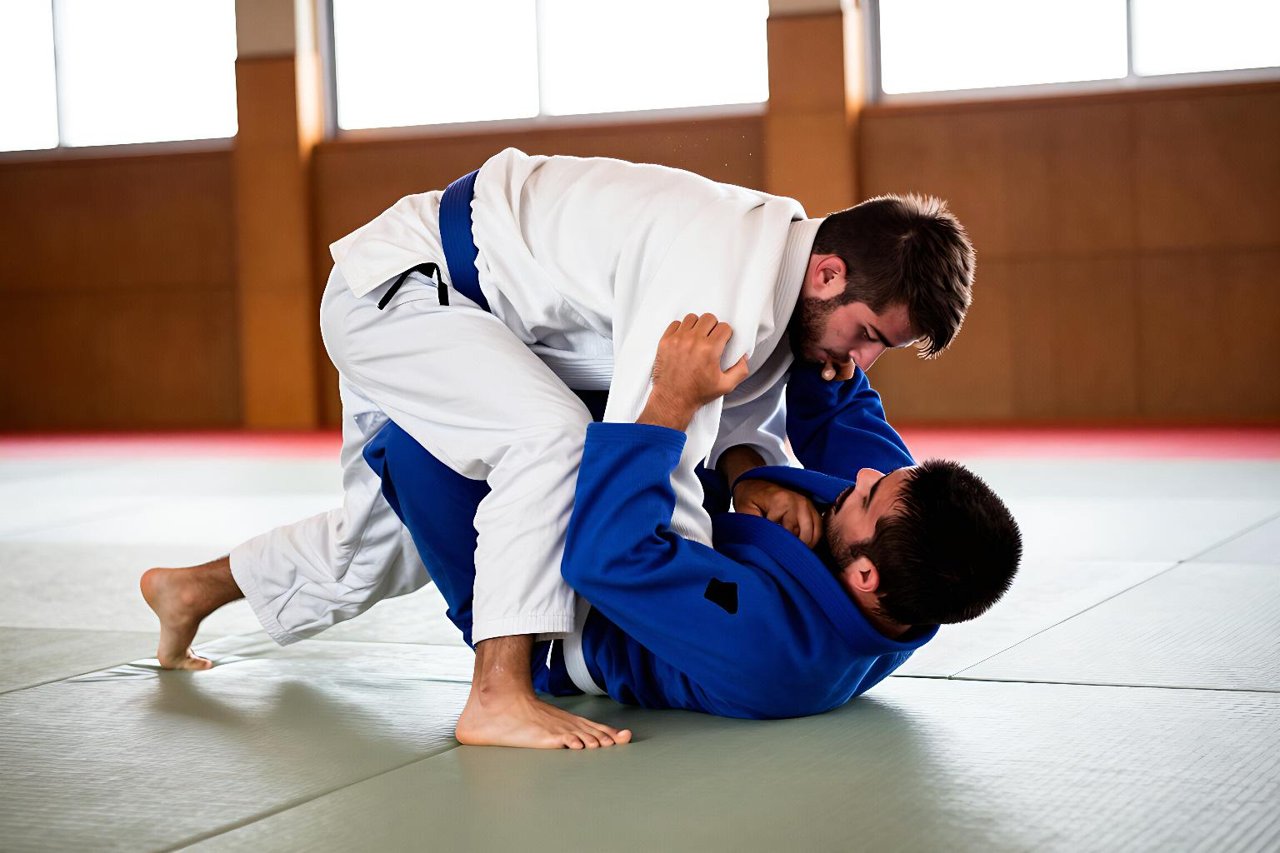
Slower, sweatier, and much more conversational. You’ll warm up, drill a technique or two for thirty minutes with a partner, then roll for four to six rounds of five minutes. Rounds usually start on the knees or with one person sitting guard. Nobody is getting thrown across the room, but you’ll spend a lot of time underneath someone who weighs 220 pounds and is not in a hurry.
The technical depth is the draw. A single position like half guard has enough layers to keep you busy for years, and there’s an entire subculture of instructionals, competition footage and online analysis. BJJ academies tend to be commercial businesses with contracts, branded gis, and a stronger social scene around competitions.
The Rules That Shaped Each Art
Competition rules quietly decide what a martial art becomes. Judo’s rule set rewards the big throw and limits the floor:
- A clean throw onto the back ends the match immediately (ippon). Two half-points (waza-ari) also win.
- A pin held for 20 seconds is ippon. Ten seconds scores waza-ari.
- Groundwork gets a short leash. If nothing develops, the referee stands you up.
- Defensive grip-fighting and passivity draw penalties (shido), and three of them end your match.
- Since 2010, grabbing the legs directly for takedowns has been heavily restricted in IJF competition.
BJJ scoring works the opposite way. Takedowns are worth two points and then get forgotten. Mount, back control and guard passes score, advantages break ties, and the only thing that truly ends a match is a submission or the clock. You can win a BJJ match 2-0 by taking someone down once and holding them in a boring stalemate for eight minutes. In judo, that same match ends with a shido against you.
Where Each Art Punishes You
Judo’s weak spot
Standing posture. If your grips are sloppy, you will get rotated through the air before you understand what happened. Beginners get thrown hundreds of times in their first year, and the learning curve is steep and physical. The flip side is that judo players develop balance and grip strength that transfers to every grappling rule set on earth.
BJJ’s weak spot
Getting taken down. Plenty of BJJ students train for years without ever practising a decent takedown, which becomes obvious the first time they enter a ruleset that starts standing. It’s a real gap, and the fix is usually a judo or wrestling class twice a month.
Injuries, Age and Body Type
Judo is a collision sport. Shoulders, knees and ribs take the hit, and the injury rate is higher than BJJ’s in most published surveys of combat sports. Good breakfalling prevents a lot of it, and a coach who insists on controlled throwing rather than wild randori prevents more.
BJJ is gentler on impact but unforgiving on joints. Knees from guard play, fingers from gi grips, and necks from chokes that got applied a beat too fast. No-gi leg locks add another risk category entirely.
Age matters here. BJJ has deep masters divisions and a large population of people training into their fifties and sixties. Judo has masters competition too, but the sport rewards explosiveness and the pool thins out fast after 35. If you’re starting at 40 with a desk job, BJJ is the easier landing. If you’re 22 and want to be thrown, judo will build a physicality that’s hard to buy anywhere else.
Belts, Timelines and Money
A judo black belt typically takes three to six years at two or three sessions a week. A BJJ black belt takes eight to twelve on average; the IBJJF sets minimum time requirements and most people blow past them. BJJ’s blue belt, usually 18 months to two and a half years, is a notorious plateau where a huge share of students quit.
Costs differ too. A judo gi runs £40-80 and club fees are often £40-70 a month, sometimes less. BJJ gis start around £70 and city academies regularly charge £90-130 monthly. Over five years that gap is a few thousand pounds, which buys a lot of private lessons.
Outside the Dojo: Which One Holds Up?
Both will dismantle an untrained attacker who grabs you. The difference is where the fight ends. Judo gives you a throw, you stay standing, and you leave. BJJ assumes you’re willing to go to the ground, which is a bad plan on pavement with someone’s friends nearby.
That’s the honest trade-off. Judo’s self-defence value is front-loaded and dramatic; BJJ’s is deeper but conditional on the fight going where BJJ wants it. Anyone serious about real-world application usually adds a striking art and some scenario training rather than relying on either grappling style alone.
A Two-Week Way to Actually Decide
Stop reading comparisons and go to a trial class at each. Most clubs offer one free or heavily discounted session, and two weeks of dipping your toes beats six months of forum research. Watch for these things:
- How many black belts teach, and whether beginners get a dedicated coach or get thrown into advanced randori.
- Whether sparring is supervised and matched by size and experience.
- Class times you can actually keep for a year, not just for January.
- Whether anyone over 35 trains regularly and looks healthy doing it.
- How the coach talks about injuries and tapping out.
One practical tip: judge each club by the second class, not the first. The first is adrenaline and novelty. The second is when you notice whether the warm-up wrecked you, whether the upper belts were helpful or just rough, and whether you’re genuinely looking forward to going back. If judo makes you nervous in a good way, that’s usually a sign to keep going. If BJJ’s slow chess match is what your brain keeps chewing on after you leave, that’s your answer. And if both feel right, plenty of people train judo for the standing game and BJJ for the floor, two or three sessions each per week, and end up better than people who picked a side.


