
Table of Contents
There are 41 bottles of magnesium on the shelf at my local health shop. I counted, mostly because I was waiting for someone and had nothing better to do. At least sixteen of them used the word “best” somewhere on the front label. Three used it twice.
The trouble with shopping for the best magnesium supplement is that the category isn’t really one product. It’s a set of trade-offs dressed up as a single purchase. The form that helps you sleep isn’t the form that helps you go to the bathroom. The one that’s cheapest per gram is the one you absorb least. The one with the most exciting brain research costs about £1 a day.
So treat this as a comparison rather than a ranking. Four forms, four formats, and the honest cost of each.
The four forms you’re actually choosing between
Ignore the brand names for a minute. Nearly every bottle on that shelf resolves to one of the following.

Magnesium glycinate: gentle, and priced accordingly
About 14% elemental magnesium by weight, bound to the amino acid glycine. It’s well absorbed, it’s the least likely of the common forms to send you running for the toilet, and a typical capsule delivers 100mg of elemental magnesium. The trade-offs are cost and swallow-ability: a 200mg dose usually means two fairly large capsules, and a month’s supply runs £12 to £20. The sleep reputation is also a bit oversold. Glycine has some modest sleep data of its own, but the combination isn’t a sedative.
Magnesium citrate: the reliable workhorse
Around 16% elemental in the anhydrous form, cheap, well absorbed, and available as capsules, tablets and fizzy powders. For general topping-up it’s the sensible default. The catch is dose-dependent: past roughly 300mg of elemental magnesium, citrate pulls water into the bowel. For plenty of people that’s a feature, not a bug, but it’s not the one to take before a long train journey.
Magnesium oxide: cheap, and you get what you pay for
Oxide is 60% elemental magnesium by weight, so a 400mg tablet looks like it delivers 240mg. On paper it’s the most efficient form per milligram of powder. In practice it’s the least absorbed of the common options, with some studies putting absorption near 4%, and it’s the most laxative. It’s fine when the goal is loosening things up or when a manufacturer needs a magnesium number on a multivitamin label for very little money.
Magnesium L-threonate: the expensive experiment
Only about 8% elemental, which means 2,000mg of the compound to get roughly 144mg of magnesium. The threonate ion has been shown to raise brain magnesium levels in animal studies, and the human trials are small and largely from a single research group. It costs £30 to £45 a month. Interesting if you enjoy following the science; a poor first purchase.
Two others appear often enough to mention. Magnesium malate is about 15% elemental, tastes sharply tart, and gets marketed for energy. Magnesium taurate is roughly 8% elemental and gets marketed for heart rhythm, on thin evidence. Both sit in the mid-price bracket with little to separate them.
Elemental magnesium is the number that breaks most comparisons
Here’s the thing almost no label puts in bold. The milligram figure on the front is usually the weight of the whole compound, not the magnesium you’re actually getting. Same-size capsules can differ sevenfold in what you swallow.
- 400mg magnesium oxide delivers about 240mg elemental magnesium
- 400mg magnesium citrate delivers about 64mg elemental
- 400mg magnesium glycinate delivers about 56mg elemental
- 400mg magnesium L-threonate delivers about 32mg elemental
Compare price per 100mg of elemental magnesium, not price per gram of powder, and half the marketing collapses. Our 5-step magnesium label walkthrough does this arithmetic on three real bottles, including one where the “high strength” claim evaporates on contact with the supplement facts panel.
Capsules, powder, gummies, or a bath
The format matters almost as much as the form, because it decides whether you actually stick with it.
Capsules are the convenience pick. Fixed 100mg steps, easy to travel with, easy to split morning and evening. You pay for the packaging, typically £8 to £18 a month.
Powder is the value pick. Unflavoured citrate powder works out at 5p to 15p per 200mg dose, and you can dial the amount up or down by the quarter teaspoon. Downside: it tastes like salty chalk, and a scoop in hot water is a daily ritual you have to want.
Gummies are the format I’d steer most people away from. Most deliver 50mg to 100mg per gummy, often as oxide or citrate, and they’re sweets. Two a day becomes four, and the cost per milligram ends up three or four times a capsule.
Epsom salts and topical sprays feel lovely and have remarkably little evidence behind them. Magnesium absorption through intact skin is poorly documented, and the relaxation people report is most likely the warm bath and the twenty minutes away from their phone. Not useless, just not a dose.
Single nutrient, multivitamin, or greens powder
If magnesium is your only gap, a single-ingredient bottle wins on dose and on cost. If it’s one of four or five things you’re trying to fix, stacking bottles gets expensive fast, and a decent multivitamin covers the lot for less. The trade-off is dose: the magnesium in most multis is 50mg to 100mg of oxide, which functions as a top-up rather than a therapeutic amount. We compared those routes in detail for men choosing between multivitamins, single nutrients and greens powders, and again for women weighing the same three options. Greens powders sit awkwardly in the middle: real food ingredients, low and inconsistent mineral doses.
Food gets you further than most people expect
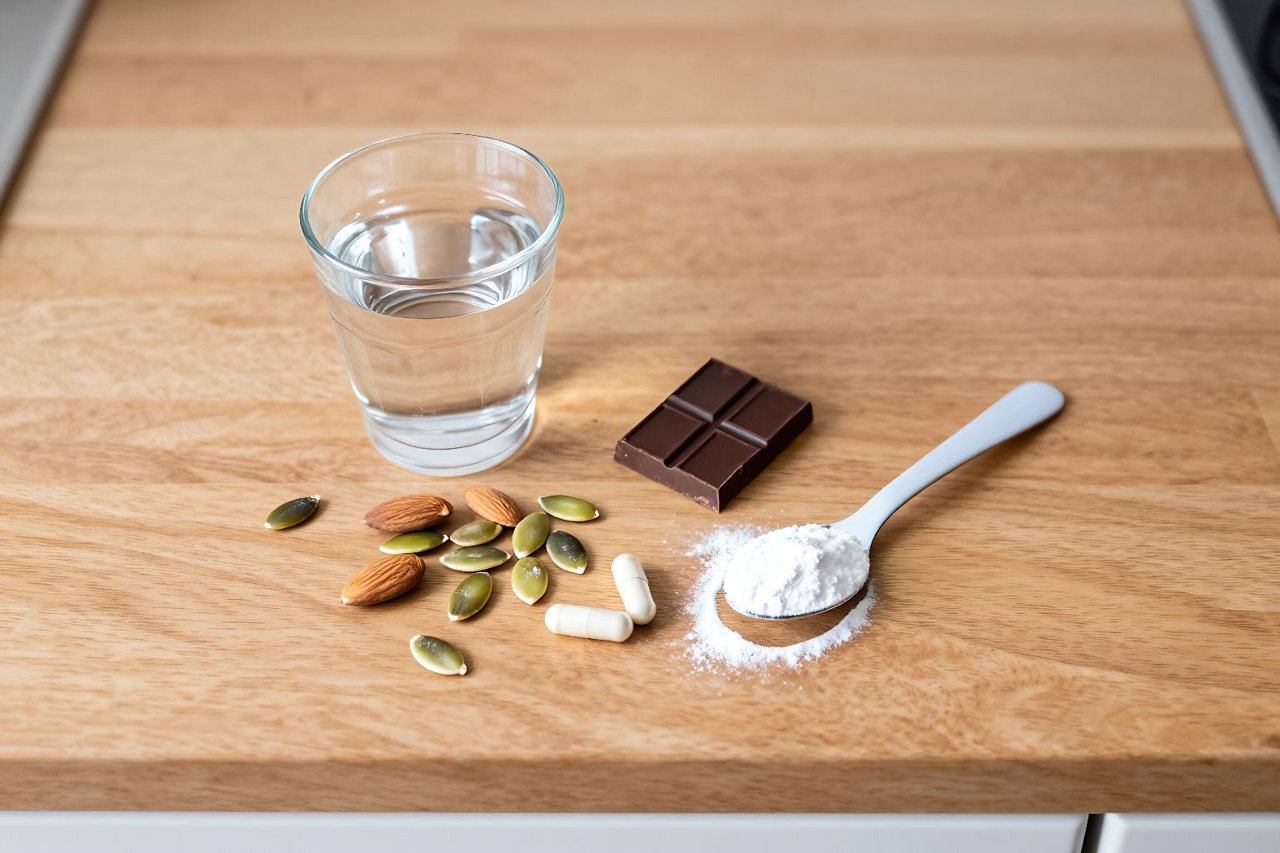
Thirty grams of pumpkin seeds carries about 165mg of magnesium. A cup of cooked spinach, roughly 157mg. Thirty grams of almonds, 80mg. An ounce of 70% dark chocolate, around 64mg. A cup of black beans, about 120mg. Two hundred milligrams a day from food is entirely achievable without touching a bottle.
Absorption from food is imperfect, since phytates in seeds and grains bind some of it, but the food route has no laxative threshold and no price per milligram. Where supplements genuinely pull ahead is in specific goals, and the same weighing-up applies to bone health, where diet, supplements, exercise and medication all compete for the same job.
Matching the form to the job you actually have
Cramping at 3am, wired at bedtime, constipation, or just a suspicion you’re low: those are four different problems and they don’t have one answer. Glycinate at 200mg an hour before bed suits the sleep crowd. Citrate at 200mg to 300mg with dinner suits the general top-up, and the same dose taken on an empty stomach suits the constipation crowd. Threonate only makes sense if you’ve already tried the cheap options and have money to spend on a maybe.
There’s a longer version of this reasoning in how to choose the right magnesium form for you, which goes deeper on symptoms, timing and interactions with medication.
Three purchases that cover nearly everyone
If you want a shortlist rather than a lecture:
Budget, general use: a plain tub of magnesium citrate powder, unflavoured, third-party tested. Around £10 for two months at 200mg a day. Mix it with something that tastes of something else.
Sleep and tolerance: magnesium glycinate capsules, 100mg elemental each, two before bed. More expensive per milligram than citrate and worth it if citrate keeps you up.
One bottle for a household: a well-formulated multivitamin with 100mg of magnesium citrate or glycinate, plus a bag of pumpkin seeds in the cupboard. Not the strongest option on any single measure, and usually the one people actually finish.
Whatever you pick, check the back panel for elemental magnesium, check the price per 100mg of it, and give it four weeks before deciding. Magnesium isn’t a drug that announces itself on day one, and the difference between two decent forms is far smaller than the difference between taking one consistently and owning three bottles you keep forgetting about.


