
Table of Contents
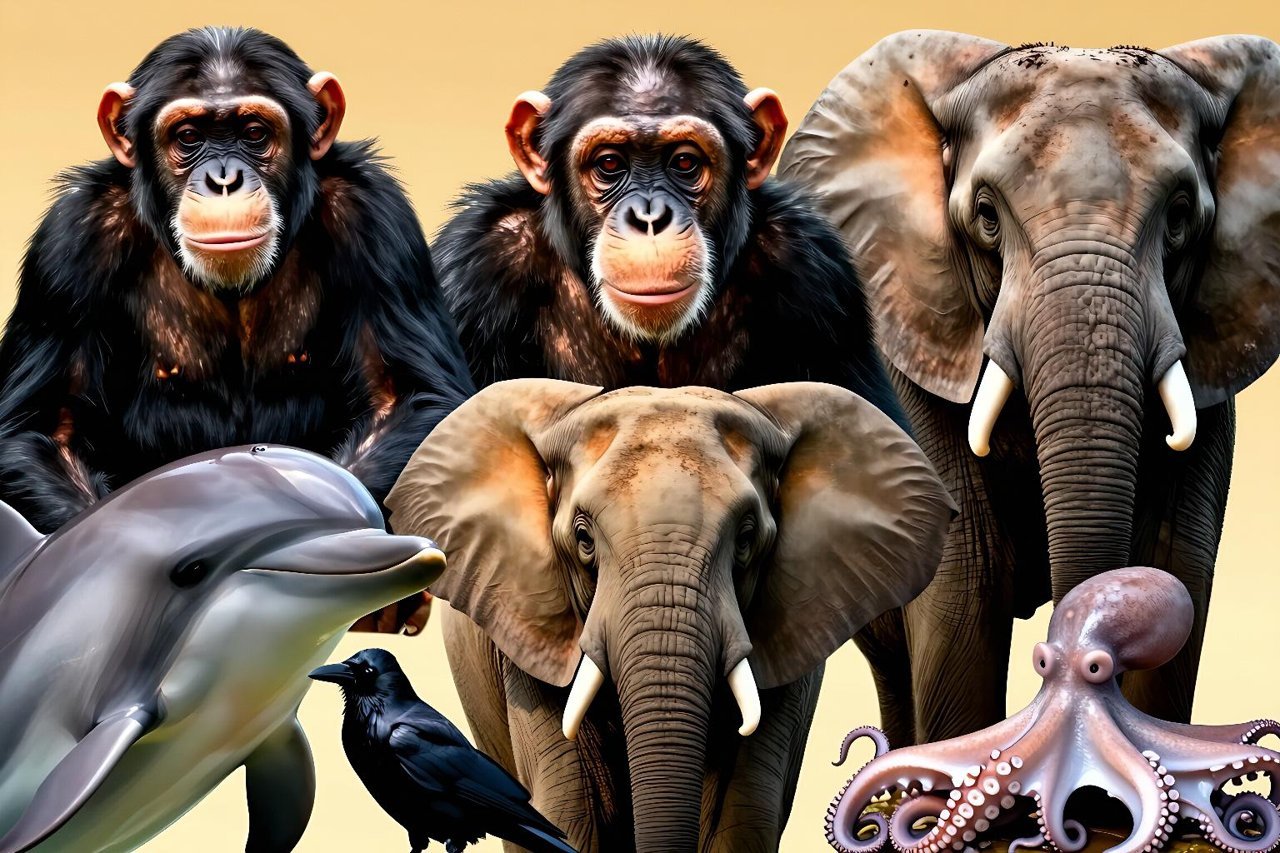
Ask anyone to name the smartest animal on Earth and you’ll get a dozen different answers. Some say dolphins, others swear by chimpanzees. After years of research, scientists have landed on a rough top 7: chimpanzees, bottlenose dolphins, elephants, crows, parrots, octopuses, and dogs. But here’s the catch: intelligence isn’t a single number. These animals shine in completely different areas. A crow that can solve a multi-step puzzle might fail at tasks a dog picks up instantly. So instead of asking who’s the smartest, let’s compare their specific kinds of genius and look at the trade-offs.
The Usual Suspects: Your Top 7 Smartest Animals at a Glance
Before we dig into the comparisons, here’s a quick map of where they stand:
- Chimpanzees – tool use, social strategy, empathy
- Bottlenose dolphins – self-awareness, complex communication, social learning
- Elephants – memory, emotional intelligence, cooperative problem-solving
- Crows – tool construction, causal reasoning, future planning
- Parrots – vocal mimicry, concept formation, puzzle-solving
- Octopuses – camouflage, escape artistry, object manipulation
- Dogs – social cognition, reading human cues, adaptive learning
Now let’s pit them against each other across different types of intelligence.
Social Intelligence: Who Reads Minds Best?
Dolphins vs. Dogs
Dolphins live in intricate fission-fusion societies where alliances shift and break. They learn from each other, use signature whistles to call peers by name, and even teach hunting techniques to their young. That kind of social savvy requires a big brain.

But here’s the trade-off: dolphins don’t have hands. They can’t pick up and manipulate objects the way a dog can with its mouth or a chimp with its paws. So while dolphins ace social memory, they struggle with tasks that require physical dexterity. Dogs, on the other hand, are the undisputed champions of reading human social cues. They understand pointing, gaze direction, and emotional tone better than any other animal, including our closest primate relatives. This trait evolved through thousands of years of living alongside us. For a deeper look at how dog personality and care intersect with intelligence, you can explore the full guide on pet personality and health. The takeaway? Each species’s social intelligence is adapted to its own world.
Tool Use and Problem Solving: The Ingenuity Contest
Crows vs. Chimpanzees
Crows have stunned researchers by making hooks out of straight wires, dropping stones into tubes to raise water, and remembering human faces for years. In laboratory tests, they rival adult apes in understanding cause and effect. One famous study showed crows bending materials to fish food out of a narrow container, something many primates struggle with.
Chimpanzees, meanwhile, are the classic tool users. They fish for termites with stripped twigs, crack nuts with rock hammers, and craft spears for bushbaby hunting. Their hands give them a huge advantage, allowing more delicate manipulation. Yet some researchers argue crows are more flexible problem-solvers because they rely less on trial-and-error and more on spontaneous insight. The cost for crows is a shorter lifespan and a higher mortality rate. For a taste of the kind of stunning behaviors these birds display, check out the astonishing things the top 7 smartest animals can do.
Memory and Emotional Intelligence: The Long Game
Elephants vs. Octopuses
Elephants are famous for their elephantine memory, and it’s not a myth. Matriarchs remember waterholes and migration routes over decades, and they also remember individuals who wronged them years ago. They grieve, show consolation, and cooperate in problem-solving tasks that require patient coordination. All of this comes with a heavy cost: a brain that needs an enormous food supply and a gestation period of almost two years.
Octopuses take a totally different approach. They are brilliant escape artists, can unscrew jars from the inside, and their camouflage is a form of rapid, intelligent mimicry. But octopuses are solitary and short-lived. A mother octopus guards her eggs for months and then dies, so there’s no chance for cultural learning or long-term memory. They solve problems, forget, and are gone. That’s a stark trade-off compared to elephants, who rely on accumulated wisdom passed down through generations.
Communication: Parrots and Dolphins Talk Up a Storm
Two Very Different Languages
Dolphins have a tiered communication system with signature whistles, burst pulses, and synchronized behaviors that some scientists compare to syntax. They can understand novel sentences like “take the ball to the basket” when trained. Parrots, especially African greys, grasp concepts like “same,” “different,” “bigger,” and “none,” and can use human words with an understanding of meaning, not just mimicry.
The pros and cons here are fascinating. Dolphins communicate in the water, where sound travels fast and far, but they lack the vocal cord control to produce complex human-like sounds beyond whistles. Parrots have a dedicated vocal organ that lets them imitate a wide range of sounds, but their performance in object-manipulation puzzles trails behind crows. So both are chatty, but they talk about different things.
The Physical Cost of Being Smart
Brains are expensive. Neural tissue consumes an enormous amount of energy, and the smartest animals pay a price. Large-brained species like elephants and great apes need extended childhoods, with years of parental investment before they’re independent. This limits their population growth and makes them more vulnerable to habitat loss. Crows and parrots also have long childhoods, but their small body size means they need constant feeding, and they face high risks from predators.
Octopuses funnel all their energy into egg production and then die, a strategy called semelparity. Trade-offs like these show that intelligence isn’t a free lunch. It’s a complex balancing act between brainpower and survival. If you want a practical way to measure animal smarts yourself, this step-by-step guide to spotting animal genius is a good starting point.
Why Ranking Them Is a Fool’s Game
Every time we try to make a single list, we’re applying a human yardstick to animals that don’t think like us. A dolphin’s intelligence is built for an aquatic life of social alliances. A crow’s is built for dodging predators and finding hidden food. An elephant’s memory serves an 80-year life full of seasonal changes. Even assessing intelligence in a lab often puts animals in unfair situations. Crows excel at puzzle boxes shaped like branches; dogs excel at reading human body language; octopuses only shine when given actual mysteries to solve, not memorization drills.
This is exactly why the top 7 list changes depending on who you ask. Some researchers prioritize tool use, others social cognition, others adaptability. For a more philosophical take on why animal smarts confound our expectations, read the list of intelligent animals that will force you to rethink animal smarts.
So, Which Animal Deserves the Crown?
If you value social cooperation, dogs or dolphins take the prize. If physical problem-solving is your metric, crows and octopuses are the edge. If memory and emotional depth matter, elephants stand alone. The top 7 smartest animals are not a ladder but a spectrum. Every single one of these animals is a genius in its own ecological niche, and the more we study them, the more we realize that human intelligence is simply one narrow slice of the incredible cognitive diversity on our planet.


