
Table of Contents
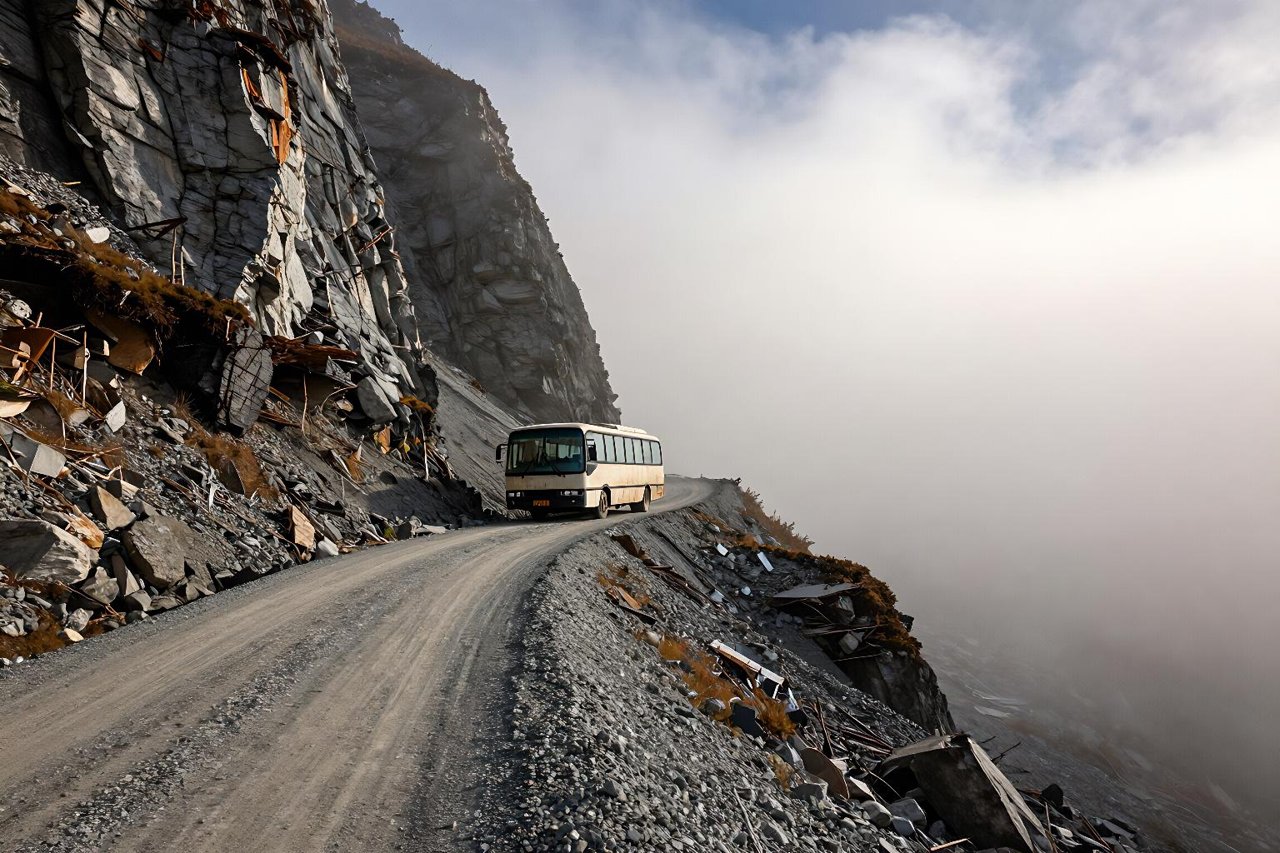
Some roads ask for your attention. A handful demand something closer to obedience. The seven routes below earned their reputations the hard way: through landslides, missing guardrails, fog thick enough to lean on, and thousands of drivers who misjudged a single bend.
None of them are famous because of a statistic. They’re famous because the danger is visible. You can see the drop, the mud, the tide line. That’s part of what makes them so unsettling, and why they sit alongside the planet’s most disorienting landscapes in the way they bend your sense of what’s normal. If you like places where the world stops behaving the way you expect, this list is a good place to start.
1. North Yungas Road, Bolivia
El Camino de la Muerte. The Death Road. Bolivia doesn’t hedge with its nicknames, and it doesn’t need to here.
The road runs roughly 64 kilometres from La Paz down to the jungle town of Coroico, dropping about 3,600 metres along the way. For most of its length it is single-lane gravel, carved directly into a cliff face, with a drop of several hundred metres on the outer edge and no barrier of any kind. In 1995 the Inter-American Development Bank reportedly called it the most dangerous road in the world. A 1983 bus crash sent a vehicle over the edge and killed close to a hundred people.

In 2006 a modern paved bypass took over most of the traffic, and these days the old road belongs mainly to mountain bikers. One detail still confuses visitors: local drivers keep to the left, unusual for a country that drives on the right. The practical explanation is that left-hand-drive vehicles put the driver on the cliff side, where they can watch their wheels and judge the clearance in centimetres.
2. Karakoram Highway, Pakistan and China
Roughly 1,300 kilometres of asphalt and rock linking Pakistan’s Punjab with Kashgar in western China, crossing the Khunjerab Pass at 4,693 metres. It’s the highest paved international road on earth, and it was cut through some of the most geologically violent terrain anywhere: the junction where the Indian and Eurasian plates collide.
The human cost was staggering. Around 810 Pakistani workers and 82 Chinese workers died during construction, and the road took roughly twenty years to finish. The mountain hasn’t stopped moving since. In January 2010 a landslide buried the village of Attabad, killed twenty people, and dammed the Hunza River, creating a 21-kilometre lake that swallowed a long stretch of the highway and forced a permanent reroute.
The route itself is ancient. It traces the corridor traders used for centuries between the Indus Valley and the Taklamakan, the same kind of artery that shaped trade, empire, and migration across Asia long before anyone thought to pave it.
3. Zoji La Pass, India
At 3,528 metres, Zoji La is the gateway between Srinagar and the high desert of Ladakh. It is also a single-lane dirt pass with no crash barriers, hundreds of metres of empty air on one side, and a surface that alternates between dust, slush, and black ice depending on the hour.
Snow closes the pass for months each year, usually from around November to May. When it opens, the traffic mix is extraordinary: army convoys, overloaded trucks, tourist taxis, and motorcycles, all negotiating a road that barely fits one vehicle. When two drivers meet, someone reverses. Often for a long way.
4. Sichuan–Tibet Highway, China
Route G318 covers around 2,000 kilometres between Chengdu and Lhasa, and it crosses a dozen passes above 4,000 metres, two of them over 5,000. Altitude sickness is as much a hazard as the driving.
The engineering problems are relentless. Permafrost thaws and buckles the surface. Rockfall and avalanches take out entire sections each spring, and repairs are done by crews working on cliff edges above river gorges. Landslides routinely close the road for days at a stretch, and drivers who try to squeeze past fresh debris are a recurring reason the fatality figures stay stubbornly high.
5. Dalton Highway, Alaska
Built in 1974 to supply the Trans-Alaska Pipeline, the Dalton runs 414 miles from Livengood to Deadhorse, ending at the Arctic Ocean. Almost all of it is gravel. Fuel and food exist at roughly two points. Cell signal is a rumour.
The danger here is less about cliff edges and more about scale and isolation. In winter, temperatures drop past −40°C, blowing snow erases the road entirely, and a breakdown can turn into a survival situation within an hour. In summer the gravel kicks up off passing trucks and shatters windshields, and the potholes are deep enough to bend a wheel rim. Heavy haulers own the road, and they do not slow down for rental cars.
6. Kolyma Highway, Russia
Known as the Road of Bones, the Kolyma Highway runs roughly 2,000 kilometres from Yakutsk to Magadan across the Russian Far East. It was built from the 1930s onward largely by gulag prisoners, and the death toll among them ran into the tens of thousands. Local legend, repeated for decades, holds that some of the dead were laid in the roadbed itself.
Much of the route is unpaved. In summer, sections turn into mud deep enough to swallow a truck axle. In winter it freezes hard and becomes drivable, though at temperatures that make engine failure lethal. Towns along the way, like Kadykchan, sit abandoned. There is no fuel for hundreds of kilometres in places, and rescue, if it comes, comes slowly.
7. Passage du Gois, France
A 4.1-kilometre stone causeway linking the mainland to the island of Noirmoutier, submerged twice a day by the incoming Atlantic tide. The water doesn’t creep in. It arrives, and the road disappears under several metres of sea.
Signs at each end display the safe crossing windows, and raised rescue towers stand along the route for people who get it wrong. Every year some do. Cars stall in the seaweed-slick surface, the tide catches them, and the vehicles float before they sink. Even the professionals get caught out: the 1999 Tour de France peloton crossed the Gois and crashed heavily on the wet stone, and the race returned in 2011 with similar results.
What Actually Makes a Road Deadly
Strip away the scenery and the seven routes above share a fairly narrow set of failure modes. The physics of risk works much the same way it does in the world’s most dangerous sports: the danger isn’t the activity itself, it’s what happens when a small error compounds with no margin left to absorb it.
No room for a mistake
Guardrails, wide shoulders, and gentle verges absorb errors. Remove them and a two-second lapse in concentration becomes permanent.
Mixed traffic and mismatched speeds
A 40-tonne truck, a 125cc motorcycle, and a tour bus sharing one lane of gravel produces conflict that no amount of skill resolves.
Weather that changes the surface
- Ice and black frost on high passes, often in shadowed sections that never see sun
- Mud and washouts during monsoon or permafrost melt
- Fog and blowing snow that erase the road edge entirely
- Tidal flooding on coastal causeways, arriving faster than people expect
Distance from help
A crash on a suburban street is a nuisance. A crash 200 kilometres from the nearest clinic, with no phone signal and night falling, is a different category of event.
Before You Drive One of These Yourself
A few practical points worth knowing, whether you’re hiring a driver or taking the wheel.
Check your rental agreement properly. Most standard policies void coverage the moment you leave sealed tarmac, which is exactly where half of these roads live. Ask in writing.
Hire locally when the terrain is serious. Drivers on the Yungas, Zoji La, and the Kolyma know where the surface gives way and which hours the landslides come down. That knowledge isn’t in any guidebook.
Travel in daylight and in convoy. Breakdowns are the real killer on remote routes, not reckless speed. Carry more water, fuel, and warm layers than the distance suggests you’ll need.
Respect the tide tables and the closure gates. The Passage du Gois, Zoji La, and the high Tibetan passes all have hard rules written in other people’s mistakes.
And keep one thing in mind. Fear makes drivers grip the wheel and stare at the drop. Respect makes them look where they’re going. The people who drive these roads for a living every week are rarely the ones who end up in the statistics.


