
Table of Contents
The top 7 smartest animals list on almost every website looks the same: chimpanzees, dolphins, elephants, crows, parrots, octopuses, and maybe dogs or pigs. Yet the way people rank them is full of mistakes. Most of these mistakes come from expecting animals to think the way we do.
That’s understandable from a human perspective, but it’s a trap. Consider a classic IQ test. If you gave a raven a written multiple-choice test, it would fail not because it is stupid but because it has no reason to care. Conversely, a raven can solve Aesop’s fable task by dropping stones into a tube to raise the water level and reach floating food. Few humans would figure that out as quickly. When you compare the top 7 smartest animals side by side, every species looks brilliant at something and clueless at something else. So the key is to stop asking who’s the smartest and start asking what each animal is smart at.
Mistake #1: Using Human Tests on Non-Human Animals
People often measure animal intelligence by testing them with human-designed problems. The mirror self-recognition test, for example, is used on elephants, dolphins, magpies, and great apes. But a dog that fails the test might simply not rely on vision the way we do. A bloodhound relies on scent and has around 300 million olfactory receptors, while a human has about 5 million. Could a human pass a scent mirror test? No.
The better approach is to know the animal’s natural history first. A dog is a social carnivore; an octopus is a solitary mollusk. They do not share the same problems, so they shouldn’t share the same tests. Most comparative intelligence studies now emphasize ecological validity, meaning tasks that matter to the animal in its own environment. If you want to spot animal genius in your own observations, this step-by-step guide to spotting animal genius can help you structure what you watch for.

Mistake #2: Believing Brain Size Is the Whole Story
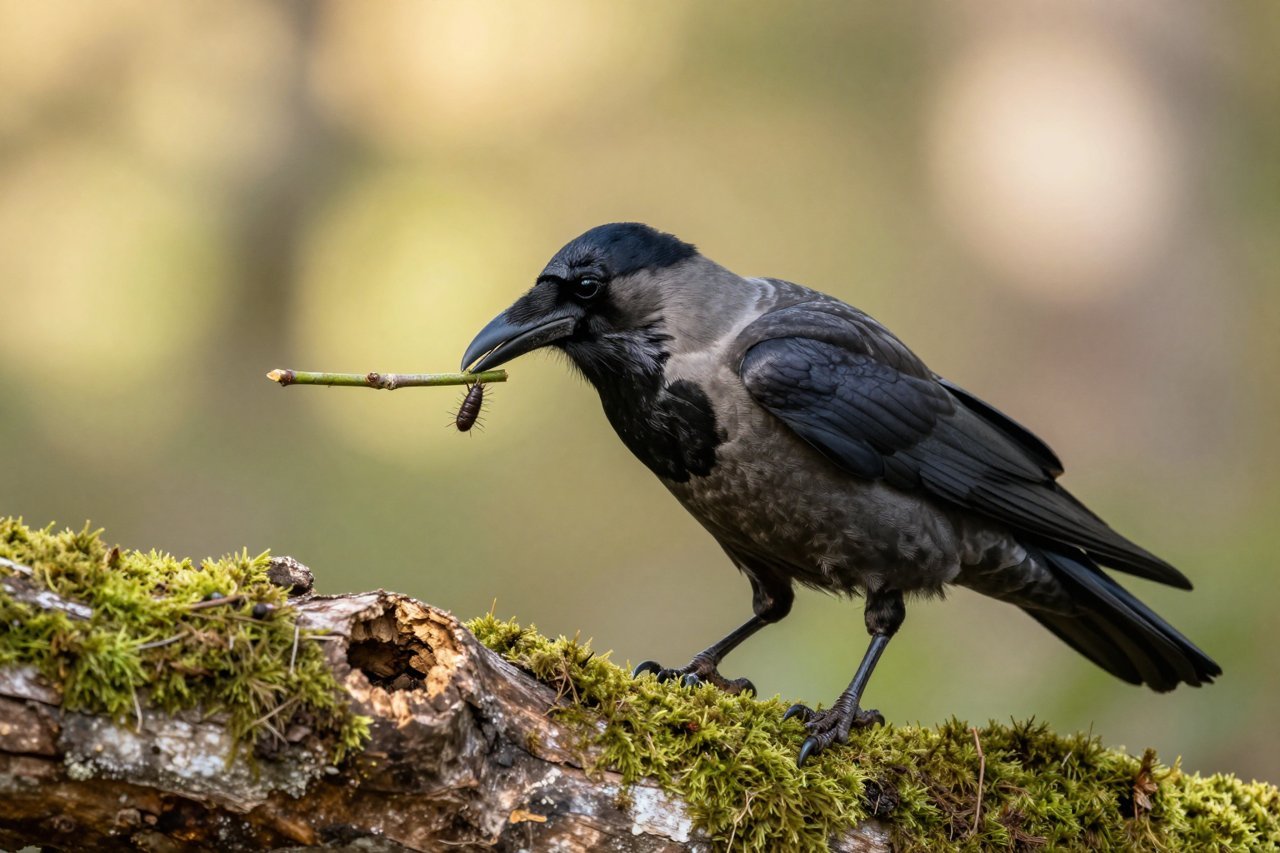
For decades, people thought big brain equaled big intelligence. A sperm whale’s brain weighs about 9 kilograms, more than five times a human brain. But most of that neural tissue controls its massive body and sonar system. On the other hand, a crow’s brain is the size of a walnut, yet it packs neurons almost as densely as a primate’s.
The myth persists because we take familiar animals and assume bigger means smarter. It also leads us to ignore species that break the pattern. Pigeons, for example, can recognize faces, categorize abstract images, and even identify cancer cells on medical scans. The most intelligent animals in the world look different once you drop the big-brain bias.
Mistake #3: Confusing Learned Tricks with Problem-Solving
It’s easy to assume the dog at the park who rolls over is smart. That is training, not necessarily intelligence. The line blurs when you watch a border collie learn dozens of commands: that shows strong associative learning. But when a New Caledonian crow fashions a hook from a twig to pull a grub from a hole, it is solving a brand-new problem without prior training.
This is a common trap when people rank the top 7 smartest animals. A macaw that raises its foot on cue resembles a trained actor, while an octopus that opens a childproof medicine bottle is doing something far more telling. To get a better picture, read about the astonishing things the top 7 smartest animals can do in the wild and in laboratories.
One clue to look for is transference. An animal that learns a rule in one context and then applies it to a different novel situation is showing flexible intelligence. A trained dog sits when it hears the word sit, but a genuinely clever animal generalizes a rule beyond the exact cue.
Mistake #4: Ignoring Animals That Are Nothing Like Us
Take the octopus. It has eight prehensile arms with a mini-brain in each, it can camouflage in milliseconds, and it remembers individual humans. Yet the octopus appears on fewer smart-animal lists than almost any mammal because it resembles an alien more than a pet.
We also overlook animals with entirely different sensory channels. A pigeon can navigate thousands of miles using magnetic fields. A honeybee can learn to count, distinguish shapes, and communicate through a dance that conveys direction and distance. If you measure intelligence by flexibility and innovation, bees outperform many animals that are thousands of times larger.
This bias shapes how we treat animals in captivity. When we only recognize intelligence in mammals with forward-facing eyes, we end up directing our empathy and conservation resources toward animals that can look back at us.
Mistake #5: Relying on Anecdotes, Viral Videos, and Outlier Stories
We have all seen an online clip of a genius dog opening a fridge and bringing its owner a beer. It is endearing, but not proof of advanced intelligence. Anecdotes are unverified by nature, and they get cherry-picked for clicks. Missing from the video are the hundred times the dog failed before it finally hooked the handle.
Even scientists can fall for this. In the early 1900s, a horse named Clever Hans made headlines for doing arithmetic. It turned out Hans was responding to subtle, unconscious body language from his trainer rather than to the math. So before you crown any animal, look for peer-reviewed studies and repeated results. If a viral video shows a crow solving a puzzle, check whether an independent lab has documented the same behavior.
Weighing evidence over anecdotes matters even when you rank the top 7 smartest animals, because every famous example carries both a clean study and a few overblown stories.
Mistake #6: Treating Intelligence as a Single, Overarching Trait
Ask which animal is smarter, an elephant or a parrot, and you’ll find the answer depends on the domain. Elephants have extraordinary long-term memory for waterholes and individual faces. Parrots are among the planet’s finest vocal learners. Crows and chimpanzees reign in tool use.
A single intelligence scale does not map to animal minds. Instead, think of intelligence as a bundle of skills: memory, abstraction, social reasoning, spatial problem-solving, and communication. No species can win in all categories. That is why the top 7 smartest animals list changes depending on which ability you measure.
This breakdown can be useful. For a closer look at who wins in each type of test, see this head-to-head comparison of the top 7 smartest animals by brainpower type.
How to Avoid These Mistakes and Form a Clearer Picture
Next time you come across a claim about an animal being smart, run it through this checklist:
- Was the behavior tested in a controlled experiment and repeated by other researchers?
- Was the task relevant to the animal’s natural habitat, or was it designed for human comfort?
- Did the animal solve a genuinely novel problem, or did it simply follow a trained routine?
- Was the ability observed in multiple individuals, or is it just one outlier?
These filters will remove most of the noise from animal intelligence claims. The top 7 smartest animals remain fascinating once you separate fact from edited footage.
One practical warning: brilliant animals make demanding pets. If you are drawn to the idea of living with a highly intelligent creature, remember that parrots, crows, ravens, and many others require constant mental enrichment and enormous enclosures. A bored smart animal can become anxious or destructive. For a realistic view of species that are legal to keep, compare the top 7 exotic pets allowed in the US in terms of cost, care, and legal trade-offs before you make a decision.
Ultimately, the biggest mistake of all is treating intelligence as a ladder with humans fixed on top. Remove that assumption, and the world unfolds into an array of minds solving problems in ways we are only starting to understand.


