
Table of Contents
The deep sea is the largest habitat on Earth, covering over 60% of the planet’s surface. Yet we know more about the surface of Mars than about the ocean floor. Every year, explorers and scientists venture into the abyss, only to return with tales of bizarre and alien-like deep sea creatures. These animals have evolved unique adaptations to survive in a world of total darkness, crushing pressure, and scarce food. From bioluminescent lures to transparent bodies, the inhabitants of the deep are among the most extraordinary life forms on our planet.
What Makes Deep Sea Creatures So Unique?
Life in the deep ocean is not easy. Below 200 meters, sunlight fades completely. Temperatures hover just above freezing. The pressure can reach over 1,000 times that at sea level. To thrive here, deep sea creatures have developed remarkable traits.
Bioluminescence: Living Light Shows
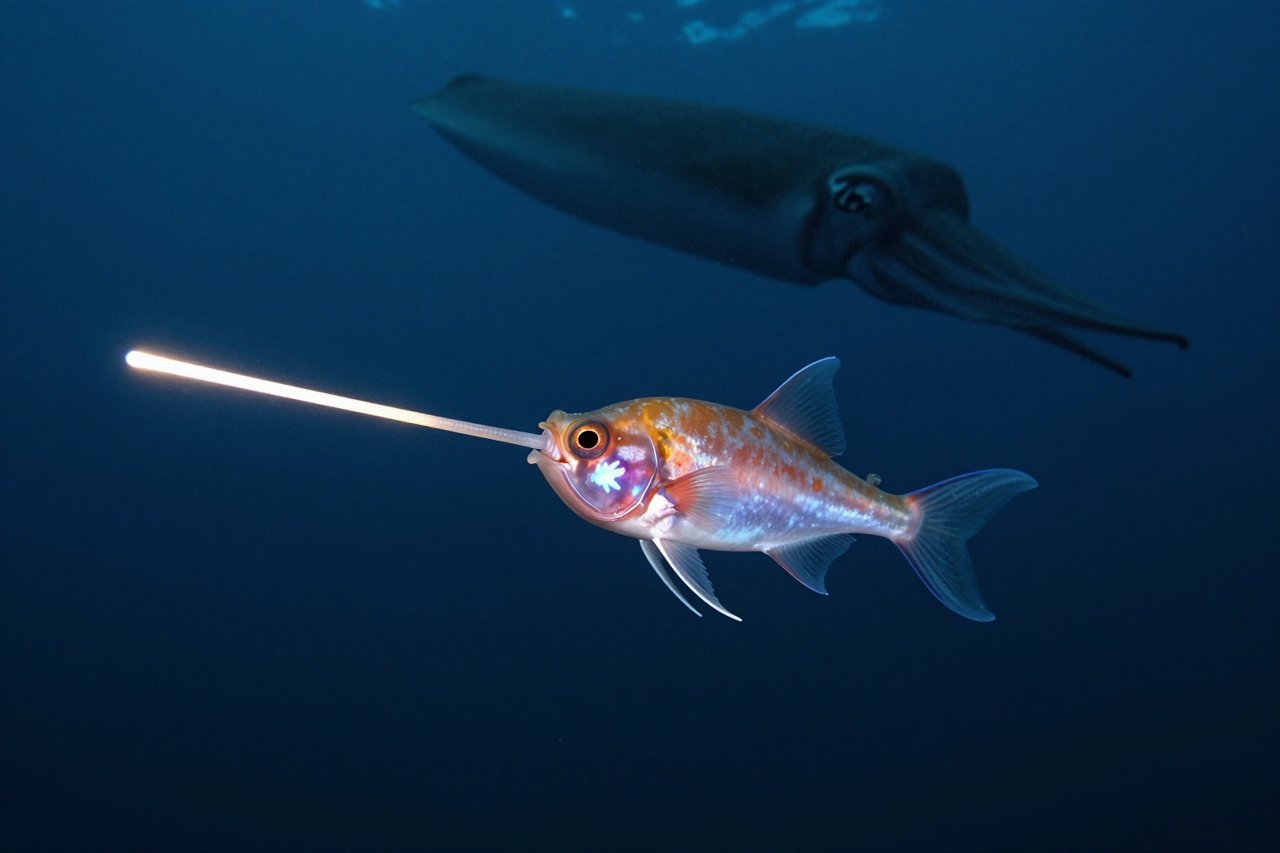
Many deep sea animals produce their own light through a chemical reaction called bioluminescence. They use it to attract mates, lure prey, or confuse predators. The anglerfish is a classic example, dangling a glowing lure from its forehead. But bioluminescence is so common that an estimated 90% of deep sea creatures can generate light.
Adaptations to Pressure and Cold
Deep sea fish often have soft, flabby bodies without swim bladders. They lack the rigid skeletons of shallow-water fish because high pressure would crush them. Many have large, sensitive eyes to capture any faint light, while others are completely blind and rely on smell or touch.

Meet the Most Bizarre Deep Sea Creatures
Some of these animals look like they come from another planet. Others are so strange that they challenge our definition of what a fish or a squid should be.
The Anglerfish: Icon of the Abyss
Made famous by Disney’s Finding Nemo, the anglerfish is a true deep-sea predator. Females have a bioluminescent lure on their heads that they wiggle to attract prey. Once a fish gets close, the anglerfish snaps it up with its large mouth and sharp teeth. Males are much smaller and parasitic; they fuse to females for life, losing their eyes and internal organs in exchange for sperm.
The Giant Squid: Legend Meets Reality
For centuries, the giant squid was a mythical creature, the stuff of sailor legends. It wasn’t until 2004 that scientists captured the first live images in its natural habitat. This elusive deep sea creature can grow up to 43 feet long, with eyes the size of dinner plates. Its only known predator is the sperm whale, which bears scars from their epic battles.
The Goblin Shark: A Living Fossil
With its long, flattened snout and protrusible jaws, the goblin shark looks like something from a horror movie. This rare shark lives near the sea floor at depths of up to 1,200 meters. It can extend its jaws forward to grab prey, much like a slingshot. Goblin sharks are often called living fossils because they belong to a lineage that dates back 125 million years.
The Dumbo Octopus: Adorable and Deep
Named after Disney’s flying elephant, the dumbo octopus has ear-like fins that flap as it swims. It lives at depths of 3,000 to 7,000 meters, making it one of the deepest-living octopuses known. Unlike many deep sea animals, it doesn’t have a bioluminescent lure; instead, it floats gently above the sea floor, hunting small crustaceans.
Recent Discoveries: New Species Found in the Deep
Scientists continue to find new species in the deep ocean. In 2025 alone, several remarkable discoveries were made. For instance, a new species of bioluminescent jellyfish was found in the Mariana Trench, and a strange, transparent fish with a visible brain was filmed off the coast of Japan. You can read more about these in our article on new species discovered in 2025, which includes both deep-sea oddities and tiny frogs.
Not all deep sea creatures are photogenic. Some are downright ugly—at least to human eyes. The blobfish, for example, looks like a sad, gelatinous blob when brought to the surface, but in its deep-sea home, it resembles a normal fish. Check out our list of the 8 ugliest creatures ever existed for more bizarre appearances.
How Deep Sea Creatures Survive Without Sunlight
Without plants, which need sunlight for photosynthesis, the deep sea relies on a constant rain of organic matter from above. This “marine snow”—dead algae, fecal pellets, and other debris—feeds animals on the sea floor. Some deep sea creatures have evolved to become predators, others scavengers, and a few even host symbiotic bacteria that produce food from chemicals (chemosynthesis).
Hydrothermal Vents: Oases in the Dark
In the 1970s, scientists discovered hydrothermal vents on the ocean floor. These cracks in the Earth’s crust spew superheated, mineral-rich water. Around these vents, entire ecosystems thrive without sunlight. Giant tube worms, blind shrimp, and unique clams depend on chemosynthetic bacteria that convert hydrogen sulfide into energy. These communities are among the most extreme on Earth.
Mysterious Creatures Caught on Camera
Deep-sea exploration has captured many strange creatures on video. Some are so bizarre that they seem unreal. For example, the barreleye fish has a transparent head and barrel-shaped eyes that can rotate to look upward through its skull. The frilled shark, with its eel-like body and 300 trident-shaped teeth, looks like a prehistoric serpent. If you enjoy mysterious sightings, check out the 7 biggest and mysterious creatures caught on camera and the 7 biggest and most mysterious creatures ever caught on tape.
The Deep Sea and Human Evolution
The deep ocean has been a constant presence throughout human evolution. Our ancestors likely relied on coastal resources, but the deep sea remained inaccessible. Only in the last 150 years have we begun to explore it. The technologies developed for deep-sea exploration—submersibles, sonar, and ROVs—have parallels in space exploration. Understanding the deep sea also gives us insights into the origins of life on Earth, as some scientists believe life may have begun near hydrothermal vents.
For a broader perspective on our own journey, see our article on human evolution: the epic story of our origins.
Threats to Deep Sea Creatures
Despite their remote habitat, deep sea creatures are not safe from human activities. Deep-sea trawling destroys fragile habitats like cold-water coral reefs. Mining for polymetallic nodules on the sea floor could harm unique ecosystems. Plastic pollution has even been found in the Mariana Trench, the deepest part of the ocean. Climate change is also altering ocean currents and oxygen levels, affecting life in the deep.
Many deep sea species grow slowly and reproduce late, making them vulnerable to overfishing. For example, the orange roughy, a deep-sea fish, can live up to 150 years but doesn’t reproduce until age 20. Populations take decades to recover from fishing pressure.
How to Explore the Deep Sea Yourself
You don’t need to be a scientist to appreciate deep sea creatures. Many aquariums have exhibits featuring deep-sea animals, such as the Monterey Bay Aquarium’s “The Deep” display. Documentaries like Blue Planet II offer stunning footage. You can also follow research institutions like the Schmidt Ocean Institute or the Woods Hole Oceanographic Institution, which livestream expeditions and share discoveries.
For a taste of prehistoric marine life, check out 7 mind-blowing dinosaur discoveries that changed what we know, which also covers ancient sea reptiles.
Final Frontier: What’s Next for Deep Sea Exploration?
The deep sea remains largely unexplored. Only about 20% of the ocean floor has been mapped at high resolution. New technologies, such as autonomous underwater vehicles and improved deep-sea cameras, are opening up the abyss. As we continue to explore, we will undoubtedly discover more strange and wonderful deep sea creatures. The next giant squid, or something even stranger, is waiting in the dark.


