
Table of Contents
Cross a shield wall and you’ll find a trading network that stretched from the ice fields of Greenland to the marble palaces of Constantinople. Ask about Viking history and many people picture only one thing: lean, bearded warriors leaping off a drakkar to burn a monastery. That picture isn’t entirely false. It just leaves out the parts that actually explain how a cluster of Scandinavian farmers became the architects of modern Russia, the first Europeans in North America, and shorthand for both explosive violence and nautical brilliance.
The Viking Age didn’t simply emerge out of nowhere. It grew from the natural spread of Scandinavian maritime culture. By the time the eighth century ended, the North Sea was already a busy highway. Then the attack on the monastery at Lindisfarne in 793 turned a local skirmish into a continental shockwave. That date has become the conventional opening of Viking history. In the next three centuries, the Norse pushed their boats into rivers, ports, and territories that still carry their fingerprints.
The Viking Age Was Not a Monolith
From 793 to around 1066, the Vikings were many things at once. They were pirates and looters. They were slavers who traded human beings across three continents. But they were also tax collectors, poets, settler-farmers and experienced merchants. A Norseman in the 10th century might raid on the coast of Ireland in summer, then travel to Byzantium in the winter and serve as a member of the Varangian Guard. The same man could leave a runestone carved in the old tongue in his mother’s honour.
The whole period overlapped with the wider medieval world. The political and social changes that eventually shaped Europe as we know it were happening right alongside Viking expansion. For a much wider lens on that entire era, this piece on medieval history beyond castles and plagues covers some of the forces that defined the middle ages. The Viking chapter cannot be neatly separated from those forces.

Raiders of the North, Traders of Everywhere
The Norse really did raid. They burned, they stole, and they tortured. The Anglo-Saxon Chronicle drips with fear of them. Yet the same people who attacked the coasts of England also founded Dublin as a Scandinavian trading hub. They occupied the Orkneys, settled Iceland, and established the Greenland colony around 985. The L’Anse aux Meadows archaeological site in Newfoundland shows that around 1000 AD they crossed the Atlantic, setting up a timber camp half a world away from Lund.
The full picture is more complicated than attackers. That trade brought silver from Baghdad to Sweden. Thousands of Arab dirhams have been found in Viking hoards on Gotland. Along the Volga River, the Norse known as the Rus developed a river route that eventually connected the Baltic to the Caspian. That same network would be funneled into the Rurikid dynasty and, eventually, the Russian state.
They didn’t only move goods. They moved people and ideas. Slavery was integral to the system; captured Slavs and Irish could be sold in markets from Novgorod to Al-Andalus. This was the criminal side of Viking history, and it is as important as the navigation.
The Longship: The Engine That Made It All Possible
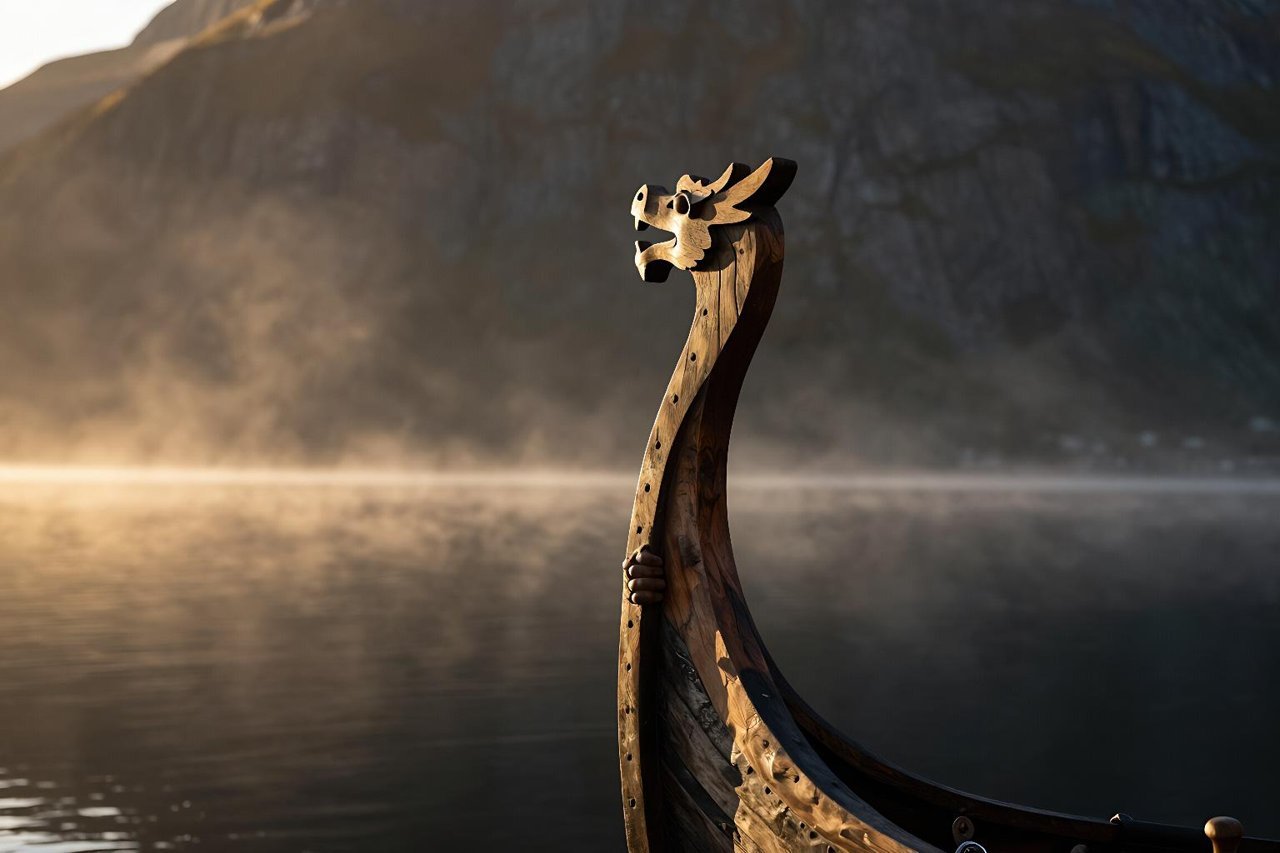
A Viking longship was not just a boat. It was a weapon system designed for the coastal and river terrain of ninth-century Europe. The hull was clinker-built, overlapped planks nailed together with iron rivets, and sealed with tarred wool or animal hair. The classic square sail gave speed with the wind, and the crew could switch to oars when the wind failed or when the beach was shallow.
One of the largest known longships, Roskilde 6, measured close to 37 metres, probably carrying a hundred men. That is tiny compared to the massive ocean going hulls that trade on the same seas today. Some of the largest oil tankers around the world stretch over 400 metres long. Yet that scale difference matters little. The Viking design was so well balanced that it could be lifted, dragged across mudflats, and relaunched on a new river a few kilometres away. No other ship of the time could do that. This combination of open-ocean capability and portability is what allowed Viking expeditions to slip past fortified estuaries and strike deep inland.
There wasn’t just one kind of ship, either. The longship was built for war, with shallow draught and speed. The knarr, in contrast, was a fatter, heavier cargo vessel used for sailing to Iceland and Greenland with livestock and timber. Both supported an economy that could not have existed without reliable long-distance transport.
Town, Farm, and Assembly: Inside a Viking Settlement
Recent excavations have shifted the focus from boat burials to ordinary settlements. A Viking farm in the rural areas of Jutland gives a very different picture. People lived in longhouses that combined living quarters and animal stalls under one roof. The hearth was the centre of life. Look closely at a typical Norse farm and you’d see:
- Timber or turf walls with a central fire pit that was kept going all winter.
- Rye and barley grown for bread, ale, and animal feed.
- Cattle, sheep, pigs and horses sharing shelter with the family.
- A thrall class who did the heaviest work, and who could earn their freedom over time.
- Free women who could own property, divorce their husbands, and run farms while men were away.
The political unit was the Thing, a local assembly where free men gathered to settle disputes, pass laws and choose leaders. This was not a chaotic mob. It was a sophisticated legal system that developed independently of Roman law. Iceland’s Althing, founded around 930, is still one of the oldest parliaments in the world.
Archaeology Is Rewriting the Story as We Speak
The written sources about Vikings are notoriously biased. Christian monks wrote many of them down, and they were not exactly fans. The archaeological record has become the real witness. The ship burial at Oseberg, dug up in 1904, gave us delicate carved furniture and a cart, revealing an artistic side that the chroniclers never mentioned. The Gjellestad ship, only discovered by radar in 2018 and excavated in 2020, showed that a high-status grave existed even in an area where no one expected it.
These discoveries feed into a much broader transformation of how we understand the past. The most fascinating archaeological discoveries that rewrote history include multiple Viking finds, but also breakthroughs in geology and climate science that have changed our reading of entire centuries of human activity. The same techniques that date volcanic ash now help pinpoint exactly when Norse people cut down trees in Greenland.
Viking History Has a Strange Modern Legacy
The most visible inheritance is the name itself. The Norse had their own word for journeys, “víking”. Centuries later, the same word was adopted for NASA’s pair of robotic landers that reached Mars in 1976. They were named Viking because they truly explored an unknown world, just as their human namesakes did. The full story of those probes, from launch to their final transmissions, is part of the longer saga of Mars missions past, present, and future. Those landers also carried the first direct test for life on another planet; the ambiguous results still fuel the broader question of whether we’re alone in the universe.
From the settlements on Greenland to the red plains of Mars, the thread is the same: a stubborn determination to see what lies beyond the horizon. That question, once left to Norse gods and Viking sagas, now occupies planetary scientists. The latest chapter in that hunt is the search for alien life and what we’ve found so far, a story with as many twists as any saga.
Modern English still carries the Norse fingerprints. Words like “sky”, “they”, “window”, “egg”, “knife”, and even “Wednesday” (Odin’s day) come directly from Old Norse. Many of these words entered the language during the Danelaw period, when Scandinavian settlers lived side by side with the Anglo-Saxons in northern England. That blending, more than any raid, is what ultimately changed the culture of an island.
The Norse didn’t vanish overnight either. They assimilated into the expanding kingdoms, adopted Christianity, and traded their runes for Roman letters. But they did not disappear without a trace. The genetic evidence shows that a good chunk of Britain, Ireland and Iceland carries Scandinavian ancestry. In a way, the Vikings never really went away. They simply became the people they had once raided, reshaped them from within, and left a saga written in the very code of the modern world.


