
Table of Contents
On 11 May 330, Constantine the Great consecrated a new capital on the site of an old Greek port called Byzantium. He named it after himself, and the city became Constantinople. What he probably didn’t plan for was that the state run from those seven hills would outlast his own dynasty by roughly eleven centuries, survive the collapse of Rome in the west, absorb the rise of Islam, and keep going until a 21-year-old sultan rode through its gates in 1453.
We call it the Byzantine Empire. Almost nobody inside it ever did. Its people called themselves Romans, Romaioi, and described their state as the Roman Empire right up to the last emperor. The label “Byzantine” is a much later convenience, popularised by a 16th-century German scholar named Hieronymus Wolf who wanted a tidy way to separate the classical empire from its Greek-speaking Christian successor.
A Thousand-Year Empire That Called Itself Rome
The story starts with a handover. In 395, Theodosius I divided the empire between his two sons, and the halves drifted apart. The western half collapsed in 476 when a Germanic commander named Odoacer deposed the boy-emperor Romulus Augustulus. The eastern half simply carried on, because it had what the west lacked: dense cities, a functioning tax system, a defensible frontier, and the richest trading position in the Mediterranean.
So this isn’t a tale of decline so much as a tale of reinvention. Latin gave way to Greek as the language of government and army under Heraclius in the 7th century. Legionaries became provincial farmers who fought when needed. The empire of the Komnenoi in the 12th century would have looked strange to Augustus, but it was still recognisably the same institution, and it knew it. For the fuller arc of that original state, see the Roman Empire beyond gladiators and straight roads, because Byzantium is really chapter two of that story.

Constantinople: A City Built to Be Defended
Geography did a lot of the work. Constantinople sits on a peninsula with the Sea of Marmara to the south, the Golden Horn to the north, and the Bosphorus to the east. Attackers could realistically approach from only one direction: west, over land.
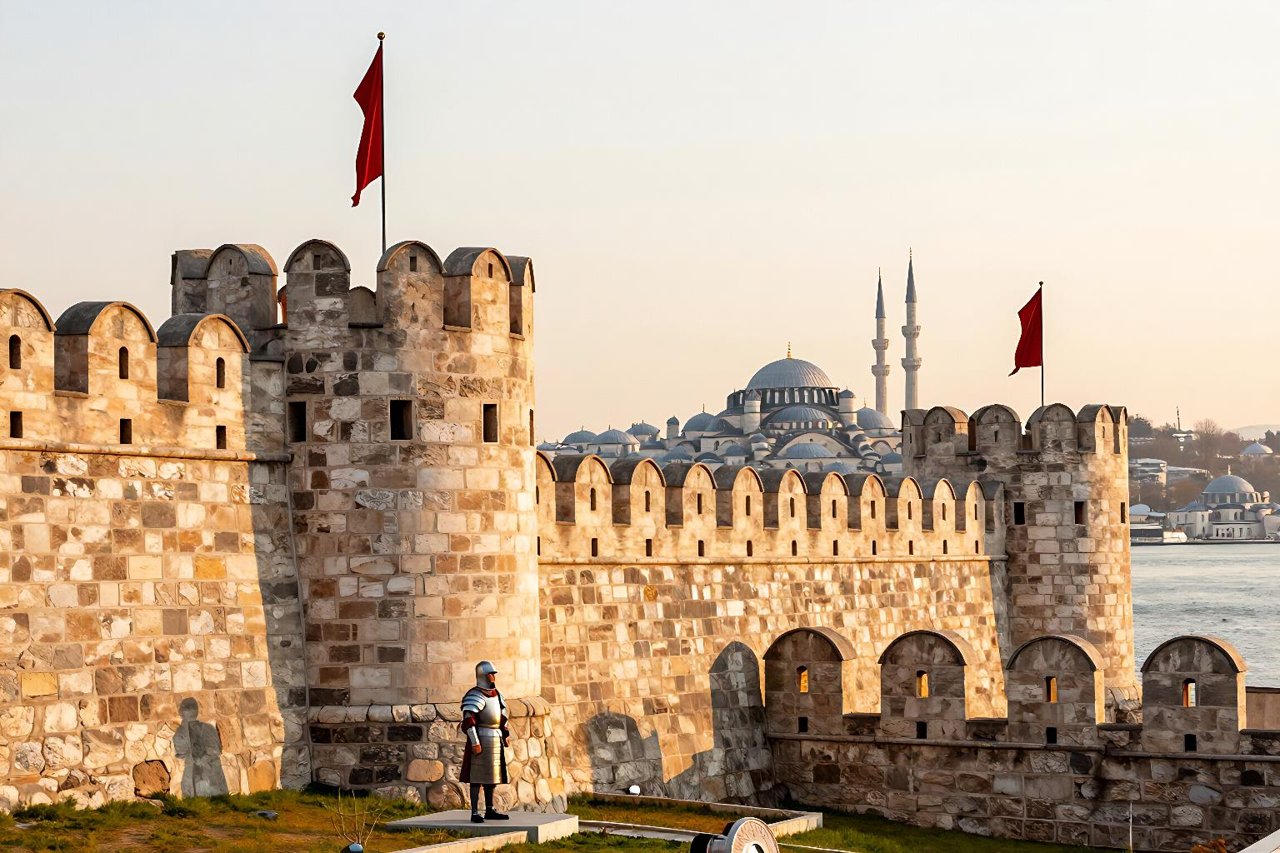
That single approach was closed off by the Theodosian Walls, finished in 413 and still the most impressive defensive system of the pre-gunpowder world. The line ran about 5.7 km, with a moat roughly 20 metres wide, an outer wall, an inner wall of around 12 metres, and 96 towers. For a thousand years no foreign army broke through the land walls. Sieges came and went, and the walls held.
Supplying the city was a separate engineering problem, since the peninsula had almost no fresh water. Byzantine engineers solved it with the Aqueduct of Valens and a hidden network of more than 80 cisterns, including the Basilica Cistern, a cathedral-sized underground reservoir carried on 336 columns that can still be walked today.
Justinian’s Gamble and the Bill That Came Due
Justinian I (527–565) is the emperor most people can name, usually because of one building. Hagia Sophia went up in five years, finished in 537, with 10,000 workers and a dome about 31 metres across that seemed to float. He also rebuilt Roman territory at astonishing cost, sending Belisarius to take North Africa in 534 and then to fight a brutal twenty-year war in Italy.
The bill arrived in stages. Taxes rose. The plague of 541–542 killed a large share of the empire’s population. Justinian’s conquests were largely lost within two generations. The ambition nearly broke the state, and it is fair to ask whether the empire recovered more from his buildings and laws than from his wars.
The Code That Outlived the Empire
His most durable achievement wasn’t made of stone. Justinian ordered the messy accumulation of Roman law to be sorted, trimmed, and published as the Corpus Juris Civilis, mostly between 529 and 534, with the jurist Tribonian doing much of the heavy lifting. That body of text survived the fall of Constantinople in 1453 and was rediscovered in the west centuries later. It shaped Napoleonic law, and it still underpins civil law codes across continental Europe, Latin America, and parts of Asia. Roughly 1,500 years later, courts are still reasoning in Justinian’s categories.
Greek Fire, Sieges, and Sheer Stubbornness
Most of Byzantine military history is about surviving. In 626 an Avar and Persian force camped outside the walls. In 678 and again in 717–718, Arab fleets tried to take the city from the sea and failed, partly because of Greek fire, a liquid incendiary sprayed from pressurised siphons mounted on ships. The exact recipe died with the empire, which is fitting, since it was arguably the best-kept military secret in the medieval world.
Even so, the empire lost most of its richest provinces, Egypt and Syria among them, to the Arab conquests of the 630s and 640s. The contest that followed reshaped the map permanently, and the wider story of how Islam spread from Arabia into a world civilisation explains why Byzantium spent four centuries on the defensive in the east.
What saved the state was administrative rather than heroic. The empire reorganised into themes, provincial military districts where soldiers were settled on land they farmed. It was cheap, decentralised, and resilient. Losing a battle no longer meant losing a province.
Icons, Monks, and the Great Schism
Byzantium was also the place where the shape of Orthodox Christianity was set. The iconoclast controversy, an argument over whether religious images were permissible, tore the empire apart between roughly 726 and 843, with emperors ordering mosaics and icons destroyed and monks resisting.
Meanwhile Greek missionaries were doing something far more consequential. Cyril and Methodius went to Moravia in 863, invented an alphabet for the Slavic languages, and effectively created the literate culture that Russia, Bulgaria, and Serbia would inherit. A great deal of what eastern Europe became is Byzantine in origin, and it fits into the larger pattern traced in the history of Europe as a continent forged by war, ideas, and migration.
Then came 1054. A papal legate and the Patriarch of Constantinople excommunicated each other, and the resulting East–West schism hardened into a permanent split. The two sides only formally lifted those excommunications in 1965.
Manzikert, the Crusades, and the Sack of 1204
The disaster everyone points to is Manzikert in 1071, where the emperor Romanos IV was captured by the Seljuk sultan Alp Arslan. Anatolia, the empire’s supply of soldiers, farmers, and tax revenue, slipped away over the following decade.
It was this crisis that pushed Emperor Alexios I Komnenos to ask the west for mercenaries in 1095. He got crusaders, and a lot of them, arriving half-obedient and highly suspicious of their supposed allies. Relations never recovered. Then came the catastrophe: in April 1204, the Fourth Crusade stormed the sea walls of a city that was by then Christian and hostile to nobody involved, and sacked it for three days. The damage to the Great Palace, the churches, and the imperial treasury was immense. As an episode in the Crusades as holy war, trade, and a clash that reshaped the medieval world, it is the ugliest single moment, a western army destroying the western world’s own bulwark.
The empire got its capital back in 1261, but as a stripped-down, impoverished rival of Venice and Genoa. Two centuries of slow bleed followed.
1453: The Last Day of the Romans
Mehmed II was 21 when he laid siege to Constantinople in April 1453. He had around 50,000 to 80,000 men, a fleet, and a fleet of enormous bronze cannon, including a piece cast by a Hungarian founder known as Orban, which fired stone balls weighing hundreds of kilograms. Defending the city were roughly 7,000 people, about half of them civilians, plus a contingent of Genoese led by Giovanni Giustiniani.
The chain across the Golden Horn was circumvented by hauling ships overland. The land walls, never breached in a thousand years, were battered down by gunpowder. In the early hours of 29 May, the Ottoman assault broke through near the Gate of St Romanus, Giustiniani was mortally wounded, and Emperor Constantine XI Palaiologos died in the fighting. His body was never identified. The way the city’s fall redirected power for centuries is covered in the Ottoman Empire’s six centuries of map-redrawing, and it makes clear that 1453 was a beginning as much as an ending.
What Byzantium Actually Left Behind
The usual caricature is of an empire of intrigue and ornate ritual, which is partly why the word “byzantine” came to mean needlessly complicated. The actual legacy is more concrete:
- Roman law, preserved and reorganised in Justinian’s code, filtering into modern civil-law systems worldwide.
- Greek literature and philosophy, copied by Byzantine scribes so that works by Plato, Aristotle, and Thucydides reached Italian humanists and, ultimately, us.
- A chain of Orthodox churches, from Greece and Bulgaria to Russia and Ethiopia, with their own liturgy, art, and calendar.
- The Cyrillic alphabet, developed in a Byzantine missionary context and now used by hundreds of millions of people.
- Art that still stuns: the mosaics of Ravenna, the frescoes of Cappadocia, and icons in every Orthodox museum in the world.
- Institutional ideas borrowed from court and church practice, from diplomatic gift-giving to the hospital as a religiously funded institution.
Look at a mosaic in Istanbul or Ravenna and you are seeing a world that thought of itself as continuous with Augustus, not as a footnote to him. For over 1,100 years, that self-belief held together a state with enemies on every side and no natural ally. When the last emperor died in a breach in the wall, he took a genuinely Roman idea with him.


