
Table of Contents
Two grapplers walk onto the same mat with the same goal and completely opposite instincts. The wrestler wants to close the distance, grab an ankle, and drive the other person onto their back. The jiu-jitsu player might be perfectly happy to sit down, hand over the top position, and start hunting for a choke from underneath.
Both are grappling. Both leave you sore the next morning. But the rules, the training culture, and the physical demands pull them in different directions, and understanding those differences is the fastest way to work out which one suits you.
Two arts, two very different family trees
Wrestling is the older of the two by a wide margin. Forms of it appear in Egyptian tomb art and in the ancient Greek Olympics. The versions most people run into today are folkstyle (the American scholastic system), freestyle, and Greco-Roman. There is no gi, no belt, and no submission. You win by pinning someone or by outscoring them, and the sport has been refined for centuries around exactly those two outcomes.
Brazilian Jiu-Jitsu is a much younger art, arriving in Brazil through Mitsuyo Maeda and developed by the Gracie family into something distinct. It reached a global audience in 1993 when Royce Gracie, weighing around 175 pounds, beat three larger opponents in a single night at UFC 1 using chokes and joint locks. That night sold a generation of people on the idea that technique could beat size, and the sport has grown into a gi-and-no-gi ecosystem with a belt system that takes most people eight to twelve years to climb.

The rules tell you what each art actually values
Strip away the marketing and each sport rewards a very specific set of behaviours. Under standard IBJJF rules, the scoring looks roughly like this:
- Takedown: 2 points
- Sweep from guard: 2 points
- Guard pass: 3 points
- Mount or back control: 4 points
- Submission: ends the match instantly
Wrestling scores differently. A pin ends the match on the spot. Near-fall points, escapes, reversals, and riding time all matter in folkstyle, and a 15-point lead finishes things early by technical fall.
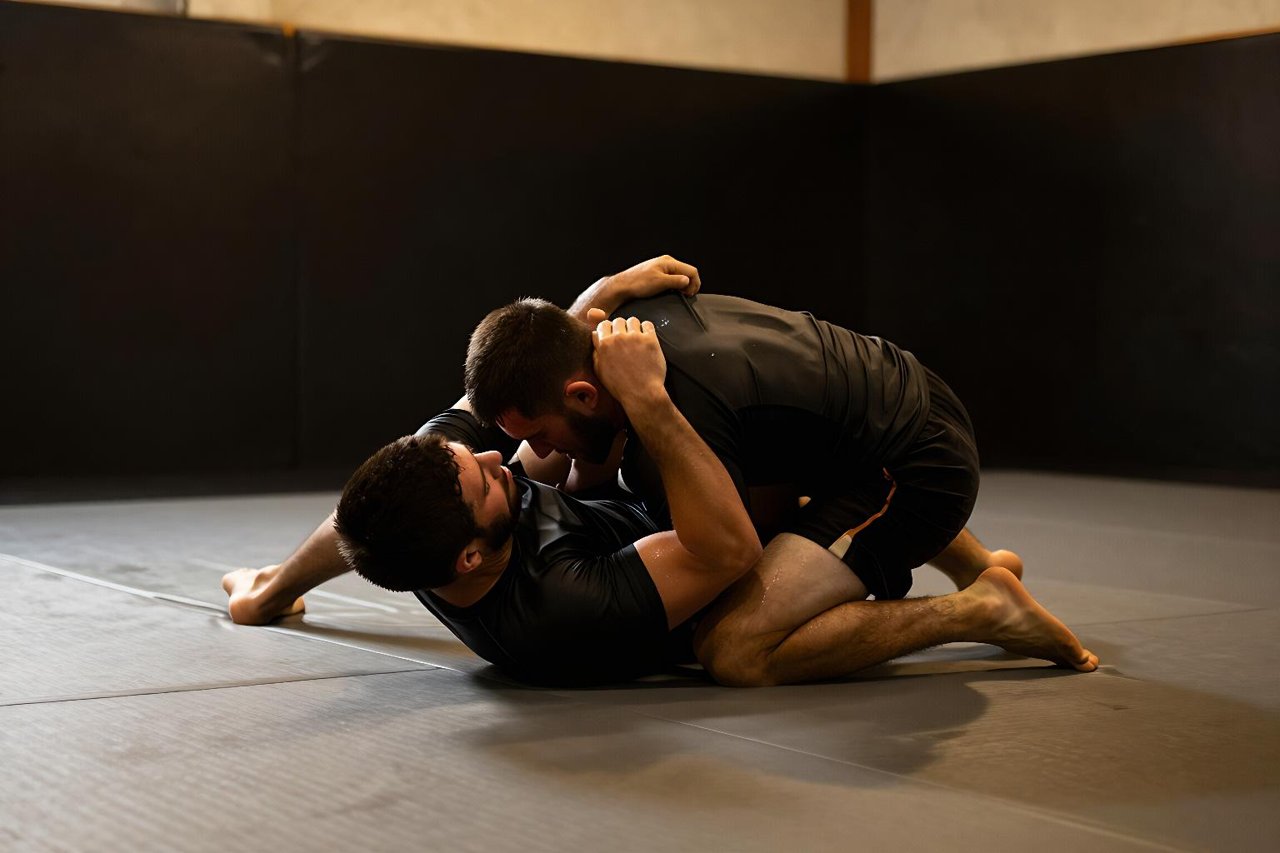
Notice what is missing from wrestling: any reward at all for fighting off your back. Being underneath is a failure state you get a few seconds to escape. In BJJ, being underneath is a legitimate position, sometimes the preferred one, because it is where armbars, triangles, and leg locks come from. That single philosophical difference explains most of what happens when the two styles meet.
Where wrestling wins
Takedowns, top pressure, and pace. A high school wrestler who trains six days a week for four years has probably drilled more penetration steps than most blue belts have drilled anything. That repetition shows up as a level of comfort in the hand fight that takes jiu-jitsu players years to match.
Wrestlers also tend to have better base. They are hard to sweep, hard to off-balance, and relentless about staying chest-to-chest once they get on top. The conditioning is a real factor too, built through constant live rounds rather than drills alone. If the match stays standing or turns into a grind against the mat, the wrestler usually owns it.
Where BJJ wins
Submissions and the bottom game. A wrestler who has never been taught to respect an armbar will happily leave an arm dangling inside someone’s guard, and that arm is gone within two seconds. BJJ also rewards technique over athleticism more heavily, which is why it is a sport you can realistically still be improving at in your fifties. Wrestling’s training culture pushes toward maximum effort every session, and bodies eventually send invoices for that.
Guard play is the other big advantage. The ability to attack chokes and leg locks from your back means a smaller, slower person has a genuine route to winning. In wrestling, there is no such route. You either get up or you lose.
Running the matchup in your head
A wrestler with six months of jiu-jitsu
He takes the jiu-jitsu player down inside the first thirty seconds, probably twice. Then he gets caught. It happens the same way almost every time: he shoots, lands in someone’s guard, postures up hard, and either gets triangled or has an arm extended for an armbar. Six months of BJJ is enough to teach him where the danger is, but not enough to override years of instinct telling him to drive forward.
A BJJ black belt with a year of wrestling
Different story. The black belt is not trying to win the takedown battle. He is trying not to get flattened, and a year of wrestling is usually enough to develop a decent sprawl, a stiff collar tie, and the ability to get back to a seated guard when taken down. Once the match hits the mat on his terms, the wrestler is in real trouble. This is the scenario that made cross-training so popular in MMA gyms.
“Which one actually works?” depends on the question
Both work. Neither is magic. Wrestling works because control of where someone’s body goes is genuinely useful, and BJJ works because most fights eventually get close and slow. The honest answer is that each art is optimised for the rules it was built around, which is the same tension that runs through the traditional martial arts vs. modern martial arts debate: effectiveness is always measured against something.
If your goal is a street altercation where strikes are possible, both have gaps, and neither replaces awareness and the ability to leave. If your goal is MMA, you need both. If your goal is a competitive sport with a defined ladder, pick the one whose rulebook you find interesting.
How to choose between them
Ask yourself a few blunt questions before you sign a contract:
- Do you want submissions? If chokes and joint locks are the reason you are interested, BJJ is the only answer here.
- Are you under 25 and love hard conditioning? Wrestling will suit you and will also wreck you in a way you will appreciate later.
- Are you over 40 with old injuries? BJJ has a longer runway, and most schools have a mat full of people in their forties and fifties still training hard.
- Do you want a gi and a visible progression system? Belts are motivating, and BJJ hands them out, slowly.
- Is there even a wrestling club near you? Availability matters more than theory. Adult wrestling programmes are rare outside university towns.
If throws and standing technique appeal to you, there is a third option worth reading about in how judo compares to Brazilian Jiu-Jitsu, since judo sits in a useful middle ground between wrestling’s takedowns and BJJ’s submissions.
What your first six months will actually feel like
Whichever you pick, expect to be bad at it for a while, and expect the badness to feel specific rather than general. New wrestlers spend weeks learning to stand in a stance that does not feel natural and getting taken down by fourteen-year-olds who have been drilling the same move since they were nine. New BJJ students spend weeks getting swept, mounted, and tap-checked by people half their size, and the first time someone holds a position and slowly increases pressure, it is genuinely unsettling.
The thing that decides whether you last is not talent. It is whether you find the problem interesting. Wrestling gives you a puzzle about pressure, balance, and pace. BJJ gives you a puzzle about leverage, connection, and patience. Both take years to solve. Pick the puzzle you want to think about on the drive home, and the rest sorts itself out.


