
Table of Contents
The word most Chinese people use for themselves is not “Chinese.” It is Han. Nearly 1.4 billion people describe their language, their script, and their ancestry with the name of a dynasty that ended more than 1,800 years ago. Few political projects in history have left a mark that deep.
The Han Dynasty ran from 206 BCE to 220 CE, give or take a fourteen-year interruption. At its height it governed roughly 60 million people, roughly a quarter of the world’s population at the time, across a territory that stretched from the Korean peninsula to the edges of Central Asia. It also produced the world’s first true paper, a bureaucratic machine that outlasted it by millennia, and a historical record so detailed that we know the name of a frontier clerk who complained about his ration of millet.
A Dynasty Born Out of Chaos
The Han did not inherit a stable country. They inherited a wreck. The Qin dynasty, which had unified China for the first time in 221 BCE, collapsed within four years of its founder’s death. Qin Shi Huang’s harsh legal code, forced labour levies, and paranoid court had made enemies of almost everyone with a sword or a grudge.
Into that vacuum stepped Liu Bang, a minor local official from Pei in modern Jiangsu. He was not a nobleman, not a general of genius, and by his own admission not much of a scholar. What he had was patience and an instinct for keeping useful men loyal. After five years of civil war he defeated his rival Xiang Yu at Gaixia in 202 BCE, and took the title Emperor Gaozu.

His crucial decision was to keep the Qin administrative system while throwing out its tone. The commanderies, the census, the standardised script, the weights and measures all stayed. The executions and the book burnings stopped. It was a lesson later empires kept relearning: institutional machinery is easier to inherit than to build, and far cheaper than rebuilding it from scratch.
Running an Empire of Sixty Million
A surviving census from 2 CE records 12.4 million households and 59.6 million individuals. Those figures are almost certainly an undercount, since tax evasion and unregistered dependents were universal, but they show a state that knew who its people were and where they lived.
The empire was divided into roughly a hundred commanderies, each run by a governor appointed from the capital and rotated regularly to prevent any one man from building a local power base. Above them sat the imperial secretariat and the chancellor, and above everyone sat the emperor, who in theory ruled by the Mandate of Heaven and in practice ruled by negotiation with his own officials.
Confucianism as a System
Emperor Wu established an Imperial Academy around 124 BCE with an initial intake of about fifty students. They studied the Confucian classics, and after examination they went into government service. The numbers grew steadily over the following centuries until the academy held thousands.
This is the root of the examination tradition that would later dominate Chinese public life for well over a thousand years. It was never a pure meritocracy in the Han period, since recommendation by a local patron still mattered enormously, but the principle had been planted: that a man’s fitness to govern should be demonstrated by his knowledge of texts rather than purely by his bloodline.
Law, Taxes, and the Family
Han households paid a land tax in grain, initially set as low as one-thirtieth of the harvest, plus a poll tax levied in cash on adults. Commoners also owed labour service, usually a month a year, which could be commuted for money. The legal code, inherited and softened from the Qin, distinguished degrees of intent and required written documentation for almost everything: contracts, loans, marriages, sales of land.
Excavated tomb and frontier records show women owning property, running businesses, and filing lawsuits in their own names. The Confucian ideal of the obedient wife existed in the texts; everyday practice was more complicated, as it usually is.
Emperor Wu and the Making of a Superpower
Emperor Wu reigned for 54 years, from 141 to 87 BCE, and it is hard to overstate how much of the Han’s reputation rests on him. He fought the Xiongnu, the nomadic confederation to the north who had been extracting tribute from earlier Han emperors, and he fought them until they split and retreated.
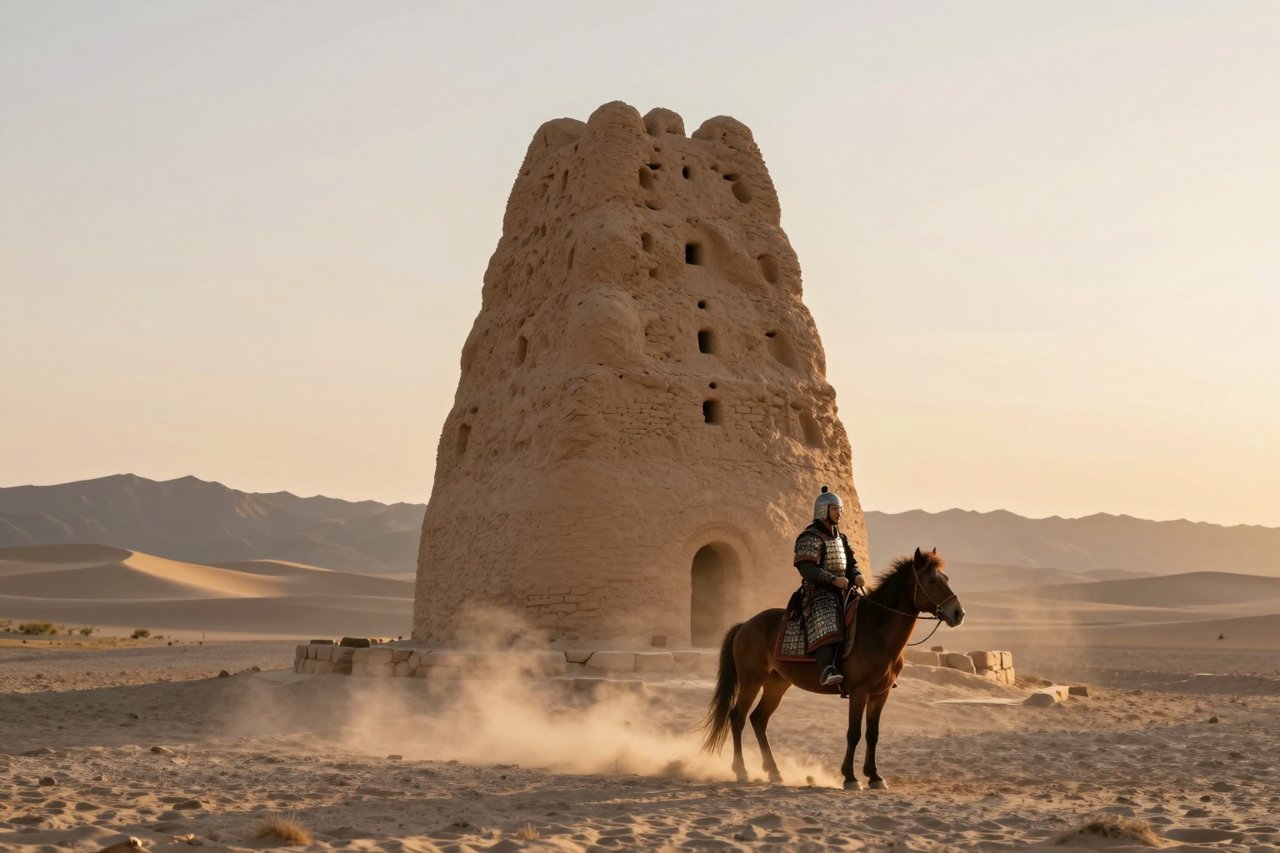
His generals Wei Qing and Huo Qubing pushed deep into the steppe. After the campaigns of 119 BCE, Han control extended into the Hexi Corridor, the narrow strip of land between the Qilian Mountains and the Gobi, where the empire founded the frontier commanderies of Wuwei, Zhangye, Jiuquan and Dunhuang. Those garrisons sat at the doorway to the west for the next four centuries.
Wars cost money, and Wu found it in ways that would be familiar to any modern finance ministry. He took salt and iron production into state hands around 117 BCE, taxed merchants heavily, sold offices and titles, and standardised the coinage around a bronze coin known as the wuzhu. The arguments over those monopolies were so fierce that a court debate held in 81 BCE was written up as a book, the Discourses on Salt and Iron, which survives and reads remarkably like a modern regulatory hearing.
Paper, Crossbows, and a Bronze Seismograph
Han technical achievement was not abstract. It was the kind of engineering that solved specific, boring, practical problems, then quietly changed the world.
- Paper. Fragments of coarse hemp paper survive from the 2nd century BCE. The court official Cai Lun is credited in 105 CE with refining a process using tree bark, rags and fishing nets, which made paper cheap enough to challenge bamboo slips and silk.
- Cast iron and agricultural tools. Han foundries ran at enormous scale, casting ploughshares, pots and weapons. The three-legged seed drill let a farmer sow rows at a fixed depth and spacing, cutting seed waste dramatically.
- The crossbow trigger. Bronze trigger mechanisms were cast to interchangeable tolerances, which meant replacement parts and mass issue to frontier troops.
- Zhang Heng’s seismoscope. In 132 CE the astronomer and official Zhang Heng built a bronze vessel with eight dragon heads holding balls. A mechanism inside dropped a ball into a toad’s mouth to indicate the direction of an earthquake. Courtiers reportedly scoffed when it triggered with no tremor felt; days later a messenger arrived reporting a quake hundreds of miles away.
- Water-powered trip hammers. Mentioned by the writer Huan Tan around 20 CE, these used a waterwheel to drive a pivoted hammer for milling grain, effectively industrialising food production.
The Silk Road and the Horses of Ferghana
The Han did not set out to build a trade network. They set out to find allies. Around 138 BCE Emperor Wu sent an envoy named Zhang Qian west to look for the Yuezhi, a people displaced by the Xiongnu who might be persuaded to attack them. Zhang Qian was captured, held for years, escaped, and came home in 126 BCE with almost no diplomatic success and an intelligence report of extraordinary value: there were wealthy kingdoms to the west, and they wanted silk.
That report changed imperial strategy. Silk moved west in exchange for horses, jade, glass and precious metals, and the Han obsession was horses. Chinese cavalry mounts were small; the “heavenly horses” of Dayuan in the Ferghana Valley were not. When the kingdom refused to sell, Emperor Wu launched two expeditions between 104 and 101 BCE, the second with tens of thousands of men, and got his animals.
By 60 BCE the Han had established a Protectorate of the Western Regions, a garrison-based administration reaching into the Tarim Basin. Goods moving along those routes ultimately fed into the Indian Ocean networks that powered trading states like the Aksumite Empire on the Red Sea coast, where Han silk eventually arrived alongside Roman coin and Indian pepper.
Wang Mang and the Fourteen Years That Broke the Momentum
The Western Han ended not with a bang but with a takeover. Wang Mang, a senior minister and relative of the empress dowager, spent years cultivating a reputation for austerity and virtue, then took the throne in 9 CE and declared the Xin dynasty. He was, in effect, a reformer with total power and no feedback loop.
He nationalised land, abolished slavery, repeatedly reissued currency at confiscatory exchange rates, and renamed offices so often that officials could not keep up. Meanwhile the Yellow River shifted course, displacing hundreds of thousands of peasants, and famine spread. Rebellions followed, including the Red Eyebrows and the Green Woodsmen. Wang Mang died in 23 CE when rebels stormed his capital. The land-reform model he attempted would not be tried again at scale for nearly 1,500 years.
Liu Xiu, a descendant of the Han imperial house, re-established the dynasty in 25 CE and moved the capital east to Luoyang. Historians call what followed the Eastern Han.
Eastern Han: Court Factions and a Rebellion That Ended Everything
The Eastern Han’s first century was competent and quietly prosperous. Its second century was a slow-motion institutional collapse inside the palace walls. Emperors ascended as children, so regents from the empress’s family governed. When emperors grew up, they relied on eunuchs to break the regents’ grip. Scholar-officials, disgusted, denounced the eunuchs; in 166 CE the court responded by proscribing the “partisan” faction, banning hundreds of officials from public life.
The end came from the countryside. In 184 CE a healer-preacher named Zhang Jue organised the Way of Great Peace, whose followers wore yellow cloth and were known as the Yellow Turbans. They rose across eight provinces in a coordinated uprising. Han generals suppressed it within a year, but only by devolving military command to regional warlords: Cao Cao, Liu Bei, Sun Jian and others. Those men never gave the power back.
In 189 CE the warlord Dong Zhuo seized the capital and installed a puppet emperor. For three decades the last Han emperor, Xian, was a hostage in his own palace. In 220 CE he formally abdicated to Cao Cao’s son Cao Pi, and the empire split into the Three Kingdoms.
What Four Centuries Left Behind
The obvious comparison is Rome, and it is a fair one: two empires of roughly 60 million people, at opposite ends of the same trade routes, fragmenting within a few centuries of each other. But the aftermath diverged sharply. Rome’s western half never reassembled. China’s did, under the Sui and Tang, using the Han blueprint almost unchanged.
The reason is administrative. The Han left behind a written, examinable, self-replicating civil service; a standardised script that let a bureaucrat from Shandong read a document from Gansu; and a moral vocabulary, drawn from Confucian texts, in which good government meant something specific rather than merely the ruler’s convenience. The Tang, Song, Ming and Qing all ruled through Han institutions.
They also left records. Sima Qian’s Records of the Grand Historian, completed around 94 BCE, and Ban Gu’s Book of Han set a template for dynastic history writing that later regimes followed out of a sense of obligation. Because of that habit, we can read the tax returns, legal cases and family disputes of ordinary people two thousand years dead, a level of documentary detail unmatched in most of the ancient world, and rarer than it should be among the great civilizations that rose and fell alongside it.
The Han’s frontier policy, meanwhile, set a pattern that steppe empires would answer for the next thousand years, from the Xiongnu to the Mongols, whose nomad-built land empire eventually swallowed the whole of China under Kublai Khan. Even the question of how a settled state manages its northern neighbours was first posed in Han court debates.
It is worth remembering how modest the beginnings were. A low-ranking clerk with a talent for delegation, a ruined country, and a decision to keep the machinery and lose the cruelty. Everything else, the paper, the coinage, the seismograph, the Silk Road, the name a billion people still use for themselves, came from that one sensible choice four centuries before the dynasty finally ran out of luck.


