
Table of Contents
It usually happens at 5 a.m. You hear a dry, rhythmic rasp from the living room and you already know exactly where it’s coming from: the arm of the sofa you bought eighteen months ago. By the time you get there, your cat has moved on and is grooming a paw with the smugness of someone who’s just finished a job.
Here’s the good news. Scratching is a hard-wired behaviour, not a personality flaw, and it’s one of the most solvable problems in cat ownership. You won’t train it out of your cat. You can, however, redirect it so completely that the couch stops looking interesting at all.
Why Cats Scratch (It’s Not Spite)
A cat scratches for three reasons at once. It sheds the dead outer sheath of the claw, it stretches the muscles through the shoulders and spine, and it leaves both a visual mark and a scent signal from glands in the paw pads. That second part matters more than most people realise. Scratching is how cats post their address on the furniture: this is mine, and I was here at 4:52 this morning.
Because scent marking is involved, cats tend to return to the same spots over and over. That’s why one sofa arm gets shredded while the matching chair looks untouched. It also means you’re not fighting a habit so much as an established signpost — and the fix is to give your cat a better place to put it.

Young cats are the most enthusiastic shredders, simply because they’re still learning what the world is made of. If you’ve recently brought home a kitten, expect a few months of testing absolutely everything, including your curtains. Our guide to the first year of caring for a kitten covers the developmental stages that drive that behaviour.
The Right Scratcher Beats Willpower
Most cats who ignore the scratching post were given the wrong one. A 15-inch carpeted post on a wobbly base is the feline equivalent of a flimsy footstool — no cat wants to commit its full weight to something that rocks.
Vertical or horizontal?
Watch your cat for a few days. Some stretch fully upright and rake downward, others crouch and pull toward themselves on the carpet. If your cat scratches the floor or a rug, buy a flat corrugated cardboard scratcher. If it’s the sofa back or a door frame, go tall — at least 30 inches, and ideally a floor-to-ceiling pole for a cat that really likes to lean in.
Materials that actually work
- Sisal rope wrapped tightly around a solid post — the gold standard for vertical scratchers.
- Corrugated cardboard — cheap, replaceable, and irresistible to most cats.
- Bark-covered logs or untreated wood, which some cats prefer over everything else.
- Skip the carpet if your problem area is carpeted furniture. You’re literally training your cat that carpet is a scratching material.
Stability is the deciding factor. A post that wobbles will be abandoned. Wedge it into a corner, bolt it to the wall, or set a heavy base on top of it. If your cat can make it shake, your cat will stop using it.
Placement: The Part Most People Get Wrong
A scratching post tucked behind the laundry door is a scratching post that never gets used. Cats scratch where they hang out and where they wake up, so the post needs to be in the middle of the action — next to the sofa, beside the window seat, at the top of the stairs.
Here’s the trick that changes the outcome for most people: put the new scratcher directly in front of the thing your cat is already ruining. Not three feet away, not in the corner. Right up against the damaged sofa arm, angled so your cat can stretch into it the moment it walks over. Once the post is being used reliably every day, you can slide it a few inches at a time toward somewhere less obtrusive. Move it slowly and watch for backsliding.
Make the Couch Less Appealing — Temporarily
You need a short-term barrier while the new post earns its reputation. Double-sided sticky tape works well on upholstery corners; cats dislike the tacky feel on their paws. Clear plastic corner guards protect the exact spot without looking terrible. A tightly fitted throw blanket over the arm can take the hit for a few weeks.
Change the texture, not the smell. Citrus sprays and commercial repellents are hit-and-miss — many cats ignore them completely, and a strong scent can make your cat avoid the whole room. Covering the spot is far more reliable.
Trim the Claws, Not the Toes
A fortnightly nail trim won’t stop scratching, but it drops the damage from catastrophic to cosmetic. You only need the clear, curved tip — well in front of the pink quick. Two claws per session is fine if your cat objects; you’ll get through all of them over a couple of days.
Soft nail caps are the other option, and they’re genuinely useful for a determined sofa attacker. They’re glued over the trimmed claw and last four to six weeks. Just remember they’re a management tool, not a solution — you still need the post.
Reward What You Want to See
Every time your cat uses the post instead of the sofa, make it worth their while. A treat placed on top of the post, a dab of catnip rubbed into the sisal, or a quick play session with a wand toy right next to it. Cats repeat what pays.
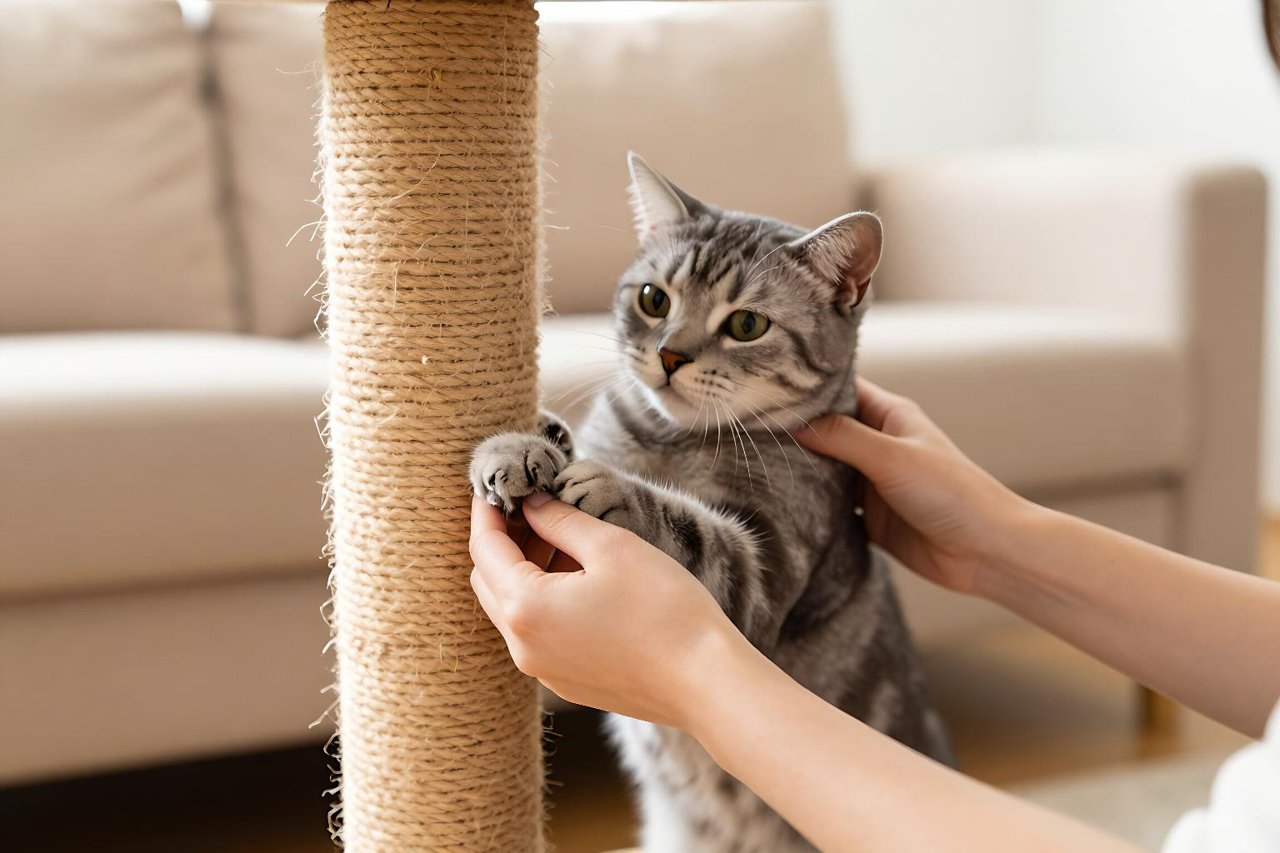
For the furniture, a calm, immediate redirect is all you need: pick your cat up mid-scratch and set them on the post, then stroke the sisal with your fingers so they hear the sound. No shouting, no spray bottles. Punishment doesn’t teach what to do instead — it just teaches your cat to scratch when you’re not in the room, which is worse.
When Scratching Is Really About Stress
If your cat suddenly starts scratching door frames, wallpaper and window sills after months of being fine, look at what changed. A new baby, a house move, a work-from-home schedule, or a new pet can all trigger extra marking. If you’re blending households, our piece on introducing a dog to a cat without a standoff is a good place to start, since tension between species often shows up first as destructive scratching.
An anxious cat also needs more vertical space, more hiding spots, and a predictable routine. Feeding, play and litter cleaning at consistent times does more for a stressed cat than any product on the shelf.
What Doesn’t Work
Declawing is an amputation of the last bone in each toe, and it’s banned or heavily restricted in much of Europe, Australia and parts of Canada. It causes chronic pain and far more litter box and biting problems than it solves. Vets who still offer it are increasingly rare for good reason.
Also unhelpful: yelling, water sprays, rubbing your cat’s nose in the damage, and locking the cat out of the room it wants to be in. And if you’re choosing a cat with a calmer temperament in the first place, our list of cat breeds that suit first-time owners is worth a read before you commit.
When It’s Marking, Not Scratching
Check the pattern. Scratching leaves vertical grooves, torn fibres and often a visible frayed claw-shed. Urine marking is horizontal, usually on vertical surfaces at nose height, and comes with a distinct ammonia smell.
If it is spraying, the answer isn’t a scratching post — it’s a vet visit. Around 10% of male cats and 5% of females spray, and it spikes with territory changes, intact hormones or underlying urinary issues. Rule out a medical cause first, then work on resource layout: more litter boxes, separate feeding stations, and enough space that your cats can avoid each other without a confrontation.
For a deeper dive into feline behaviour and enrichment, the talks from cat care experts Lili Chin, Mikel Delgado PhD and Lucy Hoile at Bark! Fest are genuinely worth an evening. Most of what we get wrong with cats comes from misreading normal behaviour as defiance — and once you see the scratching for what it is, the fix is usually a better post in a better spot.


