
Table of Contents
Uruk, in what is now southern Iraq, held something like 40,000 people by 3200 BCE. That is more residents than most European towns managed in the Middle Ages, and it was raised without a single wheeled cart pulled by an animal. Asking how ancient cities were built means asking a set of questions that have barely changed in six thousand years: where is the water, what is underfoot, who does the lifting, and what happens to the waste.
What separates a village from a city is not size. It is the moment a settlement starts importing its solutions. Food comes from somewhere else, timber comes from somewhere else, and the people who live there depend on institutions to keep the whole arrangement from collapsing. The Sumerians who built the first true cities worked this out early, and they invented writing largely to keep track of it.
Site selection was a hydrological decision first
Almost every early city sits on a river, a spring, a lake or a coastline with a freshwater lens. Jericho grew around a perennial spring in the Jordan Valley roughly 9,000 years ago. Mohenjo-daro was planted in the Indus floodplain. Rome had the Tiber; Angkor had the Siem Reap and a network of reservoirs.
Rivers gave three things at once: drinking water, irrigation, and transport. Moving a tonne of grain by boat costs a fraction of moving it by donkey. That is why so many ancient cities were built on rivers and coastlines, and why the trade routes that knitted the ancient world together tended to follow water before they followed roads.

Defensibility came second, but it mattered. Hills, bends in rivers, islands, and later artificial moats all shaped the outline of a city before a single wall was laid. The shape of the land dictated the shape of the streets.
Build with what is within walking distance
Before railways, every heavy material had a cost curve that climbed steeply with distance. Builders used the cheapest local option, then spent money on the parts that had to last. That usually meant:
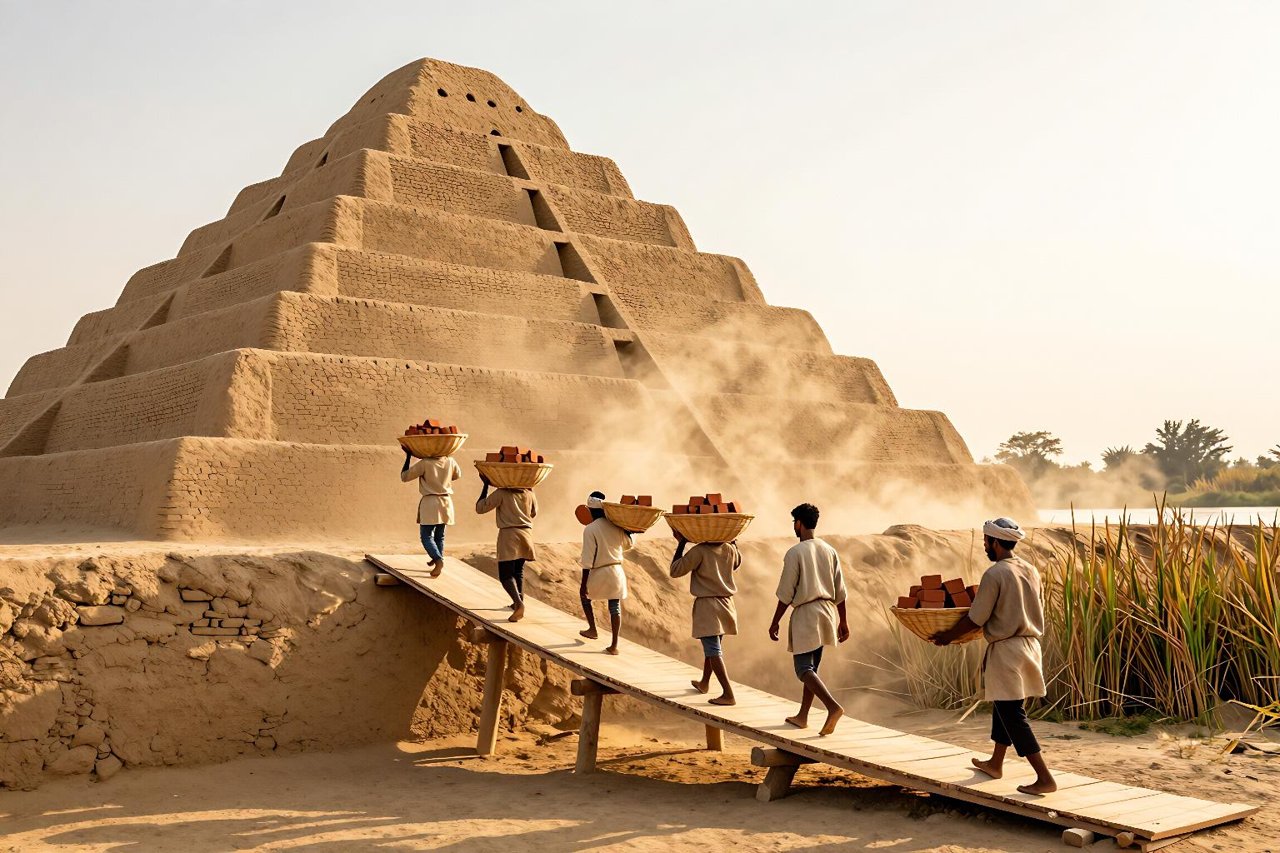
- Mudbrick where alluvium and straw were plentiful: Mesopotamia, Egypt, the Indus, the American Southwest.
- Stone where good quarries sat nearby: Greece, Nubia, the Andes, the Khmer plateau.
- Timber and wattle in forested zones, often on stone footings to keep damp out of the walls.
- Rammed earth and pisé in dry regions with the right clay and little fuel for firing.
Mudbrick was the world’s most underrated building material
Mudbrick sounds primitive. It is not. A well-made brick of clay, sand and chopped straw, dried in the sun for a few weeks, can carry enormous compressive loads, and fired brick is stronger still. The trick was standardisation. At Mohenjo-daro, bricks were made in a consistent ratio of 1:2:4 (thickness, width, length) so that every mason could lay any brick from any batch without adjusting their work. That is a building code, applied around 2500 BCE.
Mudbrick’s weakness is water. Foundations were packed with gravel and stone, walls got thick plinths, roofs got overhanging eaves, and every structure needed re-plastering each year. Cities built of mudbrick survived for centuries, but only because someone was always repairing them.
Stone was a logistics problem disguised as an engineering one
The Great Pyramid at Giza holds roughly 2.3 million blocks. The achievement was less about lifting them than about organising them: quarrying crews cutting on a rhythm, sledges on lubricated tracks, ramps fed by relays of men, and a supply chain that delivered bread, beer and fish to a rotating workforce camped nearby. The workers’ village at Giza has bakeries large enough to feed thousands, which tells you the real bottleneck was calories, not cleverness.
For a deeper look at feats that still puzzle engineers today, there is a whole category of ancient engineering that modern builders still argue about.
Feed the workforce or nothing gets built
Construction in the ancient world was seasonal, because farming was. You built between harvest and sowing, with a labour force that had to be released back to the fields. That is one reason monuments took generations.
The exception was states rich enough to pay workers year-round. Egypt’s New Kingdom pharaohs ran permanent gangs of masons; the Roman army built roads, aqueducts and forts as part of its standing function. Rome’s eleven aqueducts, delivering hundreds of thousands of cubic metres of water a day at their peak, were maintained by a dedicated staff of state employees with legal powers to protect the conduits from damage.
Plan the streets before the first wall goes up
Older cities tend to be organic. Newer ones, and especially colonial or state-founded ones, are gridded. Both work, but they produce very different places to live.
Mohenjo-daro is the classic grid: streets running roughly north-south and east-west, houses built around courtyards, wells distributed through the blocks. The grid made drainage possible. Covered sewers ran beneath the lanes, with inspection covers so they could be cleaned, and houses had chutes connecting latrines to the street drain. That is a level of sanitation not matched in Europe for another four thousand years.
Grids also serve taxation and control. A regular street plan can be surveyed, allotted, and recorded in a register, which is exactly what the Indus and later Greek and Roman city founders did. Hippodamus of Miletus gets credit for formalising the grid in the fifth century BCE, but the idea was already two thousand years old.
Water supply and drainage: the invisible half of the build
Ask someone to picture an ancient city and they picture temples. Ask an engineer and they picture the culverts. Every city that grew past a few thousand people ran into the same three problems: bringing clean water in, getting wastewater and storm runoff out, and keeping both systems from silting up.
Solutions ranged from the simple to the monumental. Wells and rainwater cisterns in dry zones. Underground qanats in Persia, gently sloped tunnels that tapped aquifers and ran for tens of kilometres. Roman aqueducts with carefully calculated gradients, often as shallow as 1 in 2,000. The Khmer built barays, vast reservoirs, and a canal grid so extensive that Angkor’s sprawl became the largest pre-industrial city on Earth, covering around 1,000 square kilometres.
Quality control, stamped into the brick
Ancient builders had inspectors. Babylonian bricks were often stamped with the king’s name, which made the maker traceable if a wall failed. The Code of Ur-Nammu, written around 2100 BCE, included penalties for flooding a neighbour’s field. Egyptian tomb records list work gangs, rations and absences, which is essentially a site diary.
The Nubian and Kushite kingdoms pushed this further, building in stone on a scale that rivalled Egypt. The Kushite kings who ruled Egypt and left roughly 200 pyramids behind were working with steep-sided pyramids at angles the Egyptians never used, which required a different internal geometry to stay standing.
Everything was a maintenance contract
The quiet truth about ancient cities is that most of them were not abandoned because of dramatic collapse. Mudbrick erodes in a decade if you stop re-plastering the roof. Canals silt. A city that loses its water source or its trade link loses its population within a generation, and the buildings slowly melt back into a mound of earth. Archaeologists call those mounds tells, and each one is a stack of rebuild after rebuild.
What kept them alive was governance: someone with the authority to call out labour, fund a canal dredge, and enforce the rules. That is less romantic than the story of genius architects, but it is the actual answer. Ancient cities were built out of clay, stone, water, calories and bureaucracy, in that order. The bureaucracy is what held the other four together, and it is the part that never makes it into the museum.


