
Table of Contents
An indoor cat can sleep sixteen hours a day and still spend the other eight climbing the walls. Boredom in cats rarely looks like a dog shredding the skirting boards. It looks like a 4am sprint across your pillow, a sudden ambush of your ankle on the stairs, or a cat who sits and stares at a blank wall for twenty minutes. Toys are the cheapest fix available, but only if you buy the right ones.
Most cat toys are designed to appeal to people. They are cute, they match the sofa, and they sit untouched in a basket for three years. The ones that actually get used tend to mimic prey: something that twitches, rustles, hides, and can eventually be caught. Here is what is genuinely worth your money.
Why indoor cats need toys more than most owners realise
A cat with a garden gets thousands of tiny stimuli a day. A beetle in the grass. A draught under the fence. The shadow of a pigeon crossing the patio. An indoor cat gets the same four walls, day after day, and that gap shows up in behaviour. Under-stimulated cats over-groom, spray, yowl at night, and take their frustration out on the other pets in the house.
Play does more than burn energy. It gives a cat a sense of control over its environment, which is why fifteen minutes with a wand toy lifts a cat’s mood more reliably than a bowl of treats. If you want the wider picture, this guide to keeping an indoor cat happy and mentally busy covers territory, vertical space, and daily routine in far more depth.

Match the toy to the hunt, not to the shelf
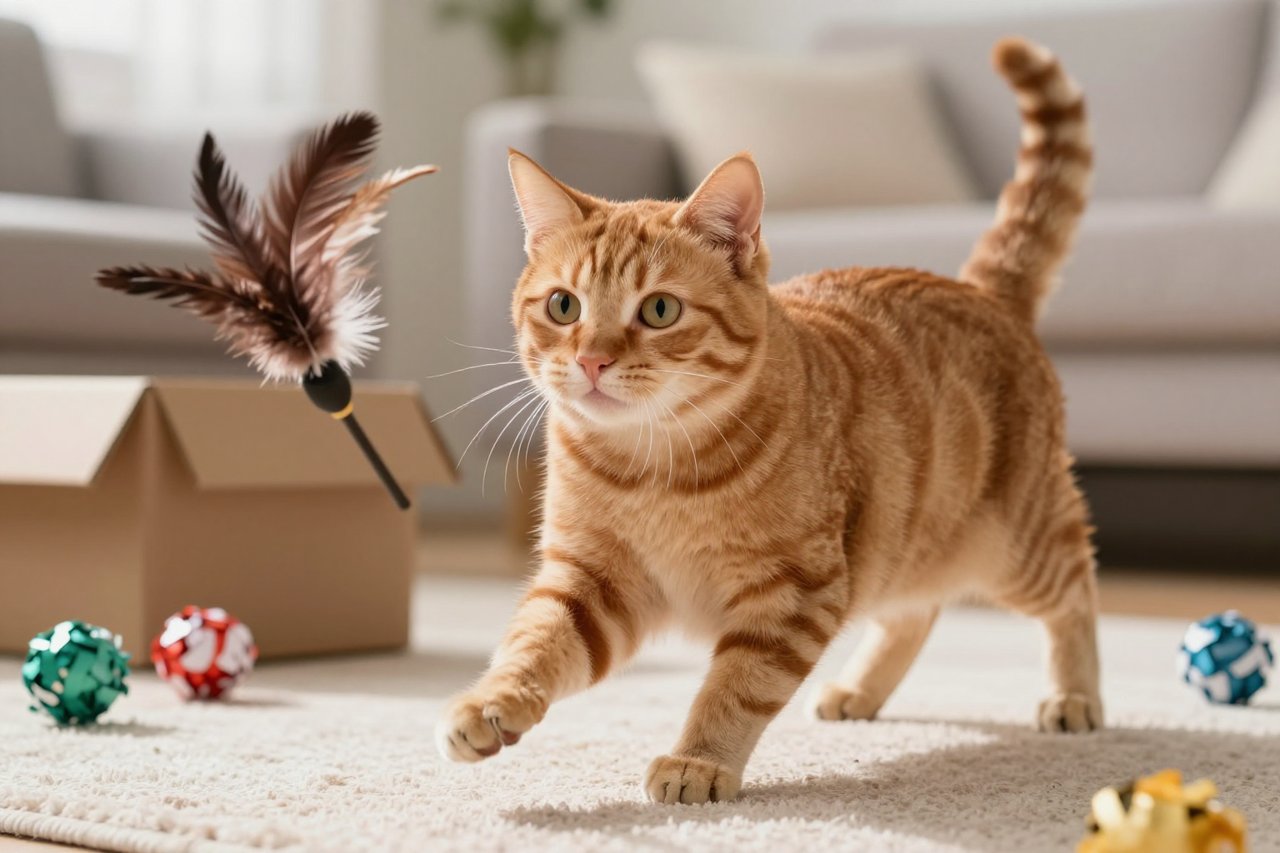
Every toy worth buying hits at least one stage of the hunting sequence: stalk, chase, pounce, grab, bite. A feather wand covers all five. A laser pointer covers two and then leaves the cat with nothing to sink its teeth into, which is exactly why some cats walk away from laser sessions looking annoyed rather than satisfied. Use a laser if you like, but finish every session by landing the dot on a real toy or a treat so the hunt has an ending.
Think about your cat’s personal style, too. A young Bengal wants twenty minutes of flat-out sprinting. A twelve-year-old British Shorthair wants to bat at something from a lying-down position and then go back to sleep. Both are normal. Buy for the cat you have, not the cat in the advert.
Wand toys: still the single best purchase
Nothing beats a wand for value. A decent one costs less than a takeaway and, used properly, becomes the most exciting object in the house. Look for a wand with a long, flexible rod and interchangeable attachments so you can swap a feather for a ribbon or a fuzzy bug when interest drops. Cheap wands with short sticks force you to loom over the cat, which reads as threatening rather than exciting.
How to get a cat that “doesn’t play” interested
- Drag the toy along the floor and around corners rather than waving it in the air. Ground movement reads as prey; air movement reads as a bird you cannot reach.
- Move it away from the cat, never towards its face.
- Pause. Freeze for five seconds behind a chair leg or under a rug edge and let the cat stalk.
- Let the cat win roughly one in three attempts. A toy that can never be caught is just a tease.
- End with a catch, then a small treat or a meal, so the hunt finishes with a kill and a feed.
Two ten-minute sessions, morning and evening, will do more for most cats than a room full of static toys. Cats are crepuscular, so first thing and last thing fit their natural rhythm.
Puzzle feeders and food toys
Food puzzles keep a cat busy long after you have left for work, and they slow down the cat that inhales its dinner in ninety seconds and then cries for more. Start simple with a treat ball or a lick mat, then move to a sliding-cup puzzle once your cat has worked out the mechanics. Most cats solve their first puzzle in under ten minutes and are noticeably quicker by the third day.
This is one of the real differences between the species. Dogs get all the credit for being trainable, but a cat working out a puzzle feeder is doing the same problem-solving, just without the audience. If you have both animals at home, these notes on how caring for dogs differs from caring for cats are a useful reality check on what each one actually needs.
Solo toys that survive being left alone
Toys you leave out need to work without you. That rules out anything on a string and anything with a bell small enough to swallow. What tends to last:
- Kicker toys roughly the length of your cat’s body, stuffed with catnip or silvervine. These satisfy the grab-and-bite instinct and double as a safe outlet for aggression.
- Crinkle balls and mylar strips because the sound matters as much as the movement. Cats hear the rustle before they see the toy.
- Ball-track toys where a ball rolls in a closed channel. No pieces to lose under the fridge.
- Cardboard boxes and brown paper bags with the handles cut off. Free, and statistically more popular than anything you pay for.
The cheap and free toys cats choose over expensive ones
Some of the best cat toys cost nothing at all. A ping-pong ball dropped into an empty bathtub becomes a fifteen-minute solo game because the ball ricochets unpredictably and the tub amplifies the noise. A plastic bottle cap skitters on a wooden floor in a way a shop-bought mouse never quite manages. A cable tie flicked across the kitchen has the same jittery motion as a beetle.
Rotate these along with the bought toys. Novelty is the whole point, and a toy that disappears for a week feels brand new when it comes back.
Making a small flat work
Limited floor space is not a barrier. In a studio or one-bedroom, shift play upwards: a wand worked along the back of the sofa, over a cat tree, and around a bookshelf uses vertical space instead of floor space. Cats are one of the few pets that genuinely suit apartment living, which is why they keep appearing in lists of the best small-space pets for flats and rentals. If you are choosing a breed rather than a toy, this rundown of cat breeds that cope well in small flats is worth a read before you commit.
What to skip
Anything with a bell attached to a collar clip, toys small enough to be swallowed whole, and long ribbons left unsupervised. Cats swallow linear objects more often than people expect, and string can cause intestinal damage that needs surgery. Supervise anything on a cord, then put it away in a drawer.
Also skip the battery-powered toys that wave a wand under a blanket for ten minutes and then die. Most cats lose interest in under a week, and the ones that do not tend to become obsessed in an unhealthy way.
Buying well without overspending
You do not need a hundred pounds of cat gear. Five or six good toys, rotated weekly, beat a full basket every time. If you are stocking up, keep an eye on sale events and buy the durable stuff then: wands with replaceable heads, a sturdy treat ball, a decent puzzle feeder. Deal round-ups such as these Amazon cat deals worth checking are a sensible time to buy the bigger items rather than full price in March.
Two short sessions beat a basket full of toys
The most useful change most owners can make takes eleven minutes. Pick one wand toy and one puzzle feeder. Play hard for ten minutes before breakfast and again before bed, finishing each session with a catch and a small reward. Put the wand in a cupboard afterwards so it stays special.
Leave the kicker toy, the crinkle ball, and a box on the floor. Swap them for the spares once a week. That is the entire system, and it solves the 4am sprint, the ankle ambush, and the wall-staring in one go, without a single purchase you will regret.


