
Table of Contents
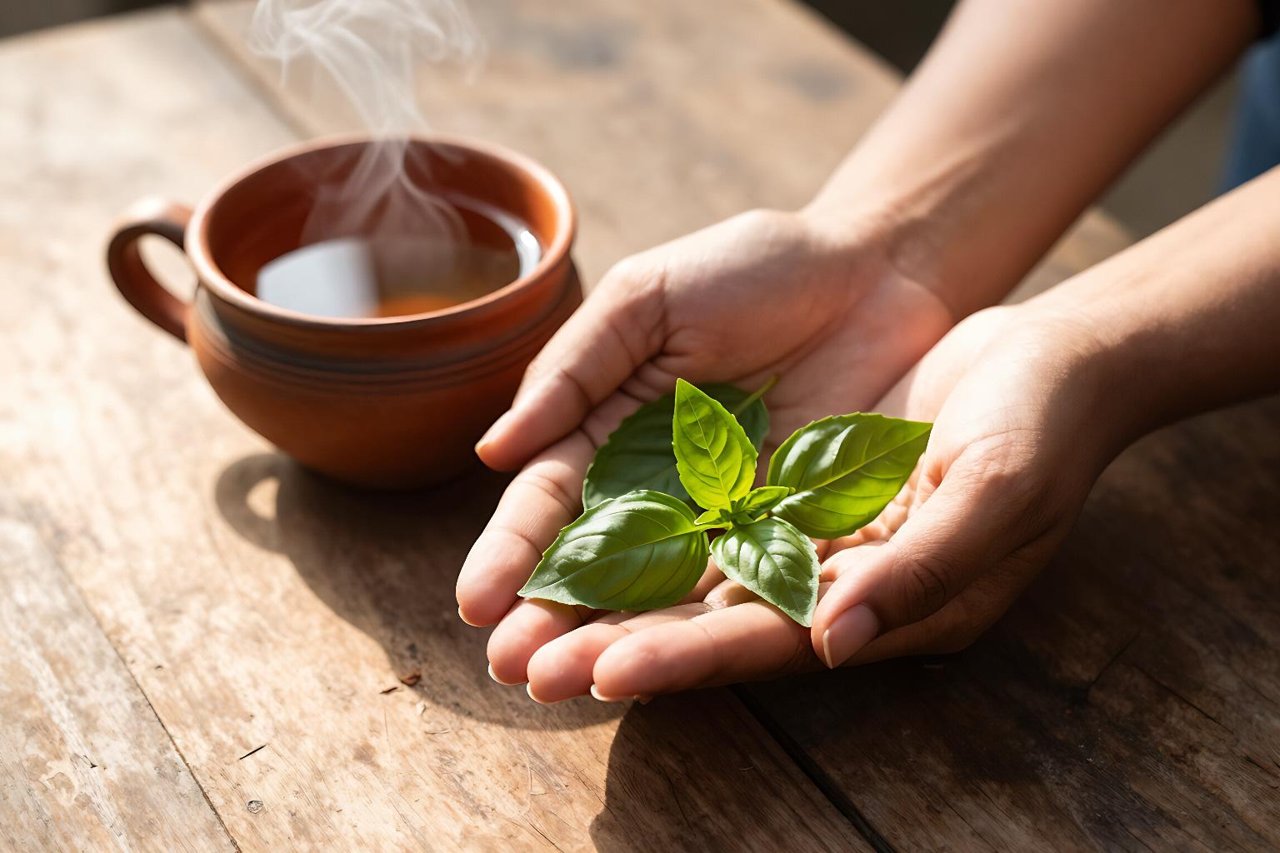
Walk past a house in almost any part of India and there’s a decent chance you’ll spot a tulsi plant in a clay pot near the door, often set on a small raised platform. Someone waters it every morning. It gets pruned, prayed to, and picked for tea the moment anyone in the family starts sniffling. That plant is holy basil, and it’s been playing roughly the same role in South Asian households for something like three thousand years.
These days you’ll find it in far more places than a doorstep: bagged tea on supermarket shelves in London, capsules in a supplement aisle in Toronto, face wash, mouthwash, and cold-pressed juice shots. The jump from household herb to commercial ingredient is worth understanding, because the version in the capsule bottle isn’t always the version your grandmother knew.
So What Is Holy Basil, Exactly?
Holy basil is Ocimum tenuiflorum, also listed on older labels as Ocimum sanctum. It’s a member of the mint family, a soft-stemmed shrub that grows 30 to 60 cm tall and throws out small purple flower spikes if you let it. It’s native to the Indian subcontinent and grown widely across Southeast Asia.
Don’t confuse it with the sweet basil on your pizza. Same genus, completely different flavour. Holy basil is clove-like, slightly peppery, and a bit astringent, which is why it works in a hot drink and clashes badly with tomato sauce. The Hindi name, tulsi, translates roughly to “the incomparable one,” which tells you something about how it’s regarded.

Three Types Worth Knowing
Rama tulsi
The common green-leaved type. Mildest in flavour, highest in the fresh, herbal notes people associate with tulsi tea. Most commercial tea bags use this or a blend built around it.
Krishna tulsi
Dark purple leaves, purplish stems, a much stronger peppery-clove punch. Often used in chai and in traditional preparations. If a product boasts “black tulsi,” this is what it means.
Vana tulsi
The wild, woody type that grows taller and tastes greener and more lemony. Less common in commerce, sometimes sold as “Amrita” or wild tulsi. Worth trying if you find the standard tea a bit flat.
What Holy Basil Was Traditionally Used For
In Ayurvedic practice, tulsi is classed as a rasayana, a rejuvenating herb, and as an adaptogen long before that word existed. The documented uses are broad, and a few of them line up surprisingly well with what people still buy it for today.
- Coughs, colds, and congestion. Fresh leaf juice with honey and a little ginger, or a decoction of leaves, ginger, and black pepper. Also used as steam inhalation.
- Fever. Typically combined with other herbs rather than used alone, often in a bitter kadha (decoction).
- Stress, low mood, and mental fog. A daily cup in the evening, or leaves chewed in the morning. This is the use that’s travelled furthest into Western markets.
- Digestion. Gas, bloating, sluggish appetite, and mild nausea.
- Skin. A paste of crushed leaves applied to minor wounds, ringworm, and inflamed skin. Still a common home remedy.
- Mouth and gums. Leaves chewed after meals, or a strong infusion used as a rinse for gum tenderness and mouth ulcers.
- Mosquitoes. Plants set by windows and doors, and leaves rubbed on exposed skin as a rough repellent.
Preparation mattered as much as the plant. Leaves were chewed fresh, infused in hot water, powdered and taken with ghee and honey, or steeped in oil for topical use. The everyday version, though, was simply a hot drink made from a handful of leaves, sometimes with cardamom or lemongrass to soften the astringency.
Where the Modern Evidence Actually Stands
Holy basil’s chemistry is genuinely interesting. The leaf contains eugenol (the clove-scented compound that dominates the aroma), ursolic acid, rosmarinic acid, and a spread of flavonoids including apigenin and luteolin. Eugenol has well-documented antimicrobial and anti-inflammatory activity in laboratory work, and ursolic acid has been studied for anti-inflammatory effects in animal models.
Human research is thinner than the marketing implies. There are small randomised trials looking at stress and anxiety scores, blood glucose in people with type 2 diabetes, and respiratory symptoms, but sample sizes tend to be in the tens rather than hundreds, formulations vary between studies, and follow-up periods are short. Reviews of the literature consistently call for larger, better-controlled trials.
That’s not a reason to dismiss it. It is a reason to treat a supplement label claiming “clinically proven stress relief” with some scepticism. Holy basil is a well-tolerated herb with a long history and promising early data. It is not a drug.
Holy Basil Products on Shelves Right Now
The commercial range is wide, and quality varies enormously.
Teas and blends
Loose leaf or bagged, often combined with ginger, lemongrass, green tea, or cardamom. The most approachable format, and the easiest place to actually taste the herb. Caffeine-free unless blended with true tea.
Capsules and tablets
Typically 300 to 500 mg of leaf powder or extract. Standardised extracts will state a percentage of eugenol or ursolic acid. Beware “proprietary blends” that list tulsi alongside ten other herbs without disclosing individual amounts.
Tinctures and liquid drops
Alcohol or glycerin extracts, usually sold as dropper bottles. Fast to absorb, easy to dose, and often the most expensive per gram of leaf.
Skincare and oral care
Tulsi appears in face washes, spot treatments, toners, toothpastes, and mouthwashes, leaning on its traditional antimicrobial reputation. Read the ingredient list carefully, because the tulsi content in a face wash is usually decorative rather than functional.
Drinks and juices
Tulsi shot drinks and herbal blends have appeared in the functional beverage aisle. Check the sugar content, which can be substantial.
How to read a tulsi label without getting fooled
- Look for the Latin name, Ocimum tenuiflorum. Just “holy basil” is not enough.
- Check which part of the plant is used. Leaf is standard; whole-herb powder dilutes it with stem.
- Prefer products that state an extract ratio (for example 4:1) or a standardised marker compound.
- Favour brands that mention third-party testing for heavy metals, which is a real issue with herbs grown in contaminated soil.
- Check whether a tea is actually caffeine-free, since many tulsi blends are cut with green tea.
Safety, Interactions, and the Cases to Be Careful With
Holy basil is generally well tolerated at culinary and typical supplemental doses. The reported side effects are mild: occasional nausea, and in animal studies some effects on blood clotting and blood sugar.
That last point matters. Eugenol has mild antiplatelet activity, so anyone on warfarin, aspirin, or clopidogrel should talk to their doctor before taking concentrated extracts, and stop two weeks before scheduled surgery. Holy basil may also lower blood glucose, which is helpful in theory but risky in combination with insulin or sulfonylureas without monitoring.
Pregnancy is another area for care. Culinary amounts in food are fine; high-dose extracts are not recommended, partly because animal studies have shown uterine-stimulating effects at large doses. There’s also older animal research hinting at reduced fertility in males at very high doses, so anyone actively trying to conceive should keep intake modest rather than maximal.
Growing It on a Windowsill
Given how cheap and easy the plant is, growing your own is the most satisfying route to a steady supply.
Start from seed or, faster, from a cutting rooted in a glass of water, which takes about two weeks. Give it six hours of direct sun, a pot with drainage holes, and soil that doesn’t stay soggy. Pinch out the flower spikes as soon as they appear, because once tulsi flowers it stops putting energy into leaves and the flavour turns woody. Water when the top inch of soil feels dry; it sulks in standing water but wilts fast in a heatwave.
Harvest from the top down, taking the top two or three leaf pairs and leaving the lower stem to branch. Two plants will keep a household in fresh leaves from late spring to the first frost, at which point you can take cuttings indoors or dry what’s left. Dry the leaves in shade, not direct sun, and store them whole in a sealed glass jar away from the stove; crushed leaves lose their aroma within a couple of months, whole leaves hold it for about a year.
A cup made from leaves picked ten minutes earlier tastes nothing like the bagged version: greener, sweeter, and much less bitter. That’s probably the most useful thing anyone can tell you about holy basil. The traditional product and the modern product are the same plant, and the gap between them is mostly a matter of freshness.


