
Table of Contents
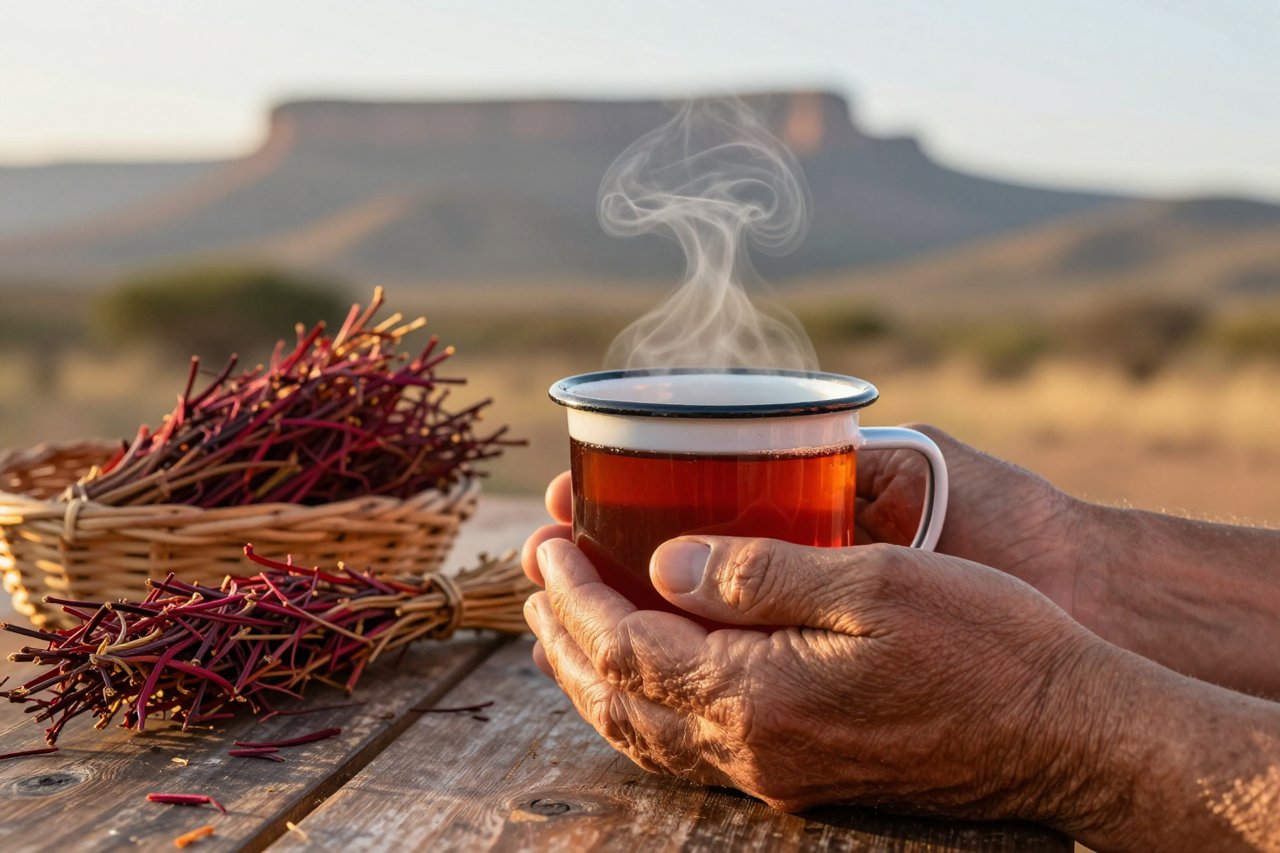
Pour a cup of rooibos and the first thing you notice is the colour: a deep amber-red that looks nothing like the pale gold of a green tea or the near-black of an English breakfast blend. Then comes the taste. No grip, no drying astringency, just a soft honeyed warmth that sits somewhere between vanilla, dried fruit and the smell of a warm wooden shed.
It gets called tea, sits on the same supermarket shelf as tea, and is brewed in the same way. But rooibos is a genuinely different drink from anything made with Camellia sinensis, and the differences run deeper than colour.
It Doesn’t Come From the Tea Plant at All
Every true tea (white, green, oolong, black, pu-erh) comes from one species of evergreen shrub: Camellia sinensis. Rooibos comes from Aspalathus linearis, a wiry, needle-leaved shrub in the legume family that grows wild on the fynbos slopes of the Cederberg, roughly 300km north of Cape Town.
That geography is not a marketing detail. The plant refuses to thrive anywhere else. It wants deep, coarse, acidic sand, winters wet enough to soak the roots, and the fierce dry heat of a Western Cape summer. Attempts to farm it in Australia, the United States and elsewhere have mostly produced bushes that sulk and die. “Rooibos” is Afrikaans for “red bush,” and since 2021 the name has held protected designation of origin status in the European Union. If it wasn’t grown in that small corner of South Africa, it can’t legally be sold as rooibos.

The harvest is equally unusual. Each bush is cut back once a year, between January and March, then the stems are bruised, piled into heaps, wetted and left to oxidise for anywhere from eight to twenty-four hours until the wood turns a rich brick red. Only then is it spread out to dry in the sun.
What Rooibos Actually Tastes Like
Traditional black tea gets its character from oxidation too, but the chemistry is different. Rooibos has far less of the bitter, mouth-drying tannins that make an over-steeped Assam undrinkable. What’s left is sweet and rounded, with a slightly woody backbone and a finish that lingers without turning harsh.
Red rooibos vs green rooibos
You’ll find two versions on the shelf, and they behave quite differently in the cup:
- Red (fermented) rooibos: the classic. Oxidised, sun-dried, sweeter and fuller, with notes of honey, vanilla, tobacco leaf and stewed plum. This is what most people mean when they say rooibos.
- Green (unfermented) rooibos: the stems are dried quickly to stop oxidation. The liquor is yellow-green rather than red, grassier and less sweet, closer in spirit to a light green tea. It also retains more of the plant’s signature polyphenols.
Both are worth trying. Green rooibos is the better choice if you take your tea without milk; red rooibos takes milk, honey and a slice of lemon with far more grace than most herbal infusions.
Caffeine-Free, Without the Herbal Compromise
A standard 240ml cup of black tea carries roughly 40 to 50mg of caffeine. Green tea lands around 25 to 30mg, and filter coffee can hit 95mg or more. Rooibos contains none. That single fact changes how you use it.
You can drink it at nine at night without lying awake at midnight. You can hand a mug to a nine-year-old or to a friend who’s pregnant and dodging caffeine. You can drink four cups before lunch and skip the wired, jaw-clenching feeling that comes with a fourth espresso. Rooibos isn’t a sedative, and it won’t knock you out the way valerian might, but it doesn’t fight your sleep either.
It’s also low in oxalates compared with black tea, which matters if your doctor has told you to watch kidney stones. And because the tannin load is modest, it doesn’t block iron absorption the way strong black tea taken with meals can.
Brewing It Properly (and Forgiving It Anyway)
Rooibos is one of the easiest drinks in the kitchen to get right. Use about 2 to 3g of loose leaf, or one heaped teaspoon, per 250ml of water just off the boil. Pour at 95–100°C and leave it for five to ten minutes. That’s it.
The forgiving part is that you can walk away and forget it. Leave the bag in for half an hour and the cup gets stronger and slightly woodier, but it never turns bitter and soapy the way an abandoned green tea does. There’s no narrow window to miss.
A few practical variations worth knowing:
- Iced rooibos: brew at double strength, cool, then pour over ice with lemon and a spoon of honey. It makes a genuinely good summer drink that doesn’t taste like a herb-tea consolation prize.
- Rooibos latte: steep 3g in 150ml water for eight minutes, add hot steamed milk and a dusting of cinnamon. The honeyed base carries milk better than most herbals.
- In cooking: a strong brew makes an excellent poaching liquid for pears, a braising base for pork, and a swap for water in rye or banana bread dough.
What’s Actually in the Cup
Rooibos has a distinctive polyphenol profile that you won’t find in Camellia sinensis. The best-known is aspalathin, a dihydrochalcone antioxidant that occurs naturally in this plant and nowhere else in meaningful quantities. There’s also nothofagin, quercetin, and small amounts of iron, calcium, magnesium and zinc.
Worth a reality check here. Most of the glowing claims about rooibos come from laboratory and animal research, and a cup of tea is not a medicine. The human evidence is thin but not empty: one small randomised trial of 40 volunteers who drank six cups a day for six weeks reported modest improvements in some cholesterol markers. Interesting, encouraging, and not a reason to skip your statins.
How to Pick a Good One
Quality varies a lot, and the gap between a cheap bag and a good loose-leaf rooibos is wider than most people expect.
Look for single-origin or Cederberg-grown leaf, and prefer long, needle-like pieces over fine dusty fragments. The dry leaf should smell sweet and faintly of hay and vanilla, not flat or papery. Small-scale suppliers, including fair-trade cooperatives around Wupperthal and Nieuwoudtville, tend to produce leaf with more character than the mass-market blends.
Store it in an airtight tin away from light and heat, and use it within a year. Rooibos doesn’t go off, but the aromatics fade, and a two-year-old bag tastes like hot water with a memory of something better.
Where It Slots Into a Real Daily Routine
The most honest argument for rooibos isn’t a nutrition label. It’s that it fills gaps that traditional tea leaves open. That 4pm slump where coffee is a bad idea. The after-dinner cup when you want something warm but need to be asleep by eleven. The thermos you take on a cold hike, where a stewed bag for three hours is a feature rather than a disaster.
Keep a tin of red rooibos next to the kettle and a box of green rooibos behind it for mornings when you want something lighter. Try it iced through summer, and try it with milk at least once before you decide you don’t like it that way. It won’t replace your morning builder’s tea, and it isn’t trying to. It’s a different plant, brewed differently, doing a different job in your day.


