
Table of Contents
The first time I boarded a Hurtigruten ship in Bergen, I had the wrong idea. I’d packed pressed shorts and an ironed shirt, expecting the kind of cruise where every night ends with a stage show and a champagne tower. Within an hour, though, I was standing on the deck in a borrowed rain jacket, watching a crewman roll a barrel of fish feed down the gangway. Nobody handed me a cold towel. Sailors were actually coiling ropes. And the ship swayed just enough to remind me that this is a working vessel, not a floating resort.
That first morning taught me more about a Hurtigruten cruise than any brochure ever could: this is a journey built around a coastline, not a casino. The formalities are few, the ports are real, and the distance between Bergen and Kirkenes is measured not in cruise ship smiles but in fjords, undersea tunnels, and the changing length of the day.
What a Hurtigruten Cruise Actually Is
For more than 130 years, the Norwegian Coastal Express has been a lifeline for the country’s scattered coastal communities. A ship leaves almost every day from Bergen in the south, heading north to Kirkenes, close to the Russian border. Along the way, it calls at 34 ports, many of which have no other regular transport connection. So when you book a Hurtigruten voyage, you’re not being ferried to a private island or a curated Caribbean beach. You’re sharing a highway with local freight, mail, cars, and the occasional schoolteacher heading to a workshop in Tromsø.
The classic route takes about six days northbound and seven days southbound, though you can join and leave at almost any port. Some travellers spend just a few nights on board, using the ship as a floating hotel between cities. Others commit to the whole loop, which takes around twelve days to return to Bergen. Either way, the atmosphere is closer to a working ferry crossed with a small, informal hotel than to a traditional cruise ship.

The Classic Route: 34 Ports of Raw Coastline
The journey starts in Bergen, a rainy city of wooden wharves and fish markets. From there, the ship threads its way through a maze of islands and fjords. It stops in place names you may have never heard of, like Florø and Måløy, where the only signs of life are a few brightly coloured houses and a ferry waiting to cross your path.
By the time you reach Ålesund, you’ll have seen enough peaks and outcrops to fill a landscape painter’s notebook. In summer, one of the most loved detours is the climb into Geirangerfjord, a UNESCO World Heritage site where the waterfalls tumble past abandoned mountain farms. The ship does a short loop into the fjord and back, giving you just enough time to feel how small culture can be against those walls.
Crossing the Arctic Circle
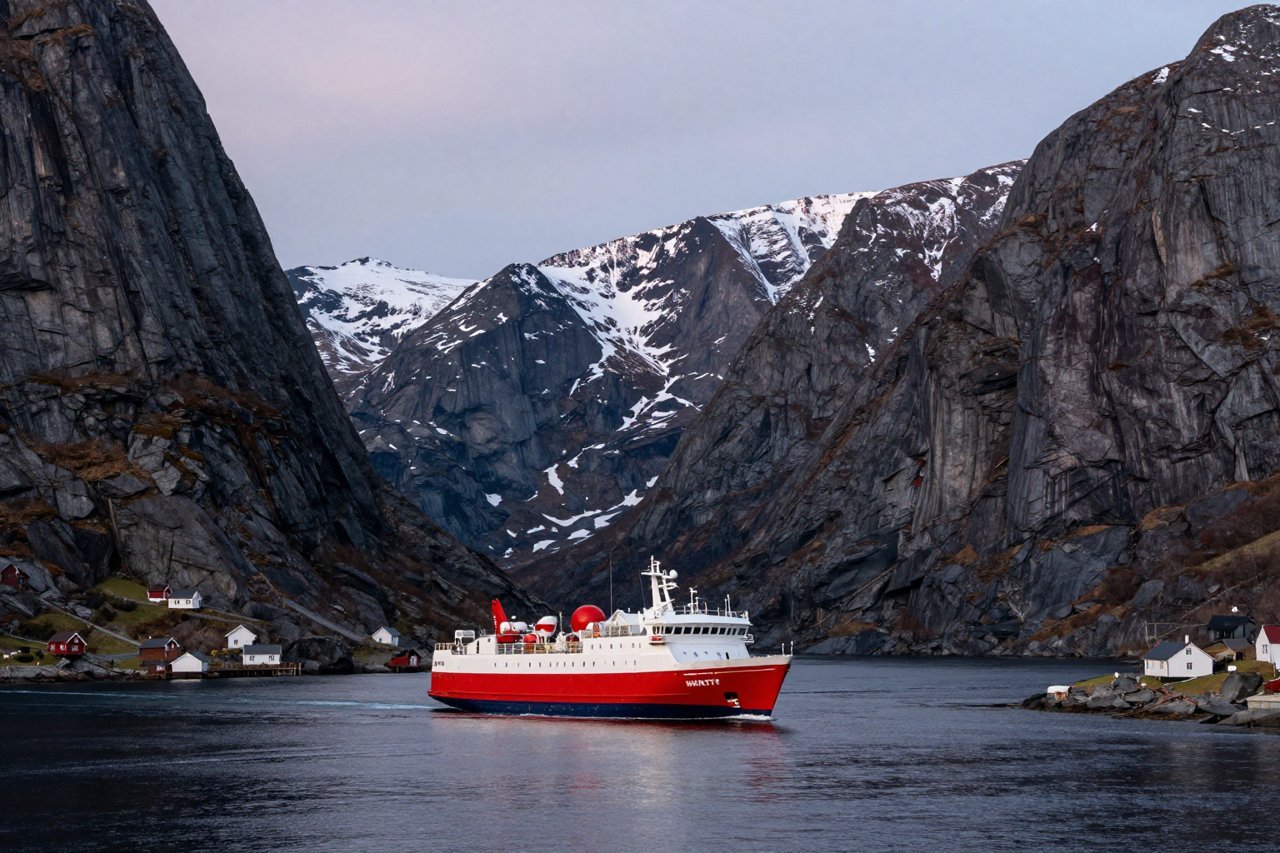
The most spectacular stretch begins after the ship passes the Arctic Circle, usually in the middle of the night. Around 6pm, it enters Raftsundet, a narrow sound flanked by sheer granite walls. The captain slows to a walk. Passengers pile onto the bow, and then the ship turns a corner and the Trollfjord opens like a cold green wound. The walls press in so close that you stop taking photos and just stare.
Further north, the Lofoten Islands rise out of the sea like a stone dragon’s back. In summer, the sun sits above the horizon for almost twenty hours, turning the peaks red and gold at midnight. In winter, this same wall of granite is one of the best places on earth to watch for the aurora.
Life Onboard: Comfortable, Understated, and Unpretentious
Cabin sizes on the classic Hurtigruten ships are modest, and the best investment you can make is a room with a window. You’ll spend more time looking out than watching television. The public spaces are built around the view, with a panoramic lounge near the bow where the coffee runs freely and the conversation comes in three languages.
There’s no formal night, no casino, and very little entertainment that involves a stage. Instead, the schedule is set by the coast. Meals are served in a single dining room, often as an open-seating buffet. You’ll eat skrei in spring, local lamb in summer, and cloudberry compote in autumn. Breakfast is a Scandinavian spread of breads, fish, cheese, and porridge, and the best seat in the house is always the one next to a window.
In winter, Hurtigruten makes a simple promise: if the Northern Lights don’t appear on select sailings, you can come back for free. It’s a sign of how much the journey itself depends on luck and the sky, not on a schedule.
Choosing the Right Hurtigruten Cruise for You
The Hurtigruten brand is actually split in two. The classic coastal express, which we’ve been describing, is the original. It’s the best way to see Norway at a deeper level, especially if this is your first visit. But there is also Hurtigruten Expeditions, a fleet of smaller polar ships that run themed adventures to Svalbard, Greenland, and the Antarctic Peninsula. These are very different trips, focused on ice navigation, wildlife, and hiking, with a professional expedition team guiding every landing.
If you want to get a feel for what that style of travel looks like, we’ve written a separate breakdown of what makes Hurtigruten expeditions a true Arctic adventure. And if your thoughts are already drifting to the far south, our complete guide to planning an Antarctica trip will walk you through the logistics, the wildlife, and the two-week crossing that turns seasoned travellers into true polar explorers.
Practical Tips to Get the Most Out of the Journey
You don’t need to rehearse for a Hurtigruten cruise, but a little preparation helps. Here are the things I wish someone had told me before I sailed:
- Book a cabin with a window. Even a small porthole makes a difference, especially when you wake up at 4am and the Lofoten Wall is outside your pillow.
- Dress in layers. The weather swings between sunshine and sideways rain in the space of an hour. A warm base layer, a waterproof shell, and a scarf will carry you through the most spectacular moments.
- Bring real binoculars. Sea eagles, fin whales, and the occasional pod of orcas don’t wait for lunchtime. You’ll be glad to have them on deck.
- Get off the ship at every port. Even in small towns, a ten-minute walk beyond the quay will show you a way of life that hasn’t changed much in a century.
- If you’re sailing in winter, check for the Northern Lights promise. Some departures include it, and it means your trip is covered if the sky refuses to perform.
The Rhythm of the Coast Gets Into You
By the final afternoon, you’ll find yourself standing at the rail without checking the map. The port names have become familiar: Rørvik, Brønnøysund, Ørnes. You know that the green light at the harbour entrance is always on, that the bakery in the passenger lounge opens at 7:30, and that the deck hand with the grey ponytail will wave when you come back from a walk ashore.
That’s the quiet magic of a Hurtigruten cruise. It doesn’t ask you to do anything in particular. It just moves from one small town to the next, carrying fish and mail and people who happen to be travelling in the same direction. By the time you leave, you’ll find you’ve slowed down to a pace you didn’t know you’d lost. The mountains, the islands, the weather, and the people are the show, and the ship is simply a way of getting you close enough to feel it.


