
[ad_1]
Key Points
- Naval Air Systems Command awarded GE Aerospace $46.5 million to supply nine T408-GE-400 engines for CH-53K Lot 10 full-rate production.
- Work will be performed in Lynn, Massachusetts, with completion expected by September 2032 using fiscal 2026 aircraft procurement funds.
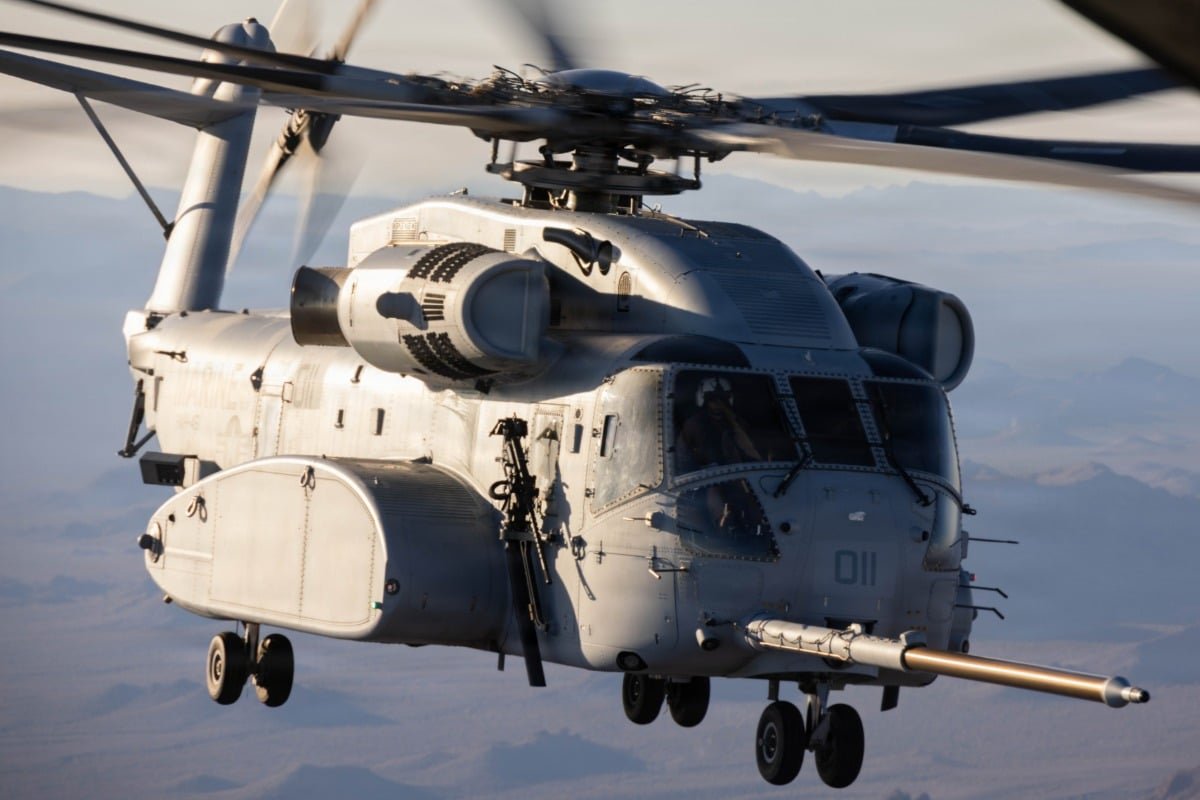
The U.S. Marine Corps is pushing its newest and most powerful heavy-lift helicopter deeper into full-rate production, with the Navy awarding General Electric Aerospace a $46.5 million contract modification to supply nine additional engines for the CH-53K King Stallion.
Naval Air Systems Command handed GE Aerospace’s Lynn, Massachusetts facility a $46,532,340 modification to an existing firm-fixed-price contract, adding nine T408-GE-400 turboshaft engines to the Lot 10 production order. The modification covers a variation in quantity — meaning these nine engines expand an already-running production lot rather than opening a new contract — and work is expected to be completed by September 2032. The full $46,532,340 comes from fiscal 2026 aircraft procurement funds and will be obligated at award, with none of it set to expire at the fiscal year’s end.
The T408-GE-400 is the engine that makes the CH-53K what it is. Each King Stallion carries three of them, and together they produce roughly 60 percent more power than the three engines on the legacy CH-53E Super Stallion the King Stallion is replacing. That power advantage translates directly into lift capacity: the CH-53K can carry 27,000 pounds of external cargo — three times what the CH-53E could manage under the same high-altitude, hot-weather conditions that degrade helicopter performance most severely. For the Marine Corps, which needs to move artillery, vehicles, and ammunition in expeditionary environments where roads don’t exist and runways are nonexistent, that lift margin isn’t a luxury. It’s the difference between what a mission can carry and what gets left behind.
– ADVERTISEMENT – CONTINUE READING BELOW –
The T408 engine itself represents a generational advance in turboshaft technology. GE designed it specifically for the CH-53K program, incorporating full-authority digital engine control, advanced materials, and a architecture optimized for the kind of sustained high-power operations that heavy-lift missions demand. The engine produces approximately 7,500 shaft horsepower — each one, on each of three pylons. Running three of them simultaneously gives the King Stallion a combined power output that no previous helicopter in the Marine Corps inventory has matched.
Lynn, Massachusetts — designated a labor surplus area, a classification that carries weight in federal contracting — is where GE Aerospace manufactures the T408. The facility has long been a center of GE’s military engine production, and the CH-53K program has become one of its anchor programs as the King Stallion moves through full-rate production. That production status matters: the CH-53K is no longer a developmental program working through engineering challenges. It has passed the military acquisition milestone that certifies a system is ready to be built at scale and delivered to operational units at pace.
As with virtually all engine procurement for a sole-designed military turboshaft, there is no meaningful competition to be had — GE designed the T408, GE manufactures the T408, and GE is the only entity capable of producing it to the airworthiness standards the program requires. Sole-source contracting in this context is not a procurement shortcut; it is the straightforward consequence of how military propulsion systems get developed and sustained across the lifecycle of the aircraft they power.
Naval Air Systems Command at Patuxent River, Maryland, serves as the contracting activity, consistent with its role as the Navy and Marine Corps’ primary aviation acquisition authority.
The CH-53K program has had a long road to this point. Development stretched across years of engineering refinement, software maturation, and operational testing before the Marine Corps declared initial operational capability. Full-rate production arriving now means the Corps has cleared those hurdles and is committed to fielding the King Stallion across its heavy-lift squadrons as the CH-53E retires. Each engine order under Lot 10 brings the program one step closer to the fleet density the Marine Corps needs — enough aircraft distributed across enough squadrons to make the King Stallion’s capabilities routinely available rather than carefully rationed.
[ad_2]
Source link


