
Table of Contents
Call it the day everything changes. In one moment you’re moving freely, and the next your left leg refuses to obey a simple command. For many survivors, the thought that immediately follows is: will I ever feel like myself again? The answer lies in a well-structured stroke recovery treatment plan. It’s not a single pill or a single exercise. It’s a coordinated, often exhausting, and undeniably hopeful process of re-teaching your brain.
Stroke isn’t just an event that you survive. It’s a condition that carries on with you. The good news is that your brain has an extraordinary ability called neuroplasticity — it can rewire itself, forming new pathways to take over the work of the damaged regions. What feels impossible in the first few weeks can become routine after months of the right kind of practice. This guide walks you through what effective stroke recovery treatment actually looks like, from the ICU to your living room, and how you can get the most out of every stage.
Why the First Weeks After a Stroke Are So Important
In the first 48 hours, the hospital team isn’t just stabilising your breathing and blood pressure. Because the brain is primed to reorganise quickly, intense early therapy can have an outsized effect on your eventual recovery. A physiotherapist, an occupational therapist, and a speech-language pathologist will assess what you can and can’t do. They’ll measure the slight movement in your fingers, whether you can safely swallow water, and how far you can stand.
According to the American Heart Association, rehabilitation should ideally begin within 24 to 48 hours after a stroke, as soon as you’re medically stable. Several trials have shown that getting someone out of bed and walking—even with assistance—on the first or second day drastically improves the chance of regaining independent mobility. Bed rest is not your friend here. The longer your muscles and nerves lie idle, the stronger the message they receive that they are no longer needed.

A big part of early stroke recovery treatment is simply fighting deconditioning. Sitting upright at the edge of the bed, moving your unaffected limbs, shifting your weight while seated — these micro-victories lay the foundation for bigger milestones like standing and stepping.
And even during this acute stage, you and your family should already be thinking about preventing a second stroke. The lifestyle shifts — blood pressure control, low-dose aspirin, quitting smoking, and adjusting your diet — are described in detail in this guide to stroke treatment, prevention, and diet. Because if you don’t protect the brain you have left, all the rehabilitation in the world won’t hold.
The Core Pillars of Stroke Recovery Treatment
Once you leave the acute stroke unit, rehabilitation usually moves to a dedicated rehab facility or an outpatient clinic. The therapies you’ll encounter all fall into three broad pillars, each targeting a different kind of damage.
Physical Therapy: Rebuilding Movement and Balance
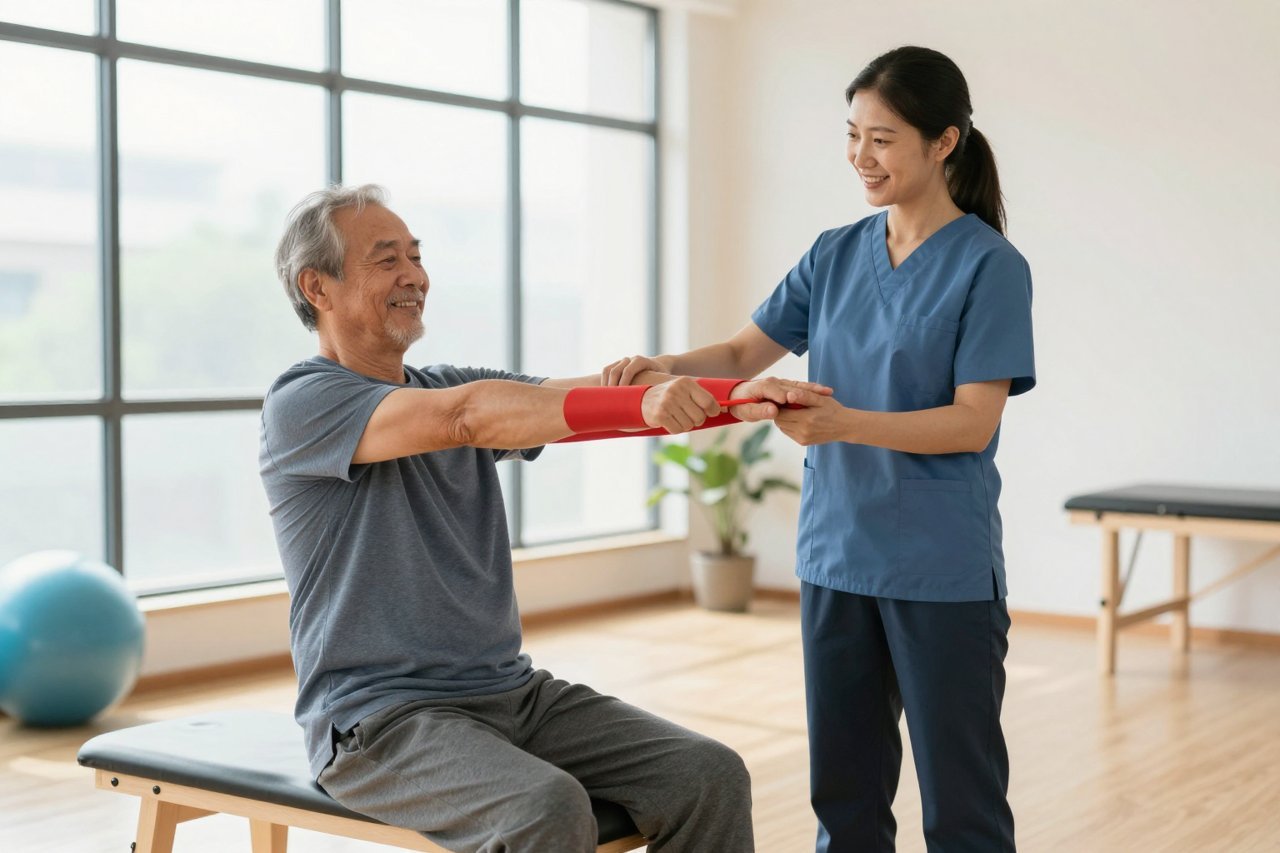
Most stroke survivors have some degree of weakness on one side of the body (hemiparesis). Physical therapy is the heavyweight in this battle. Sessions will focus on sitting balance, standing up from a chair, and walking. A therapist might support you in a harness on a treadmill, or have you practice stepping over small obstacles, and throw in a few balance exercises on a foam pad.
One method that outpaces traditional low-intensity gait practice is high-intensity interval walking. Instead of strolling at a comfortable pace, you walk at near-maximum speed for two-minute bursts, then rest. The repetition and intensity signal your brain to recruit more muscle fibres and build new neural loops. It’s not easy, but the data says it works.
Occupational Therapy: Making Daily Life Possible Again
While physical therapy is about the big muscle groups, occupational therapy is about the small ones that let you live independently. It trains you to put on a button-down shirt, brush your teeth, and cut food with one hand if needed. An occupational therapist might show you a long-handled hook to pull up a sock, or add a tap-turner to your kitchen faucet.
They also assess your home environment. The bed that’s too low, a narrow hallway, or a tub edge you can’t swing your leg over can undo months of progress. Simple changes — a raised toilet seat, grab bars in the shower, removal of loose rugs — are all part of the stroke recovery treatment prescription.
Speech and Language Therapy: More Than Just Talking
About a third of stroke survivors experience aphasia, which disrupts the ability to speak, understand, read, or write. Speech therapy uses cueing, picture cards, and intensive repetition to rebuild language networks. But this therapist also monitors your swallowing. Dysphagia, or difficulty swallowing, is often silent and can lead to food entering the lungs, causing pneumonia. Practicing safe swallowing techniques and modifying food textures can be a literal life-saver.
Advanced Therapies That Are Changing Stroke Rehabilitation
The field has moved far beyond the standard therapy table. Newer, evidence-based approaches can give you an edge, especially if you hit a plateau.
Constraint-Induced Movement Therapy (CIMT)
CIMT is as simple as it sounds: you wear a mitt on your unaffected hand, forcing the stroke-affected arm to do tasks like picking up a glass or writing. It may feel awkward, but doing this for several hours a day over a couple of weeks has been shown to increase the size of the brain region controlling arm movement. It’s intense, but the gains are often dramatic.
Robotics and Virtual Reality
Robotic devices guide your arm or leg through large, repeated movements, providing just enough support to complete the motion. The sensor feedback also tells you whether you’re actually driving the movement. Virtual reality takes this step further by projecting you into a game that asks you to reach, grab, and balance — delivering thousands of repetitions in an engaging way. These tools are not replacements for a therapist, but they multiply your practice time.
Hidden Barriers That Can Slow Your Recovery
Sometimes rehabilitation stalls for reasons that have nothing to do with your effort. These complications affect nearly every survivor, and addressing them is a crucial part of stroke recovery treatment.
Spasticity happens when muscles stay constantly tightened. Your arm might pull into a fist or your leg feel stiff. This can make stretching painful and movement exhausting. Botulinum toxin (Botox) injections directly into the tight muscle can help it relax, making therapy sessions far more effective. A custom splint worn at night can also prevent contractures.
Post-stroke depression affects roughly one out of three survivors. It manifests as persistent sadness, loss of interest, and low energy. Treating it with antidepressant medication and cognitive behavioral therapy isn’t optional — it’s a biological necessity. The brain needs a healthy chemical environment to rewire itself, and depression directly blocks that signal.
Fatigue is the most underrated barrier. After a stroke, your brain works harder to do ordinary things, which drains energy reserves fast. Overexerting to ‘catch up’ often backfires into a nap that wipes out your next session. The solution is to deliberately schedule rest between therapy blocks and treat naps as part of the prescription.
Medication and Lifestyle Changes During Stroke Recovery
Recovery is not just about exercises and therapies. It’s also about protecting the brain from another event. Around one in four survivors will have a second stroke within five years if risk factors aren’t aggressively managed.
Your care team may prescribe an antiplatelet agent like aspirin or clopidogrel, a statin to lower cholesterol, and medications to keep blood pressure in a tight range. If the stroke was caused by atrial fibrillation, a common heart rhythm disorder, you’ll likely need a stronger anticoagulant to prevent clots from forming. If that fits your situation, the treatment options for atrial fibrillation can guide what to discuss with your physician.
Many survivors are surprised that a stroke is so closely linked to heart health. High blood pressure, diabetes, and high cholesterol damage both organs. That’s why the modern medical approach to heart disease says the same things we’re telling you here: move daily, eat unprocessed food, and manage stress. Prevention is not a separate chapter — it’s woven throughout your recovery, every single day.
Building a Daily Recovery Plan at Home
After formal rehabilitation ends, what you do at home becomes your stroke recovery treatment. Research consistently shows that total intensity matters more than each individual session. You need to become your own coach.
- Set a regular wake-up time. Your brain consolidates new skills during sleep. A stable circadian rhythm makes that consolidation far more efficient.
- Do 30 to 45 minutes of focused practice twice a day. That could be walking from room to room, practising your speech words, or doing gentle range-of-motion stretches.
- Break every task into micro-steps. Instead of saying ‘go to the kitchen,’ say ‘stand up, take three steps to the doorway, rest, take three more steps.’ This explicit feedback loop rewires your brain faster.
- Keep a simple recovery diary. Note what you did, not just how it felt. Small wins become visible when written down.
- Adapt your space. Remove tripping hazards, put frequently used items at waist height, and install grab bars where you turn around most.
Also, involve your family in the right way. They should cue you and encourage you, but not take over the task. Letting you struggle through a few attempts is how you learn. It takes patience on everyone’s part, but it pays off.
What to Do When Progress Seems Stuck
Don’t panic if your recovery graph flattens after a few months. Plateaus are common and often temporary. A study of stroke patients who were at least six months post-stroke found that a structured programme of high-intensity task-specific training continued to improve walking and arm function significantly — well beyond what could be called the ‘spontaneous recovery window.’
If you’ve seen no improvement in about six weeks, ask for a fresh assessment. Your therapist may switch you from isolated strengthening exercises to functional tasks like carrying a shopping bag, climbing a curb, or reaching for a high shelf. Sometimes the method that got you here isn’t the one that takes you further.
Consider adding a completely new therapy. CIMT, robotics, aquatic therapy, or even music-based rhythmic training can stimulate parts of the brain that have gone quiet. Novelty itself is a powerful trigger for neuroplasticity.
Finally, be kind to yourself. The goal of stroke recovery treatment is not to erase the stroke and become the person you were before. It’s to build a new version of yourself that can live meaningfully, with strength, adaptability, and as much independence as you can grasp. That’s a process you can keep improving for years.


