
Table of Contents
The Aksumite Empire rarely gets the attention lavished on Rome, Byzantium or Persia, yet for nearly a thousand years it was one of the most important trading states on the planet. From its capital at Aksum in the highlands of northern Ethiopia, it controlled a corridor between the Mediterranean and the Indian Ocean, minted its own coins, carved colossal stone obelisks and, in the fourth century, became one of the earliest states to adopt Christianity officially.
Its story sits at the intersection of African, Middle Eastern and Indian Ocean history. That makes it a useful antidote to the idea that ancient power was concentrated in a handful of familiar places. The Aksumite Empire was not a remote curiosity on the edge of the known world. It was a commercial and cultural force whose ships, merchants and diplomats connected Africa to Arabia, India and the late Roman world.
A kingdom built on the Red Sea
Aksum’s rise owed much to geography. The capital sat in the northern highlands, where rainfall and fertile soil supported agriculture. Its port of Adulis, on the Red Sea coast in modern Eritrea, gave it direct access to maritime trade. Goods flowed inland to Aksum and out to Adulis: ivory, gold, frankincense, myrrh, slaves and exotic animals from the African interior; textiles, glass, wine, olive oil and spices from the Roman and later Byzantine world.
The scale of this trade was unusual. Aksumite merchants dealt in goods that originated far beyond their borders, including Indian spices and silk that had travelled through Persian intermediaries. Customs records and travellers’ accounts, including the Periplus of the Erythraean Sea, describe Adulis as a busy port with regulated trade and a king who took a close interest in commerce. Unlike the Nile-centred Kingdom of Kush, which had flourished further north, Aksum looked east as much as it looked inland. Its wealth came from the sea.

Obelisks, palaces and a distinctive civilization
The stelae
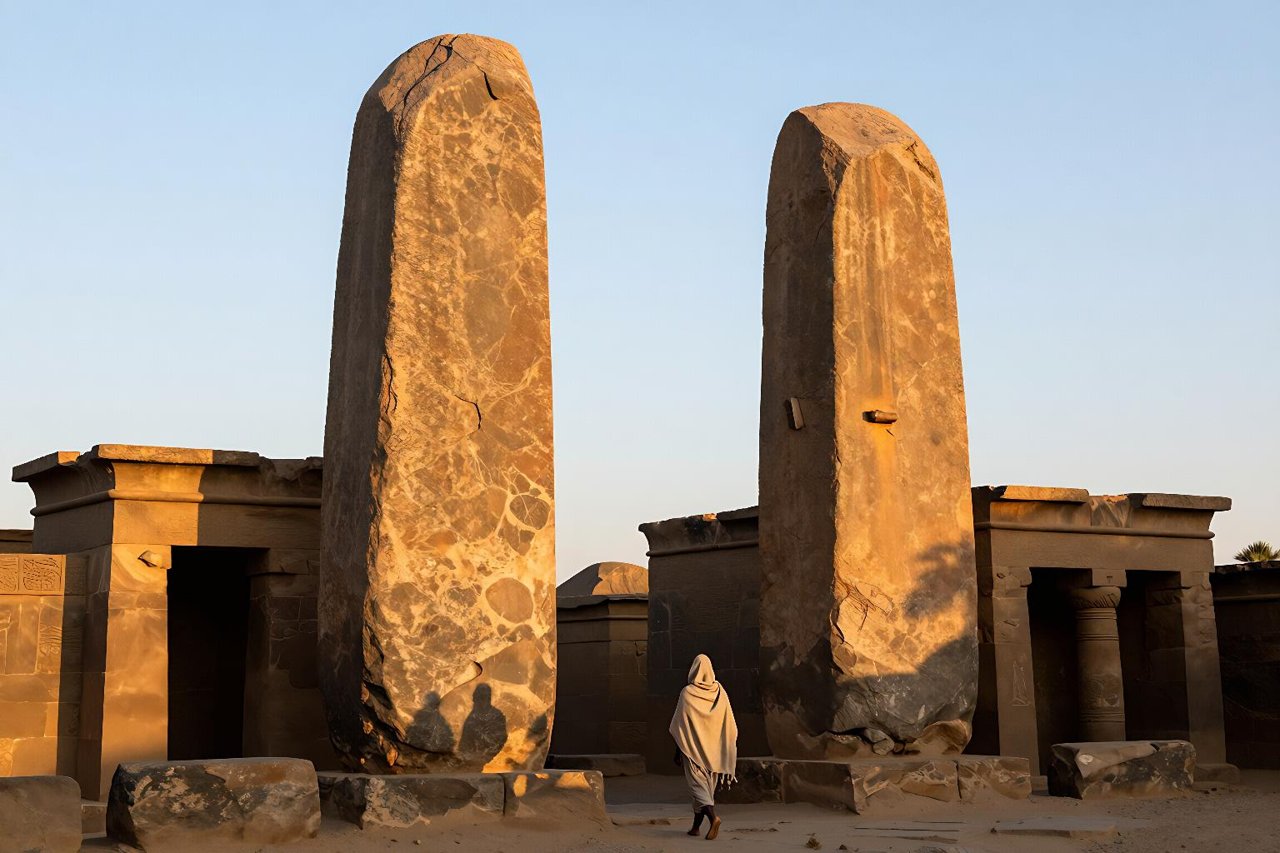
Visitors to Aksum today see the remains of a city that was once a major metropolis. The most famous monuments are the stelae, tall granite obelisks carved with false doors and windows to resemble multi-storey buildings. The largest ever attempted, known as the Great Stele, stood about 33 metres high before it collapsed, possibly during construction. The Obelisk of Aksum, around 24 metres tall, was looted by Italian forces in 1937 and returned to Ethiopia in 2005.
These monuments mark royal tombs and were probably intended to project dynastic power. Around them lie the ruins of palaces, including the large complex at Dungur, sometimes linked to the legendary Queen of Sheba, and the remains of churches, reservoirs and terraced fields. Aksumite builders used stone, timber and mortar in sophisticated ways. The city was not just a trading post; it was a political and religious centre with a distinctive visual culture.
Palaces and urban life
Aksum’s rulers lived in stone-built complexes with courtyards, storerooms and private quarters. The surrounding city supported metalworkers, potters, weavers and scribes. Excavations have turned up imported pottery, glassware and coins, evidence of a population accustomed to goods from across the Red Sea and beyond.
- Coinage: Aksum began minting gold, silver and bronze coins in the third century, making it one of the first states in Africa to do so. The coins carried royal portraits and later Christian symbols.
- Writing: The Ge’ez script developed from earlier South Arabian writing and became the basis of Ethiopian literature and liturgy.
- Architecture: Stelae, tombs, palaces and reservoirs show a state capable of organising large labour forces and long-distance resources.
- Religion: Pre-Christian Aksum honoured gods such as Mahrem and Astar, before the royal court adopted Christianity in the fourth century.
King Ezana and the Christian turn
The most consequential ruler in Aksumite history was Ezana, who reigned in the fourth century. He was converted by Frumentius, a Syrian Christian who had been captured and later became a bishop. Ezana’s inscriptions record his campaigns and his new faith, sometimes in Greek as well as Ge’ez and Sabaean. His conversion made Christianity the religion of the court and, over time, of the kingdom.
That decision tied Aksum to the wider Christian world, especially Egypt and the Byzantine Empire, while also giving it a distinct identity. The Ethiopian Orthodox Church traces its roots to this period. Ezana’s coins changed too, replacing pagan symbols with the cross. In a world where religion and political legitimacy were closely linked, the move helped the Aksumite Empire present itself as a Christian kingdom with international standing.
Money, language and the machinery of power
Aksum’s coins are one of the best clues to how the state worked. They show a ruler’s name, portrait and titles, and they were produced in several metals. That suggests a government organised enough to control minting and collect taxes, and a market economy that used money rather than relying only on barter. Ge’ez writing allowed the court to record laws, inscriptions and religious texts. The kingdom’s rulers also maintained diplomatic contacts; embassies between Aksum and the Roman emperor Constantine are recorded.
Aksum belongs in any serious account of the history of Africa, not as a footnote but as an example of how African states built complex institutions and connected to global networks. Its cities produced literature, coinage and architecture. Its merchants moved between cultures. Its kings negotiated with empires. The Aksumite Empire was one of the great trading kingdoms of late antiquity, and its achievements challenge any narrow view of where civilisation was happening.
Decline, disruption and a long afterlife
Aksum’s position depended on the Red Sea, and that made it vulnerable. In the seventh century, the rise of Islam and the Arab conquests reshaped the region. Persian and then Arab control of key ports and trade routes disrupted old patterns. Aksumite merchants still traded, but the kingdom’s commercial dominance weakened. Environmental pressures, including soil erosion and deforestation in the highlands, may also have strained the agricultural base. Political power shifted south and inland, and the old capital declined as a major centre.
Later Ethiopian traditions remember a queen named Gudit or Yodit, sometimes blamed for attacks on Aksumite churches, though the evidence is thin and debated. What is clearer is that the Aksumite state did not vanish overnight. Its culture, script and church continued, and later dynasties claimed its legacy. The Zagwe dynasty, famous for the rock-hewn churches of Lalibela, ruled after Aksum’s decline. The Ethiopian Orthodox Church kept Ge’ez alive in liturgy and scholarship.
The ancient history that produced the Aksumite Empire still matters because it shows how a state can be both deeply local and globally connected. It was African, Christian, commercial and literate at a time when many of those categories are assumed to have been separate. Its stelae stand in the highlands, its coins sit in museum cabinets, and its script still appears in Ethiopian churches. For anyone interested in the distant past, Aksum is not a side story. It is one of the main routes into it.


