
Table of Contents
Basil is the herb people either treat as a garnish or fall in love with. Walk through a farmers’ market in late July and you’ll find at least four kinds piled in bunches, and they don’t taste anything alike. Thai basil carries anise and clove, lemon basil smells like a squeezed lemon peel, and purple basil tastes of cinnamon-tinged mint. Buying the wrong one for a recipe is the difference between a green curry that sings and one that tastes flat.
This guide breaks down the varieties worth knowing, what each one actually tastes like, and where they belong in your cooking — including how to keep a bunch from turning to black mush by Thursday.
Sweet basil: the one you already know
Genovese, the classic sweet basil, has broad, cupped leaves and a flavour of anise, clove and black pepper. It contains roughly 20% eugenol by volume in its essential oil, which is why it smells faintly medicinal when crushed but sweet when torn. That clove note is also why it pairs so well with tomatoes — both share volatile compounds that amplify each other.
Buy it in bunches with leaves that look barely able to stand upright. Drooping leaves mean it was harvested days ago and the flavour has already faded.

How to use sweet basil
Heat destroys its aromatics fast. Tear leaves into a sauce at the very end of cooking, or better, add them off the heat. In a batch of Marcella-style tomato sauce, stirring in a handful of torn leaves after the pot is off the burner gives a brighter result than simmering them for 20 minutes. For pesto, blanch the leaves for 10 seconds, shock them in ice water, then squeeze dry — the colour stays vivid green instead of turning muddy.
Thai basil: anise, pepper, and staying power
Thai basil has narrow leaves with purple stems and a stiff, upright structure. It tastes of anise and sweet liquorice with a peppery finish, and crucially, it holds up to heat far better than sweet basil. That’s why it goes into stir-fries at the start rather than the end.
Use it in a chicken stir-fry with garlic, chilli and fish sauce, or tear it into a bowl of pho where the hot broth wilts it in seconds. It’s also the herb for green curry — stir it in off the heat and let the residual warmth release the oils. Roughly one generous handful per two servings is a good starting ratio.
Holy basil (tulsi): clove, menthol, and a bite
Holy basil is sharper and more peppery than Thai basil, with a strong clove aroma and a cool menthol edge. Its leaves are slightly serrated and fuzzy. In Thai cooking it’s the herb for pad krapow, where it’s fried hard in hot oil until it crackles and darkens.
The trick with holy basil is speed: get your wok properly hot, add the leaves to oil for 20–30 seconds until they crisp, and move on. Long cooking turns it bitter. Outside Thai cuisine, it makes an excellent herbal tea — a few leaves steeped in hot water for three minutes taste of clove and mint.
Lemon basil: citrus without zesting
Lemon basil has pale, narrow leaves and a scent so citrusy you’ll check whether someone nearby is peeling a lemon. It’s used heavily in Thai and Laotian cooking and in some Indonesian dishes, and it’s badly underrated in Western kitchens.
Try it shredded into a cucumber and yoghurt salad, stirred through grilled fish, or muddled into a gin and tonic in place of lime. It also deals well with fruit: a few leaves with sliced peaches and a drizzle of honey is a two-minute dessert. Use it raw — cooking flattens the citrus note almost completely.
Purple and opal basil: colour and cinnamon
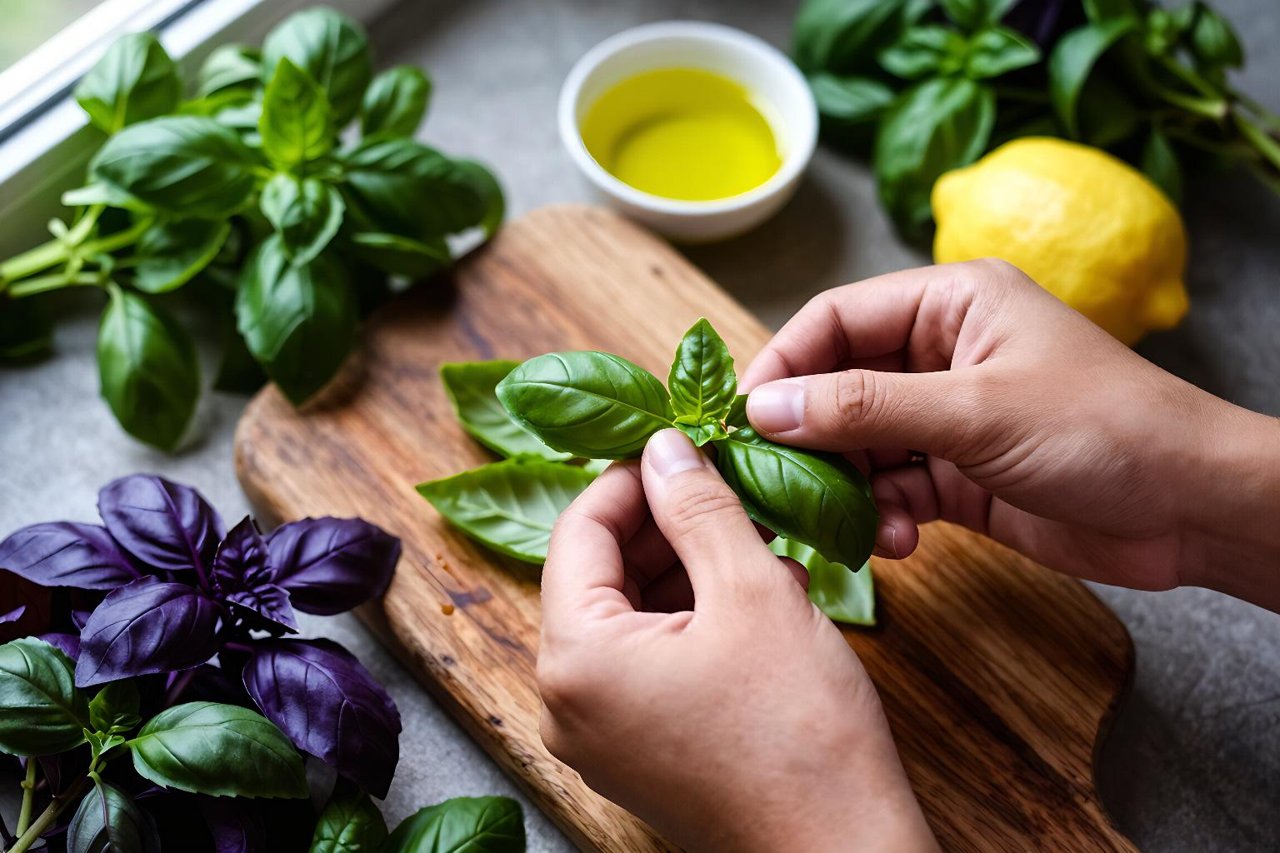
Purple basil (sometimes sold as opal basil) has deep burgundy leaves and a flavour like sweet basil crossed with cinnamon and mint. It’s less anise-forward than Genovese, which makes it friendlier in salads.
Two practical notes. First, purple basil loses its colour in heat and bleeds into dressings, so use it raw or as a garnish. Second, if you tear it into a salad, dress the leaves separately and add them last — otherwise everything on the plate turns a greyish pink. It’s excellent with mozzarella, olive oil and a squeeze of lemon, and it makes a striking deep pink vinegar if you steep a bunch in white wine vinegar for a fortnight.
A quick reference to basil varieties
- Genovese / sweet basil: anise and clove; pesto, tomato salads, caprese; add off the heat.
- Thai basil: anise and black pepper, heat-stable; stir-fries, curries, pho.
- Holy basil / tulsi: clove, peppery, menthol bite; pad krapow, herbal teas.
- Lemon basil: bright citrus, delicate; salads, fish, cocktails, fruit — raw only.
- Purple / opal basil: cinnamon and mint, milder; raw garnishes, infused vinegar, salads.
- Bush basil / Greek basil: tiny leaves, concentrated sweet flavour; whole in salads where you don’t want to chop.
- African blue basil: camphor-heavy, ornamental, best left to the bees.
Storing and prepping basil so it lasts
Basil is cold-sensitive. Refrigerating a bunch dry is the fastest way to black leaves, because temperatures under about 10°C damage the cell walls. Instead, trim the stems, stand the bunch in a glass of water on the counter, and loosely cover it with a plastic bag. Change the water every two days. It keeps for a week to ten days this way, sometimes longer.
For longer storage, blend leaves with olive oil — roughly two parts oil to one part packed leaves — and freeze in ice cube trays. Each cube is about a tablespoon and drops straight into a soup or sauce. Drying basil is possible but the anise note largely disappears; frozen oil cubes are a better bet.
Chop or tear?
Tear. A knife blade bruises the leaves and starts the oxidation that turns them black, and it also smears the cut surfaces so the aroma escapes before it reaches the plate. If you do need chopped basil, use a very sharp knife and a light touch, and add it at the last possible second.
Growing a few plants for the summer
Basil is one of the easiest herbs to grow in a pot, and homegrown leaves taste noticeably stronger because they’re used within minutes of picking. Give it at least six hours of sun, water it when the top centimetre of soil dries, and pinch out the growing tips every couple of weeks. That pinching is the important part — the moment flowers form, the leaves turn woody and bitter. Keep harvesting from the top and the plant stays productive until the first frost.
One habit that pays off immediately: plant two varieties side by side, a Genovese and a Thai basil. You’ll stop reaching for the supermarket packet, and you’ll start noticing that the recipe calling for “basil” probably had a specific one in mind.


