
Table of Contents
The box says “made with real honey” in letters the size of a billboard. The panel on the back says 12 grams of added sugar per bar. That is roughly a third of what most adults should eat in an entire day, in something sold as a healthy snack. The gap between the marketing and the maths is exactly why learning to read a nutrition label pays off so quickly.
Serving size comes first, and it is rarely the whole package
Every number lower down the panel is tied to the serving size printed at the top. A 500ml bottle of orange juice might declare 250ml as one serving, with 26g of sugar. Finish the bottle in one go and you have had 52g, or about 13 teaspoons. Four grams of sugar equals roughly one level teaspoon, which is the fastest mental conversion you can carry around a supermarket.
Serving sizes also reflect what regulators assume people eat, not what actually lands on your plate. The reference serving for a bagel is 55g; the ones at the bakery counter weigh closer to 100g. If your portion is double the label’s, double everything: calories, sodium, sugar, the lot.
Added sugars have their own line for a reason
Labels in the US have listed “Added Sugars” separately since 2020, with its own percentage daily value. The reference is 50g a day, which is more generous than the American Heart Association’s 25g for women and 36g for men. Four grams of added sugar is 8% of the daily value, and those small percentages stack up fast across a day of snacks, sauces and drinks.

Yogurt is a clean example. Plain Greek yogurt carries about 5g of sugar per 150g pot, all of it lactose. A flavoured tub of the same size often hits 15g, and ten of those grams were added.
Sugar wears a lot of names
Ingredient lists rarely say “sugar” more than once, but they do not have to. Watch for:
- Cane sugar, cane juice, brown rice syrup, tapioca syrup
- Agave nectar, honey, maple syrup, coconut sugar
- Dextrose, maltodextrin, corn syrup solids, fruit juice concentrate
Coconut sugar and agave get marketed as gentler alternatives. Your body handles them much like table sugar, and the panel counts them the same way. Total carbohydrate also lumps in fibre and sugar alcohols, so two products with identical carb counts can behave very differently in your body. If you are tracking net carbs for a low-carb approach, this practical guide to ketosis and keto food lists explains how to work the numbers out.
The ingredient list is the honest half of the label
Ingredients appear in descending order by weight. A cereal starting with “whole grain oats” is a different product from one starting with “wheat flour, sugar, corn syrup.” Wheat flour is refined flour; only “whole wheat flour” tells you the bran and germ survived the milling.
Splitting is the classic trick. Sugar listed three ways (cane sugar, dextrose, fruit juice concentrate) can sit in the bottom half of the list while being the single biggest ingredient by weight once the three are added together. Reading the first five ingredients and counting how many are sugar in disguise takes about eight seconds.
“Made with whole grains” is a claim, not a measurement. It can mean a spoonful of oats scattered through a product that is mostly white flour.
Check protein and fibre before you check calories
Protein %DV is based on 50g a day, which is a floor rather than an ideal for most active adults. A 150g pot of Greek yogurt lands around 15g; a slice of standard sandwich bread has 3g. Putting a chicken breast, a cup of lentils and a pot of Greek yogurt side by side on protein and fibre makes the spread obvious. If you want to raise your intake without weighing every meal, this step-by-step plan for eating more protein-rich foods is built around ordinary portions.
Fibre is the number most people skip. Adults average around 15g a day against a target of 25 to 30g. A “good source of fibre” claim means 10% of the daily value, or 2.8g, per serving. “Excellent source” means 20%, so read the panel rather than the badge.
Sodium hides in bread, cheese, sauces and anything frozen. The daily value is 2,300mg, so one frozen lasagna at 900mg takes 39% of your day before you have added a side.
Percent Daily Values are a ruler, not a prescription
Every %DV is calculated against a 2,000-calorie diet, a reference person who probably is not you. Use it as a scale: 5% is low, 20% is high, and the middle ground is middling. A cyclist training four times a week and a desk worker in her fifties have very different needs from the same box of crackers.
For a deeper walk through the panel layout and how to compare products fast, this breakdown of how to read food labels like a pro is worth ten minutes.
Supplement bottles play by different rules, with their own serving sizes, ingredient forms and dose quirks. That is why choosing a multivitamin starts with the same label-reading habit, just applied to a Supplement Facts panel instead.
Front-of-pack claims follow looser rules
Words on the front are marketing. The panel on the back is regulated. Some common gaps:
- “No added sugar” means nothing sweet was tipped in, but a date-and-raisin bar can still carry 20g of naturally occurring sugar.
- “Sugar-free” means under 0.5g per serving, so check that serving size. It can be two squares of chocolate.
- “Light” means a third fewer calories, or half the fat or sodium, than the standard version. It does not make the product low in anything.
- “Multigrain” means several grains were used. None of them have to be whole.
Put two products side by side
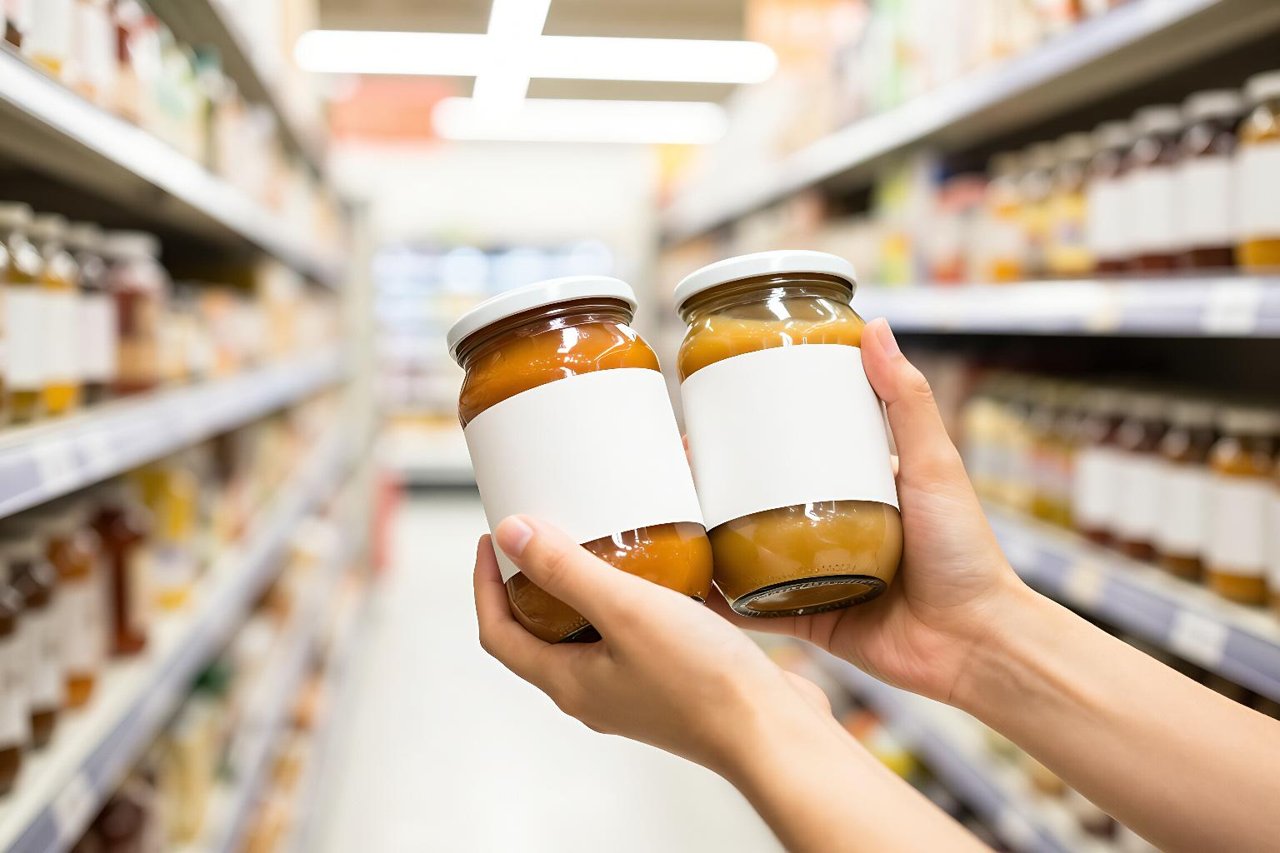
The skill sharpens fastest when you compare rather than judge in isolation. Take two peanut butters. The first lists peanuts, sugar, palm oil and salt, with 3g of sugar and 120mg of sodium per 32g serving. The second lists peanuts and salt, with 0g of sugar and 60mg of sodium. Neither is poison, but only one matches what you probably went looking for.
Run the same exercise on granola, pasta sauce, protein bars, yogurt. Pick the two products you buy most and spend a minute on the labels this week. After a few trips you stop reading every panel and start reading the four or five that genuinely change your choices, which is the point where label reading stops feeling like homework and quietly becomes a habit.


