
Table of Contents
A good beach town is not the same thing as a good beach. You can find flawless sand in a hundred places and still spend the week circling for parking, shouting over a beach bar, and checking your watch because the one restaurant you wanted has a ninety-minute wait.
The towns below get the other parts right. They’re small enough to walk, cheap enough to stay a while, and built around something other than separating visitors from their money. None of them are secret. All of them reward people who show up without a packed itinerary.
Seven picks across four continents, plus a note on timing at the end that matters more than most people expect.
The Quiet Checklist: What These Towns Have in Common
Before the list, here’s the filter I used. It isn’t scientific, but it holds up:

- Walkable to the water. Ten minutes from bed to sand, ideally on flat ground.
- Some local life. A school, a hardware store, a fish market. Tourism is part of the economy, not the whole thing.
- Low buildings. One or two storeys. A high-rise strip changes the feel of a place faster than anything else.
- One free thing to do. A pier, a headland trail, a square where people actually sit.
- A real off-season. Towns that empty out for a few months tend to stay sane the rest of the year.
Pacific Towns That Run on Their Own Clock
San Pancho, Nayarit, Mexico
Forty-five minutes north of Sayulita, San Pancho (officially San Francisco) holds about 2,000 people and refuses to grow up in a hurry. There’s no jet-ski rental row, no beach club with a minimum spend, and the paved road gives out roughly eight blocks from the water.
Mornings belong to surfers and to the fishermen hauling pangas onto the sand. Evenings belong to the turtle release at the north end of the beach, where volunteers let hatchlings go at sunset a few times a week in season. Swimming isn’t the draw here; the surf is punchy and the undertow is real. Bring a book, walk the estuary trail behind town, and eat at the taco stands along Calle Tercer Mundo.
Hanalei, Kauai, Hawaii
Kauai’s north shore ends at a one-lane bridge, and the town on the other side has barely changed in thirty years. Hanalei sits in a bowl of taro fields and green cliffs, with a bay close to two miles wide and a pier that locals use for fishing and kids use for jumping.
The water inside the bay is calm enough for paddleboarding; the waves at the far end suit actual surfers. Go early, because the beach park lot fills by 9am in summer. If you want to walk the Kalalau Trail or see Ke’e Beach at the end of the road, book your Ha’ena State Park entry online weeks ahead. Numbers are capped and there are no drive-up tickets.
Warm Water and Slow Mornings
Amed, Bali, Indonesia
Bali’s east coast is where the island goes to slow down. Amed is really a string of fishing villages spread along 14 kilometres of black-sand coast, and the pace is set by the jukung boats heading out at dawn and the snorkellers drifting over the reef at Jemeluk an hour later.
Skip the beach clubs and take a guesthouse with a rooftop. The best swimming is off the reef edge at Jemeluk and Lipah, and Mount Agung turns pink behind you around 6pm on clear evenings. If you want the rest of the island’s coast to compare, this guide to the best beaches in Bali for swimming and surfing covers the west and south too.
Diani Beach, Kenya
Thirty kilometres south of Mombasa, Diani runs white sand for 17 kilometres behind a coral reef that keeps the lagoon flat and bath-warm. Colobus monkeys cross the hotel driveways, the kitesurfing season runs June to September, and a plate of grilled kingfish at a beachfront shack costs less than a coffee in most European capitals.
It’s also the kind of place where two weeks makes more sense than a long weekend. For a longer stay, this piece on digital nomad destinations on Kenya’s coast covers Diani, Watamu and Kilifi, including wifi speeds and where people actually work.
Cool-Water Towns for People Who Don’t Want Heat
Lunenburg, Nova Scotia, Canada
Not every relaxing beach vacation has to be warm. Nova Scotia’s South Shore has water that will take your breath away in June and a coastline that empties almost completely by late September.
Lunenburg is the obvious base: a UNESCO-listed waterfront painted in yellows, reds and blues, with the Bluenose II tied up for part of the summer. From town you’re 25 minutes from Hirtle’s Beach, a crescent of white sand behind a drumlin that rarely has more than thirty people on it. Pack a windproof layer. For a wider route, these things to do in Nova Scotia stretch from Halifax up to Cape Breton.
Cape May, New Jersey, USA
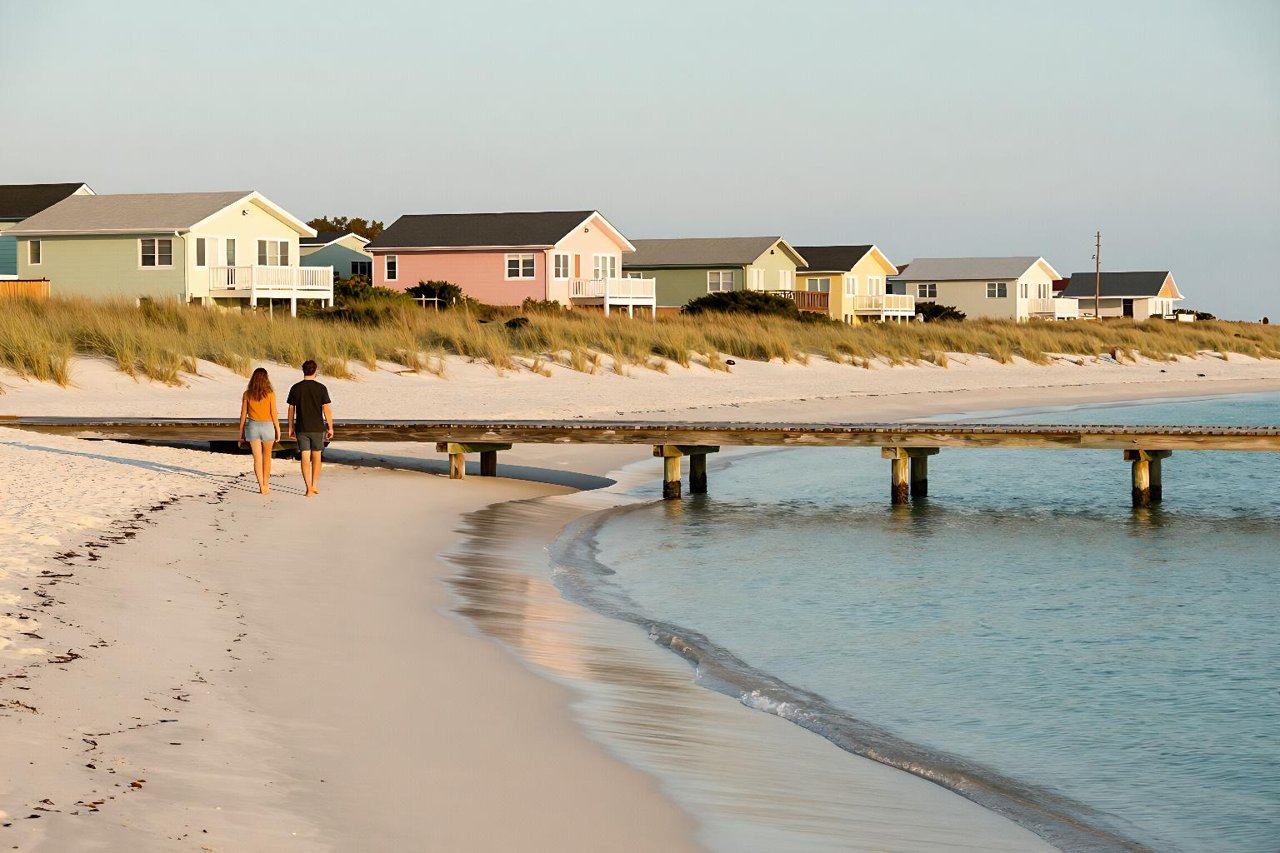
Cape May sits at the very tip of New Jersey, where the Atlantic meets Delaware Bay. It’s a Victorian town rather than a boardwalk town: gingerbread houses, horse-drawn carriages, a lighthouse you can climb, and a beach wide enough that it still feels open in mid-August.
You need a beach tag to sit on the sand in summer, and it’s worth buying one. Go after Labor Day, when the ocean is still around 22°C and the porch chairs on the guesthouse verandas are free. Prices drop the same week. This list of places to visit in September in the USA puts Cape May in good company.
One Mediterranean Town Worth the Trip
Otranto, Puglia, Italy
Puglia’s heel gets overlooked next to Sicily and the Amalfi Coast, which is exactly the point. Otranto has an Aragonese castle, a cathedral mosaic floor laid in 1163, and a bay of clear turquoise water that stays swimmable into October.
Book a room inside the old town walls and walk everywhere. Baia dei Turchi, a short drive north through pine forest, is the beach to plan a day around. July and August belong to Italians on holiday; in late May or early September you can get the same harbourfront table without waiting. A bicycle is the most useful thing you can rent.
Pick Your Dates Before You Pick Your Town
Two weeks of timing will do more for your trip than a better hotel. A few rules that hold almost everywhere in the Northern Hemisphere: the fortnight after Labor Day is the best-value beach window of the year, with warm water, empty schools and rates down 30 to 50 percent in most coastal towns. In the Mediterranean, June and September beat July and August on price, crowds and temperature alike. Mexico’s Pacific coast is driest from November into early December, before the holiday rush. Bali’s east coast is best between April and October, outside the wet season.
One last practical thing: book somewhere with a kitchen. In a small beach town, half the good meals are the ones you assemble from whatever the fish truck dropped off that morning, eaten on a balcony while the light goes orange. Leave one day in every three completely unplanned, and let the town tell you what to do with it.


