
Table of Contents
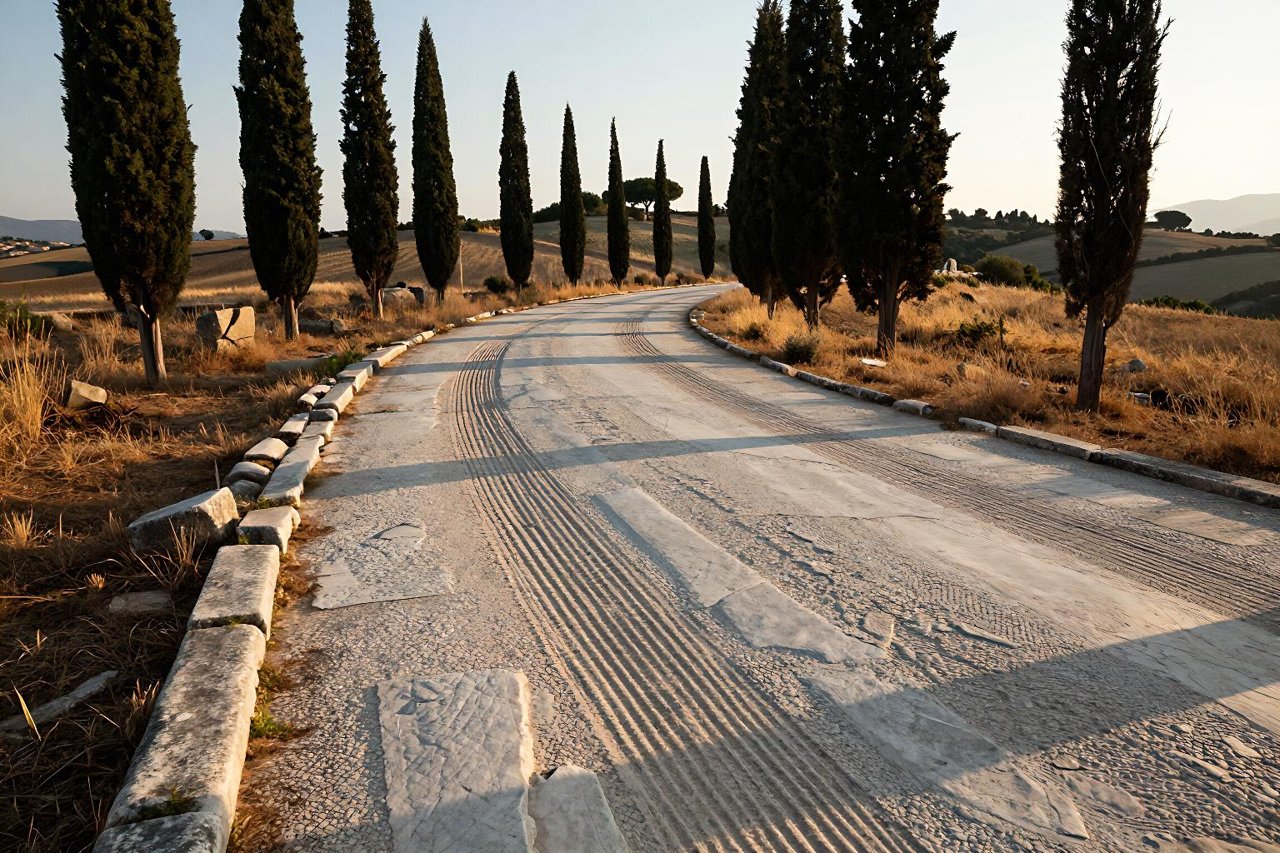
In 312 BC a Roman official named Appius Claudius Caecus ordered a road built south from Rome towards Capua. It was paved in tightly fitted basalt, crowned so rainwater ran into ditches on both sides, and long stretches of it are still walkable more than 2,300 years later. The Via Appia became the template for a network that eventually stretched to roughly 80,000 kilometres, and it is the reason the phrase “all roads lead to Rome” outlived the empire that built them.
Rome gets the credit, but the road is far older than Rome, and the engineering behind it is more varied than most people assume. Ancient road builders had no asphalt and no steam rollers, and usually no animal stronger than an ox. What they did have was survey geometry, an effectively unlimited labour force, and a very clear sense of what a road was for.
Before Paving: Trackways, Causeways and Cleared Stone
The oldest engineered track in northern Europe is the Sweet Track in Somerset, England, laid across a marsh around 3800 BC. Oak planks rested on crossed rails, held down by hundreds of hazel pegs hammered into the peat. Wood analysis shows the pegs came from coppiced trees, meaning the builders were managing woodland specifically to produce straight, uniform stakes. That is a surprising amount of forward planning for a footpath through a swamp.
Most early routes solved a local problem. Britain’s Ridgeway followed high chalk downland to stay out of the mud and the woods. Egyptian desert tracks to the oases were cleared of loose stone and marked with cairns, and some had wells and shelters spaced a day’s walk apart. In the Mesopotamian floodplain, where stone was scarce and mud was everywhere, roads were often little more than graded earth embankments kept dry by constant repair.

Rome’s Roads Were Built in Layers
Roman engineers treated a road as a structure rather than a surface. They dug a trench (the fossa), sometimes two metres deep, then filled it in courses that each did a different job:
- Statumen – a base of large flat stones or rubble, laid to spread the load.
- Rudus – broken stone or cobbles rammed tight with lime mortar.
- Nucleus – finer gravel and lime, compacted to bind the layers above and below.
- Summum dorsum – the polygonal paving stones, cut to fit snugly so a cartwheel could cross a joint without splintering it.
The surface was cambered, usually with a gentle crown of about 1 in 40, so water shed sideways into drainage ditches. In flat or marshy ground the whole thing went on a raised embankment, the agger. Ditches did more for the lifespan of a Roman road than the paving did.
Setting out a dead-straight line over 50 kilometres of hilly ground took instruments, not guesswork. Surveyors used the groma, a cross on a staff with plumb bobs, to sight right angles, and the chorobates, a levelled bench about six metres long, to check gradients. They also cut cuttings through hills and built switchbacks where a straight line was impossible, though they avoided them when they could because a gradient slowed the pack animals.
The Persian Royal Road and the Relay of Riders
Herodotus describes a road running from Sardis in western Anatolia to Susa, about 2,500 kilometres, with 111 post stations and fresh horses at each. Ordinary travellers took around ninety days. Royal couriers, handing messages along the chain day and night, could cover the distance in a fraction of that, which prompted Herodotus to write that nothing in the world travels faster than these Persian messengers. The line survives, in slightly altered form, on the facade of the New York post office.
This was infrastructure built for control as much as commerce, a theme that runs through the whole story of how the Persian Empire turned a highland kingdom into a superpower. Roads carried orders, tax grain, troops and, incidentally, merchants.
The Inca: 40,000 Kilometres Without a Wheel
The Qhapaq Ñan, the Inca road system, ran roughly 40,000 kilometres along the Andes, from what is now Colombia down to Argentina and Chile. Two main highways ran north to south in parallel, one along the coast and one through the highlands, linked by cross routes.
There were no wheeled vehicles and no horses, so the surface was designed for feet and llamas: stone steps on steep climbs, flights of stairs cut into cliff faces, drainage culverts under the paving, and retaining walls holding the road against slopes. Rivers were crossed on suspension bridges woven from twisted grass rope, cables as thick as a man’s thigh. One of them, the Q’eswachaka bridge over the Apurímac, is still rebuilt by hand each June by communities using pre-Hispanic techniques.
Labour came through the mit’a, a rotating obligation owed to the state, which is why a mountain empire with no iron tools and no draught animals could maintain tens of thousands of kilometres of road. Messages moved through relay runners called chasquis, each covering a few kilometres before sprinting on, transferring a knotted quipu or a spoken message at speed.
China, Standard Axles and the Straight Road
Qin Shi Huang, the first emperor, is credited with the Zhidao, a “straight road” pushed north from the capital at Xianyang towards the frontier around 212 BC. More significant than any single road was his standardisation of axle widths. If every cart on the network has the same track, vehicles run in the same two ruts, and the road wears evenly and stays passable in wet weather. Han records describe some 6,800 kilometres of imperial highway, with post stations, granaries and garrison depots along the way.
Gradients, Rivers and Tropical Mud
Holding a gradient
Water destroys roads faster than traffic does. Ancient builders fought it with camber, side ditches, stone-lined culverts and raised causeways. Where a route had to climb, they either cut a shelf into the hillside or crossed it with zigzags long enough for a loaded animal to manage. Log corduroy roads, laid plank across plank over soft ground, appear from Bronze Age Europe to Roman Britain.
Bridges that moved armies
Darius crossed the Bosphorus on a bridge of boats in 513 BC. Trajan’s bridge over the Danube at Drobeta, designed by Apollodorus of Damascus around AD 105, spanned about 1,135 metres on twenty masonry piers, some of which still stand in the river. Roman stone bridges used cutwaters on the piers to split the current and semicircular arches shaped from wooden centring that was removed afterwards.
Laterite in the monsoon belt
In mainland Southeast Asia the material of choice was laterite, a iron-rich soil that hardens almost to concrete when cut and left to dry. The road builders of the Khmer Empire, which built the largest city on earth in the jungle, laid laterite highways between Angkor and major provincial centres, with rest houses every fifteen kilometres or so, hospitals, and bridges whose balustrades were carved as nagas. The paving survives; the maintenance organisation that kept it clear of jungle did not.
What a Road Actually Leaves Behind
Milestones, itineraries and customs records show that these networks were as much commercial as military. The Antonine Itinerary lists routes and stopping points across the Roman world, and the Peutinger Table compresses the whole empire into a schematic strip map. Roads fixed the shape of the trade that ran along them, from the salt caravans of the Sahara to the silk moving overland from China, a pattern still visible in the ancient trade routes that reshaped whole economies.
They also reveal who was paying. The techniques of levelling, drainage and mass labour described here were the same ones used for how ancient cities were built from water, mud and muscle, and both depended on a state able to conscript tens of thousands of people for months at a time.
The clearest lesson from surviving stretches of road is that construction was never the hard part. Roman law made landowners responsible for the road fronting their property, and emperors appointed curators to keep the highways in repair. When that administration collapsed, the engineering outlasted it by centuries but nothing replaced it. Roads built fifteen hundred years ago still cut across the landscape in straight lines, and the tracks of civilizations that disappeared without a trace can often be followed on foot today, overgrown but lined up exactly where a surveyor set his sighting staffs. What failed was not the paving. It was the institution that swept it.


