
Table of Contents
There’s no single food that adds years to your life. That’s the first thing worth knowing, and it saves a lot of money on powdered mushroom blends. When researchers follow large groups of people for 20 or 30 years and look at who lives longest, the answer that emerges isn’t a superfood.
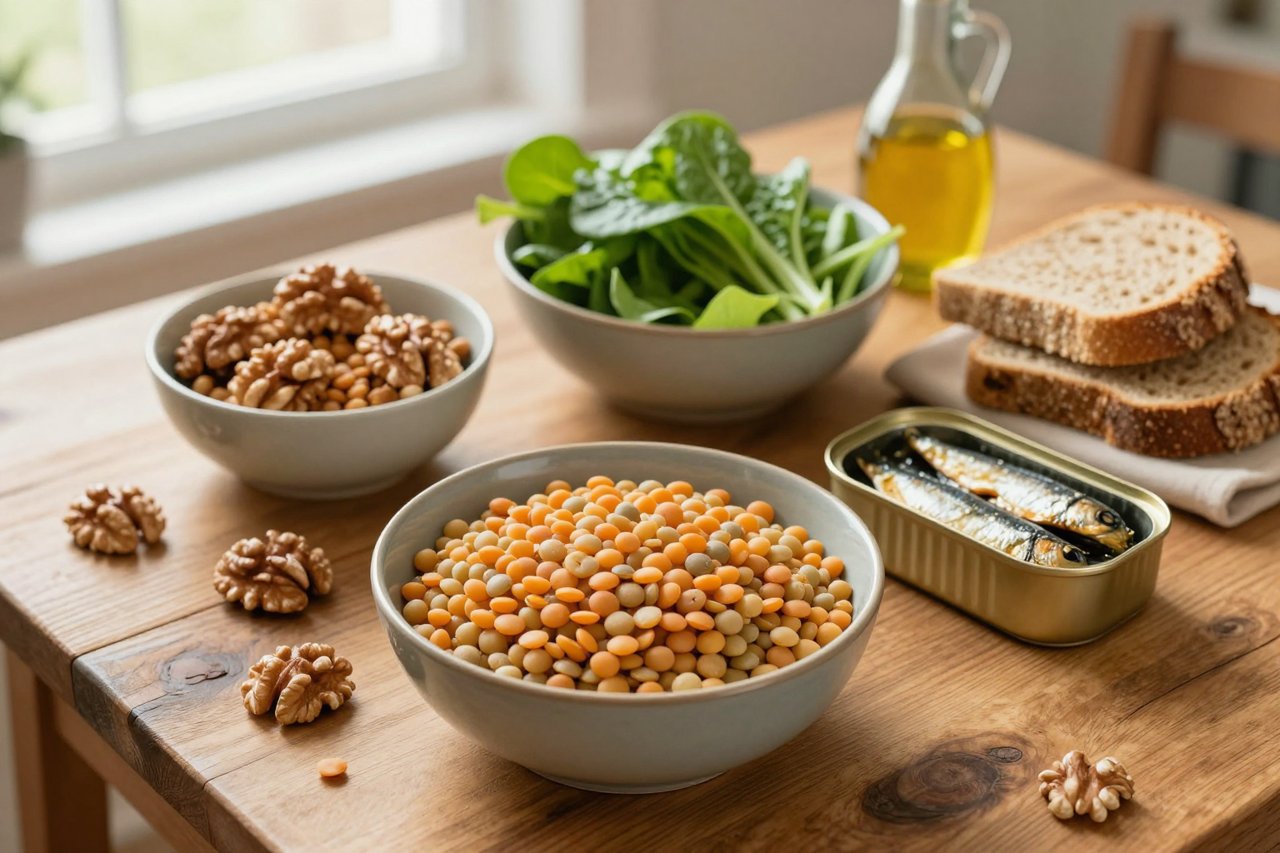
It’s a pattern: beans, vegetables, whole grains, nuts, fish and olive oil, eaten most days without much drama. Not exciting. Extremely well documented.
If you’re starting from zero, this is the primer worth reading before you buy your first tub of collagen. We’ll cover what longevity research actually measures, the food groups that keep showing up, the one number on a nutrition label that matters more than any ingredient list, and five swaps you can make this week.
What the research actually measures
Longevity nutrition isn’t really about living to 110. It’s about compressing the years you spend unwell into the last few months of life, so you get more time with a body that works.

Three types of study do most of the heavy lifting:
- Cohort studies: tracking 100,000+ people for decades and comparing what they eat against death rates.
- Randomised trials: like PREDIMED, which assigned 7,447 people at high heart risk to a Mediterranean diet or a low-fat control diet and found roughly 30% fewer heart attacks and strokes in the Mediterranean groups.
- Blue Zone fieldwork: populations in Okinawa, Sardinia, Ikaria, Nicoya and Loma Linda, where people reach their 90s at unusual rates.
None of these prove a specific food is magic. They show that combinations of food, repeated over decades, shift your odds. A 2019 analysis in The Lancet estimated that poor diet contributes to about one in five deaths worldwide. That’s the scale we’re working at.
If you want a picture of what that looks like on a real plate, the everyday version of longevity eating fills in the practical detail.
The food groups that keep showing up
Legumes: beans, lentils, chickpeas, split peas
This is the group most people under-eat and the one with the strongest track record. Legumes deliver fibre, protein and minerals in one cheap package, and studies consistently link higher intake to lower death rates. A can of chickpeas costs about a pound and covers two meals.
Vegetables, especially the leafy ones
No surprise here, but the specifics matter. Leafy greens (spinach, kale, rocket, chard) carry nitrates, folate and vitamin K. Cruciferous vegetables (broccoli, cabbage, cauliflower) come with compounds that show up repeatedly in cancer research. Variety beats eating the same three vegetables on rotation.
Whole grains
Oats, barley, brown rice, wholegrain bread, quinoa. Meta-analyses put each additional 30g of whole grains a day at roughly 5 to 8% lower risk of dying during the study period. Whole grains also feed gut bacteria that produce short-chain fatty acids, which is a big part of why they keep appearing in longevity data.
Nuts and seeds
People who eat a small handful most days have around 20% lower all-cause mortality than people who rarely eat them. Walnuts, almonds, pistachios, pumpkin seeds, flaxseed. The handful matters more than the type.
Fish and seafood
One or two servings of oily fish a week (salmon, sardines, mackerel, herring) is the standard recommendation. Tinned sardines count and cost very little. Omega-3 fats get the headlines, but fish also takes the place of processed meat on the plate, which is arguably the bigger win.
Olive oil
Extra virgin olive oil is the fat most consistently linked to lower mortality. In a 2022 study of more than 90,000 people, those with the highest olive oil intake had around 19% lower risk of dying from any cause, and swapping 10g of butter or margarine for olive oil was linked to a lower risk still.
You’ll notice the Mediterranean and Blue Zone patterns are built almost entirely from the groups above. There’s a useful breakdown of how the Mediterranean, Blue Zones and plant-based patterns compare if you want to see where they overlap and where they genuinely differ.
The one number worth tracking: fibre
If you change a single thing, change this. A major 2019 meta-analysis in The Lancet pooled 185 studies and found that people eating the most fibre had 15 to 30% lower risk of dying from any cause compared with those eating the least.
Most adults in the US and UK get roughly 15 to 18g a day. Targets sit at 30g in the UK and 25 to 38g in the US depending on sex. That’s a gap of nearly double.
Some real numbers to work with:
- 1 cup cooked lentils: about 15g
- 1 cup cooked black beans: about 15g
- 1 cup cooked oats: about 4g
- 1 medium pear with the skin on: about 5g
- 30g almonds: about 4g
- 1 cup cooked broccoli: about 5g
Fibre also slows how quickly glucose reaches your bloodstream, feeds gut bacteria and keeps you full, which is why it does double duty for weight and blood sugar. If you’re managing diabetes, that shifts the calculus a little, and comparing the low-carb, Mediterranean and plant-based approaches for blood sugar is worth doing before you overhaul your plate.
One caution: build up gradually. Going from 15g to 40g overnight buys you bloating and a bad attitude. Add about 5g a week and drink more water than you think you need.
What to eat less of
Adding kale to a diet built on fizzy drinks and processed meat does very little. The subtraction side matters as much as the addition side.
- Ultra-processed food. A 2024 BMJ umbrella review of 45 studies linked the highest intakes to roughly 50% higher risk of death from cardiovascular disease, plus higher rates of type 2 diabetes and anxiety.
- Processed meat. Bacon, ham, salami, hot dogs. The cancer agency classifies it as a Group 1 carcinogen, and around 50g a day (one hot dog, two rashers) is linked to about 18% higher colorectal cancer risk.
- Sugary drinks. Liquid sugar bypasses the fullness signals whole fruit triggers, and regular intake tracks closely with type 2 diabetes risk.
- Salt. Most people eat 8 to 10g a day against a WHO recommendation of under 5g. Around three quarters of it hides in bread, sauces and processed food rather than the salt shaker.
None of this means never. It means the weekly ratio shifts. Heart disease is the clearest example, because there are also common habits that quietly cancel out heart-healthy food, mostly to do with what you eat alongside the good stuff rather than the good stuff itself.
And there’s a specific set of everyday mistakes that cancel out the foods that actually work, which is worth knowing before you spend six months doing the right things badly.
Your first week: five swaps that stick
Skip the 30-ingredient smoothie. Start here instead.
- Swap half your white grains for whole. Half white rice, half brown. Half white pasta, half wholewheat. The fibre difference is real and the taste transition is far easier than going cold turkey.
- Add one can of beans to something you already cook. Chilli, soup, pasta sauce, curry. It’s the cheapest nutrition upgrade available.
- Replace one daily snack with a small handful of unsalted nuts.
- Cook your vegetables in olive oil. Same effort, better fat profile. Keep the bottle next to the hob.
- Eat oily fish twice a week. A tin of sardines on toast covers one of those in about 90 seconds.
Do those five for a month and you’ll likely be 8 to 10g of fibre a day ahead of where you started, which is most of the way to the target.
Then build. Get leafy greens in most days. Use herbs, lemon and spices before reaching for salt. Keep fruit visible on the counter rather than hidden in a drawer. The changes stack, and those 30-year studies are really just measuring what a handful of consistent choices look like across a lifetime.
One last thing, said plainly: you don’t have to get this perfect, and almost nobody does. The research doesn’t compare perfect eaters with everyone else. It compares people who get most of their calories from plants, beans, fish and olive oil with people who don’t. That gap is where the extra years live, and you can start closing it at your next meal.


