
Table of Contents
The first time my Lab puppy shot through a hole in the fence, I did exactly what you’re not supposed to do. I grabbed my phone, opened the GPS puppy collar app, and saw a dot sitting calmly in the yard. I exhaled. Then I looked up. The yard was empty. The collar was on the front steps, chewed off.
That day taught me more than a lesson about puppy teeth. It taught me that a GPS puppy collar is not a magic shield. It’s a tool with real limitations, and most owners, including me, make the same assumptions about it. The good news is that every one of those mistakes is avoidable. Here’s how.
Mistake #1: Buying a Bluetooth Beacon and Calling It GPS
A “GPS puppy collar” should use satellites and cellular data to show your puppy’s location anywhere. But many devices on the market are actually Bluetooth range trackers. They only work within a few hundred feet of your phone. If you’re at work and your puppy is home, you’re not tracking anything.
I walked through the differences in our real-world comparison of GPS puppy collars, Bluetooth trackers, and GPS fences, and the difference matters more than most new owners realize. Look for the words “GPS” and “cellular” in the specifications. If it relies on Bluetooth alone, you’re buying an expensive version of a magic vanishing act.

Mistake #2: Ignoring the Subscription and Battery Reality
A GPS tracker is essentially a phone strapped to your dog. It needs a data plan and consistent charging. The monthly subscription can range from $5 to $25, depending on the brand, and some charge extra for offline maps or unlimited location history.
Battery life is equally sneaky. A collar that lasts “7 days” might last 10 hours in its most accurate, real-time tracking mode. I’ve seen owners discover this after their puppy disappeared into a wooded area and the tracker died before they got there. Read the fine print on battery, and understand the trade-offs in our guide to the real trade-offs between battery, subscription, and range. It’s not about the biggest number; it’s about how that number changes in real use.
Mistake #3: Fitting the Collar Like a Necklace, Not a Tool
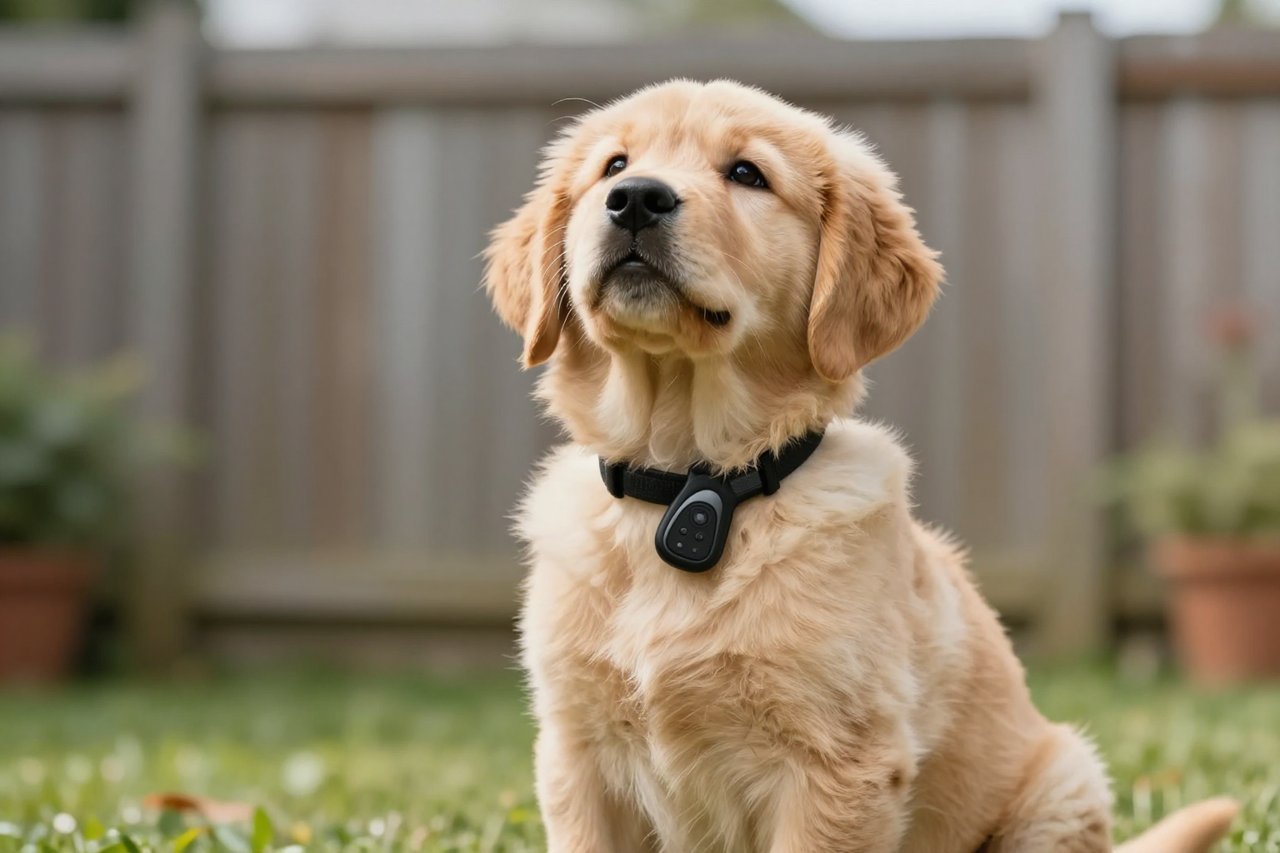
Fit is everything. If the collar is too loose, the tracker jiggles and the antenna can’t get a clear satellite signal. Too tight, and it will rub your puppy raw. The tracker unit should sit squarely on the top of the neck, so it points toward the sky.
A good test: you should be able to slide two fingers under the collar, but it should not be able to rotate more than a few inches. As puppies grow, you’ll need to adjust often. The step-by-step setup guide for a GPS puppy collar shows the exact placement that works. And please, don’t put the tracker underneath the chin or tuck it under a harness strap; you might as well wrap it in foil.
Mistake #4: Testing the Tracker Like It’s a Watch Battery
You’d be surprised how many owners put a collar on their puppy, open the app, and call it done. They don’t check if the location is accurate. They don’t know whether it takes ten seconds or sixty to get a fix. They only realize the problem when the app shows the puppy in the neighbor’s pool and the puppy is actually in the basement.
I recommend a simple drill. Put the collar on, walk a known route, and stop at five or six landmarks. Open the app and compare the reported position to where you actually are. Do this in an open field, near tall buildings, and under thick trees. The guide to testing and trusting your dog tracker in seven steps goes deeper into this process. If your tracker is off by 30 feet, that’s a different problem depending on whether you’re in a backyard or a busy parking lot.
Mistake #5: Turning the Collar into an Off-Leash Permit
A GPS collar is not a training tool; it’s a rescue tool. I see people in parks who let their puppy roam because “the tracker will find him.” That thinking puts the dog at risk. The tracker won’t stop your puppy from running into traffic or picking a fight with a bigger dog.
Teach your puppy a reliable recall command first. Our training tips that actually work in real life are a great start, but the principle is simple: the collar is for after the escape, not for avoiding the responsibility of supervision. Use the GPS to give your puppy a little more freedom, but do it gradually and in a safe environment.
Mistake #6: Ignoring the App’s Refresh Rate and Geofence Boundaries
Most GPS puppy collar apps let you choose how often the location updates, often every 10, 30, or 60 seconds. Faster updates use more battery. Slower updates mean your puppy can move a lot before you see the next dot. Pick the fastest setting that still gets you through the day, and remember that the displayed “last seen” time is something you should check regularly.
Geofence alerts are a gift, but only if you set them correctly. I once set a safe zone around a friend’s yard and accidentally included the street because I dragged the circle too wide. The alert never fired when her puppy ran out into traffic because the road was “inside” the zone. Be precise. Draw the boundary along your property line, and test it by walking outside with the puppy.
Mistake #7: Buying Before Checking Cellular Coverage in Your Area
A GPS tracker uses a cellular network to send its location. If that network has gaps where you walk, the tracker is worthless. Each device works with one or two carriers, and the app usually has a coverage map. But don’t assume the map is accurate. Take a walk with the tracker and watch the signal bars.
This is one of those things that’s easy to skip because it never crosses your mind. But if you hike in a canyon where your carrier has no signal, your GPS collar becomes a plastic ID tag. Some higher-end trackers use satellite communication, but those cost more and have their own limitations. For a deeper discussion of range and coverage, the article on dog trackers with GPS is a good resource.
Mistake #8: Forgetting That Puppies Chew Everything
My own puppy chewed the GPS collar off before I even had a chance to test the escape alert. Amazon reviewers have similar stories. The tracking unit is often a small, exposed box that looks like a chew toy to a teething puppy.
When your puppy wears the collar, make sure the tracker is securely attached with no loose straps. Some brands offer chew-resistant sleeves. You can also apply a bitter-tasting deterrent to the plastic, but that’s a temporary fix. Eventually, you’ll need to spend time training your puppy to ignore the collar, or you might want to put it on only when you’re out of the house. A collar that’s been chewed to pieces won’t track anything.
The Pre-Outing Checklist That Takes 30 Seconds
Before you walk out the door, run these checks. It sounds fussy, but it’s the same kind of routine a pilot uses before a flight.
- The tracker has at least 50% battery.
- The collar is snug and the tracker is pointed upward.
- The app shows the puppy’s last location from within the last minute.
- The geofence is set tightly around your property.
- Notification alerts are enabled on your phone, not just in the app.
- You’ve tested the accuracy sometime in the last week.
- Your puppy knows a basic recall command.
The Unpopular Truth About Peace of Mind
After all this, it might sound like I’m bashing GPS puppy collars. I’m not. I own one, and it has saved me from two heart-stopping moments. But the peace of mind you get isn’t automatic. It comes from understanding the limitations and designing your own safety net around them.
The collar will give you a dot on a map. It won’t give you a well-trained dog or a perfectly closed fence. The best owners I know treat the GPS collar as one piece of a bigger system: training, good fences, and constant supervision. When you put the effort in, the GPS becomes the backup you hope you never need—not the thing you rely on to save you.
Play it smart, test everything, and adjust as your puppy grows. That’s the difference between a GPS collar that gives you real peace of mind and one that just gives you anxiety at an unpredictable moment.


