
Table of Contents
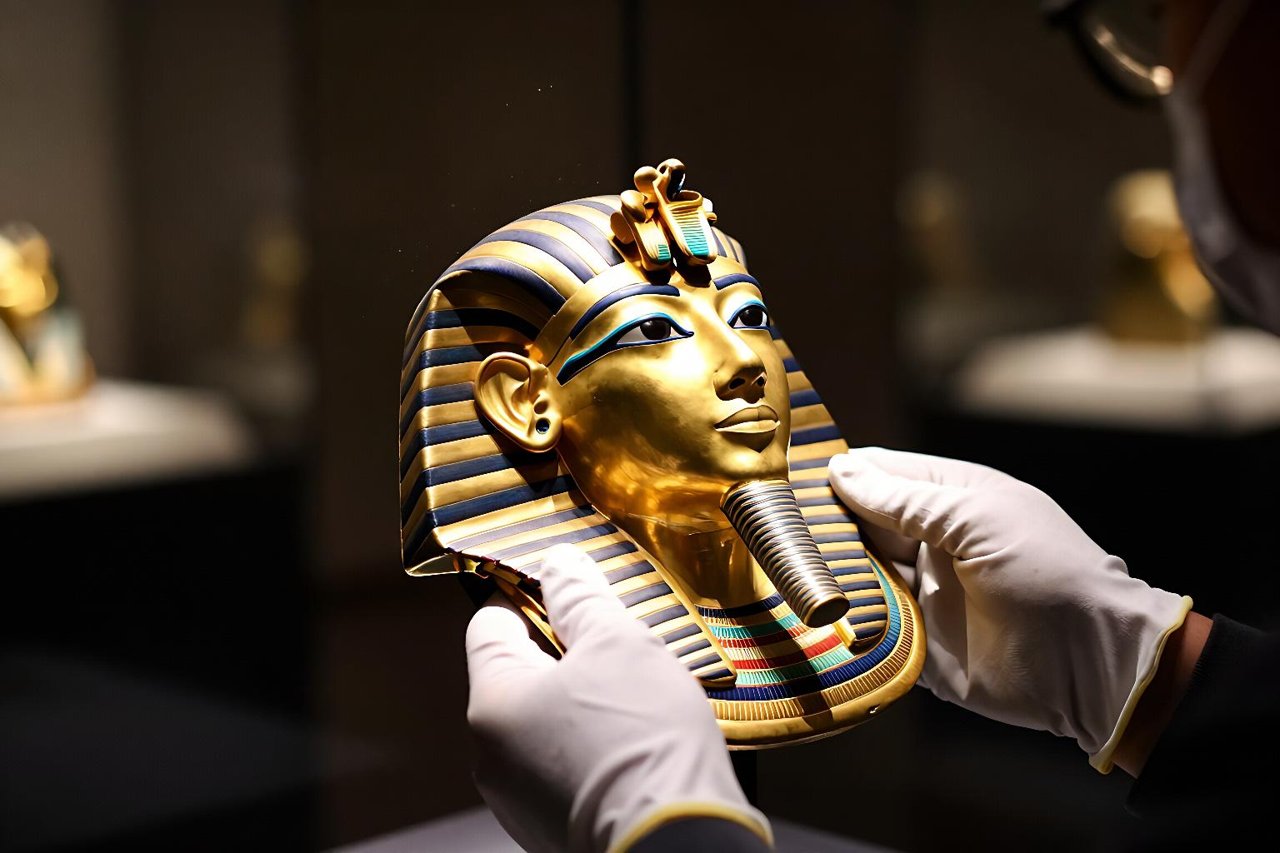
The lid of Tutankhamun’s inner coffin came up in October 1925 and the men in the room stopped talking. Laid across the boy king’s face was a sheet of beaten gold shaped into a young man’s features, inlaid with lapis lazuli, carnelian and quartz. It weighed 10.23 kilograms. Howard Carter had opened the tomb three years earlier, but it took another three to reach that moment.
The mask has never been sold. It never will be. Egyptian law forbids it and no insurer would write a sensible policy anyway. That’s the awkward problem with ranking the top 7 most valuable artifacts ever discovered: a handful of them come with real receipts, and the rest sit in national collections where “value” is a polite fiction. So this list uses both measures. Some entries changed hands for genuine fortunes. Others carry so much cultural weight that a price would tell you nothing useful.
1. Tutankhamun’s Mask: The Benchmark
Everything about the mask is specific. Fifty-four centimetres tall. 10.23 kilograms of gold, inlaid with lapis lazuli, turquoise, carnelian and obsidian, the nemes headdress striped blue and gold. It lay across the mummy’s chest and shoulders, inside three nested coffins, inside four gilded shrines, inside a tomb sealed for 3,200 years.
There is no auction record because there has never been an auction. Press estimates drift into the billions, usually with the word “reportedly” bolted on. The honest answer is that the object sits outside the market entirely. In 2014, conservators knocked the ceremonial beard off during a cleaning and glued it back with epoxy, a mistake that took a German team years to reverse. That accident made headlines on four continents, which tells you how much weight the thing carries.

Carter’s find still sets the bar for every Egyptian discovery that followed, including the ancient tombs recently discovered along the Nile and further afield.
2. The Guennol Lioness: $57.2 Million for Eight Centimetres of Limestone
Not much to look at, at first. The Lioness stands 8.3 centimetres tall, carved from white limestone around 3000 BC somewhere in ancient Elam, in what is now southwest Iran. Human torso, lion’s head, crossed forearms. She is one of the earliest known composite creatures from the region, and she looks like she would bite.
She spent nearly sixty years on loan to the Brooklyn Museum before Sotheby’s put her on the block in December 2007. The hammer fell at $57.2 million, more than double the high estimate and a record for an antiquity at auction that still stands. The Martin family had owned her since 1948. Sotheby’s never confirmed who signed the cheque.
3. The Codex Sassoon: $38.1 Million for a Bible
The oldest nearly complete Hebrew Bible in private hands sold in May 2023 for $38.1 million, which Sotheby’s billed as a record for any manuscript at auction. The book dates to the late ninth or early tenth century: 792 pages of vellum, written with vowel points and cantillation marks that fixed exactly how the text should be chanted aloud. Twelve leaves are missing.
It survived a millennium, several wars and a line of owners, including the Baghdad-born collector David Solomon Sassoon, who bought it in 1929 for £350. The winning bidder was Alfred H. Moses, a former US ambassador, who donated it to the ANU Museum of the Jewish People in Tel Aviv. Rare outcome, that. Most record-breaking sales end in a private vault.
4. The Bust of Nefertiti: The Object Germany Won’t Let Go
Ludwig Borchardt’s dig at Amarna turned up the bust on 6 December 1912, in the ruined workshop of a sculptor named Thutmose. It stands 48 centimetres tall, a limestone core under painted stucco, and it was found with one finished eye and one blank socket. Whether that asymmetry was deliberate or simply unfinished is still argued about.
It reached Berlin in 1913 under a partition agreement Egypt has disputed ever since. The Neues Museum gives it a room to itself. Reported insurance figures have crept into the hundreds of millions of euros, though no official valuation exists, and Germany has refused repeated restitution requests, including a formal Egyptian claim lodged in 2019. In this case, value is mostly a measure of how badly two countries want the same object.
5. The Rosetta Stone: Priceless Because of What It Unlocked
French soldiers rebuilding a fort near the town of el-Rashid in July 1799 found a slab of granodiorite covered in three scripts. The bottom one was Greek, and that meant scholars could read it. The middle was Demotic Egyptian. The top was hieroglyphs, a writing system dead for roughly 1,400 years. The decree carved into it is dull stuff: a 196 BC priestly statement about tax exemptions and the cult of Ptolemy V.
Jean-François Champollion cracked the code in 1822, and everything Egyptologists have read since, from tomb walls to papyrus grocery lists, traces back to that slab. The British Museum has held it since 1802, when the French surrendered it under the Treaty of Alexandria. It is the museum’s most-visited single object, and Egypt has formally asked for it back more than once.
Its worth has almost nothing to do with the rock. Three parallel texts left in the same place by accident made an entire civilisation legible again. That pattern runs through the whole discipline, and it’s the reason the dirt usually wins the argument over whatever shiny thing is sitting in the display case.
6. The Dead Sea Scrolls: Fragments That Sell for Seven Figures
In 1947 a Bedouin shepherd threw a stone into a cave at Qumran and heard pottery crack. Roughly 900 manuscripts and 15,000 fragments followed over the next decade, the oldest surviving copies of texts that became the Hebrew Bible, plus previously unknown writings from a Jewish sect living near the Dead Sea around two thousand years ago. The Great Isaiah Scroll alone runs 7.34 metres.
The market for fragments is grubby and lucrative. Individual pieces have changed hands for seven figures in private sales. Then in 2020 the Museum of the Bible in Washington announced that all sixteen of its fragments were modern forgeries, cut from old leather and inked by hand. Most of the money in this trade chases real objects while swimming in fakes.
7. The Antikythera Mechanism: The Artifact With No Comparable
Greek sponge divers hauled a corroded lump of bronze out of a shipwreck off Antikythera in 1901 and left it in a drawer for decades. When researchers finally looked inside, they found gear teeth. Around thirty bronze gears survive; the original probably had more. The device dates to roughly 150 to 100 BC and modelled the movements of the sun and moon, predicted eclipses and tracked a four-year cycle of athletic games.
Nothing remotely like it survives from the ancient world. No second example, no workshop, no mention in any surviving text. Its price is effectively undefined, because the only question worth asking is what a museum would pay to understand it properly, and nobody is going to write that cheque.
What Actually Drives the Price of an Artifact
Strip away the romance and the same handful of factors do nearly all the work:
- Material. Gold and silver come out of the ground looking like money. Limestone, bronze and papyrus mostly don’t.
- Legal status. A piece with a documented export history from before 1970 can be sold openly in most markets. One without it is unsellable, whatever it’s worth on paper.
- Story. The Guennol Lioness is a beautiful small carving. It became a $57 million one partly because it sat in a Brooklyn museum case for six decades and every dealer in New York knew its name.
- Oddity. The Antikythera Mechanism has no peers, which makes it both more valuable and impossible to price.
- Attention. Objects that pull crowds get budgets, climate control and security. Objects that don’t get a storage box and a catalogue number.
Which brings the list back to that gold face in Cairo. It sits in a case, gold and glass, worth a number nobody has bothered to invent because no scenario exists in which it changes hands. That’s not a failure of the market. It’s the market admitting, correctly, that some objects were never meant to be priced.


