
Table of Contents
Every pot of beef stew has that moment. Someone’s spoon hits something firm and flat, lifts it out, and sets it on the rim of the bowl. It looks like a stray leaf from the garden. It gets thrown away without a second thought. And yet nearly every serious stock, braise and soup recipe written in the last three centuries asks for one.
So what is it doing in there? Quite a lot, as it turns out, just not in a way you’d notice if you tasted the leaf on its own. Understanding what bay leaves add to soups and stews changes how you use them, how many you drop in, and when.
Alone, a Bay Leaf Tastes Like Almost Nothing
Chew a dried bay leaf straight from the jar and you get weak black tea, a whisper of eucalyptus, something faintly like clove, and a bitterness that lingers. It is not pleasant. That’s the first clue about how it works.
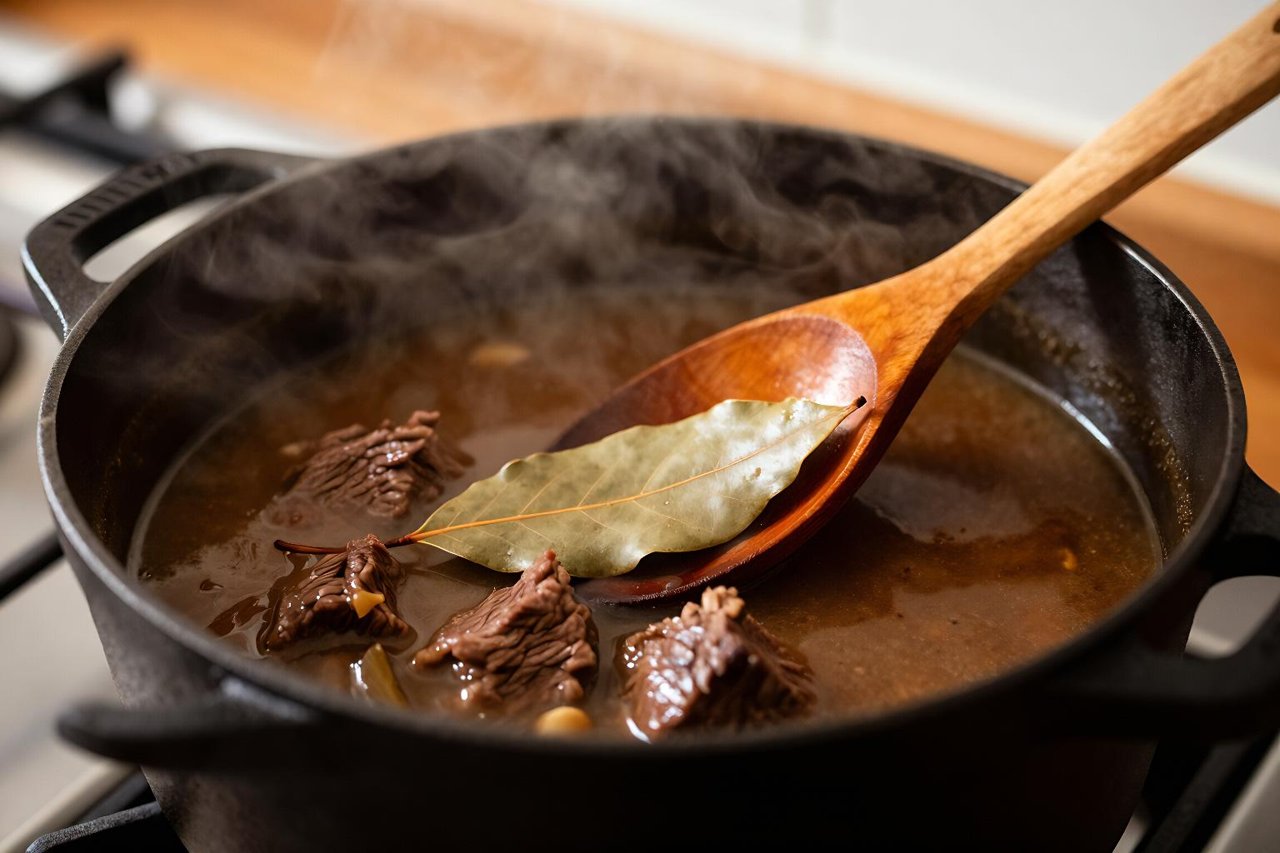
Bay (Laurus nobilis) is a Mediterranean evergreen in the same plant family as cinnamon and cassia. The dried leaf holds roughly 1.5 to 2 percent essential oil, dominated by a compound called 1,8-cineole, which is the eucalyptus note, plus eugenol and linalool. Those aromatics are fat-soluble and slow to escape. Drop a leaf into cold water and nothing much happens. Drop it into a pot of beef shin, onions and red wine simmering at a lazy bubble for an hour, and the fat in the dish pulls those compounds out and spreads them through every spoonful.

The result isn’t a bay-flavoured stew. It’s a stew that tastes rounder, deeper and more finished, with a savoury tea-like bass note you’d struggle to identify blind. Cooks call it a background flavour. Think of it as the bass line rather than the melody.
Fresh vs Dried, and the Bay Leaves You Should Avoid
Most of us cook with dried leaves, and that’s fine. Drying concentrates the aromatics, and a good dried leaf will out-perform a tired fresh one. A few practical points:
- Fresh leaves are milder. They’re greener, more floral and slightly more bitter. Use roughly twice as many as you would dried.
- Dried leaves fade fast. Twelve months in an airtight jar away from light is realistic. A leaf that snaps cleanly still has something to give. One that crumbles to dust in your fingers or smells of nothing but hay belongs in the bin, not the pot.
- Turkish bay is the standard. Long, pale, two-edged leaves labelled Laurus nobilis are what most recipes mean.
- California bay is a different beast. Shorter, rounder and far more powerful, with a menthol punch that can flatten a delicate soup. Use half a leaf where a recipe calls for one.
- Indian bay leaf (tej patta) is not a substitute. It’s a cinnamon relative with a warm clove-and-cassia scent, essential in biryani and dal, wrong in a French pot-au-feu.
What It Changes Inside the Pot
Four things happen when a bay leaf goes in early and stays in long enough.
It softens hard edges
Brown meat hard in a hot pan and you build bitterness and a slightly acrid note along with the colour. Tomatoes and wine bring acidity. A bay leaf doesn’t neutralise either, but it blunts the sharp corners so the finished stew tastes sweeter and more integrated. This is why a leaf is so often paired with tomato-based braises.
It lengthens the flavour of stock
A chicken broth made with just onion, carrot and celery tastes thin, even when it’s well salted. One bay leaf simmered for forty minutes gives it a middle register, a savoury depth that reads as long cooking rather than a shortcut.
It bridges herbs and meat
Thyme and parsley sit high and bright. Beef and lamb sit low and dark. Bay occupies the space between them, which is why the classic bouquet garni is built around it.
It cuts richness
A gentle astringency on the finish keeps a fatty pork shoulder or a lamb neck from feeling heavy by the third spoonful. It’s the same reason a leaf turns up in traditional bean and lentil pots, where smoked pork is doing the heavy lifting.
Timing and Quantity Matter More Than You’d Think
Bay is not a seasoning you add at the end. It needs at least 30 minutes of gentle heat to release anything meaningful. In a soup that’s on the stove for ten minutes, the leaf contributes exactly nothing except a garnish to fish out.
Two rules cover most situations:
Use fewer than you think. One or two leaves for a 2-litre (2-quart) pot of stew is standard. Never more than three, even for a huge batch. Bay doesn’t scale linearly. Push past three leaves and the eucalyptus note turns medicinal and slightly soapy, and no amount of simmering fixes it.
Pull it out. After about an hour, the leaf has given everything it has. Leave it in for three hours and it starts contributing bitterness instead. Fish it out with tongs once the meat is tender, then carry on reducing.
Crushing or tearing the edge of a leaf speeds things up, which is worth doing with older leaves or when you’re short on time. Ground bay is another option: about a quarter teaspoon equals one leaf, it disperses evenly, and it keeps releasing flavour as a dish sits, so use it sparingly.
The bouquet garni shortcut
Tie a bay leaf, three sprigs of thyme and four parsley stalks into a square of muslin or a leek leaf with kitchen string. Drop it in at the start, pull it out in one movement at the end. No fishing, no stray leaf in someone’s bowl.
Soups and Stews Where the Leaf Earns Its Place
Some pots take to bay better than others. These are the ones where its absence is genuinely noticeable:
- Beef and barley soup. Bay, thyme and a splash of Worcestershire is the whole backbone of the flavour.
- Split pea with ham. One leaf for 45 minutes turns a flat, salty soup into something that tastes slow-cooked.
- Lentil soup. Particularly with cumin and garlic, where bay adds a savoury note that stops the spices from dominating.
- Minestrone and other tomato-heavy vegetable soups. Bay and tomato are one of the great quiet pairings.
- Chicken and turkey stock. The single biggest improvement you can make to homemade stock for about four pence.
- Court bouillon and fish poaching liquid. Bay, peppercorns, lemon and white wine.
- Braised lamb shanks and pork shoulder. Where the astringency earns its keep.
It also works further afield: a leaf tucked into a pot of rice pilaff, into the vinegar for pickled beetroot, or into milk for a set custard. In each case it’s doing the same job, adding depth without announcing itself.
Five Mistakes That Make Bay Leaves Pointless
Using ancient leaves. The most common cause of “bay leaves do nothing” is a jar that’s been open since 2019. Buy small quantities and replace them annually.
Adding at the end. No time, no flavour. If you’re only going to have the soup on for fifteen minutes, skip the leaf entirely.
Adding too many. Two leaves taste like depth. Five taste like cough sweets.
Leaving it in for hours. Bitterness creeps in past the 90-minute mark in most dishes.
Never tasting the difference. Most cooks never isolate bay because they’ve never cooked two pots side by side.
The Two-Pot Test That Settles It
If you want to know exactly what bay leaves do, run a controlled experiment. It takes one evening and costs almost nothing.
Make a plain chicken broth: a chicken carcass, an onion, a carrot, a celery stick, two litres of water, salt. Simmer it for an hour, then strain it and divide it between two saucepans. Drop one dried bay leaf into the left-hand pan and leave the right one alone. Simmer both for another 30 minutes, then taste them side by side, in that order, then back again.
The unseasoned pan will taste clean, salty and a bit thin. The pan with the leaf will taste like it has more body, a faintly sweet tea-like undertone and a finish that lasts a beat longer. It’s a small difference, and it’s the reason the leaf has stayed in kitchens for two thousand years. Once you’ve tasted the gap, you’ll stop throwing the leaf away and start counting how many go in.


