
Table of Contents
Selling a dog as low-maintenance is one of the easiest small lies in the pet business. Nearly every breed profile claims “easy to care for,” and almost none of them tell you what that looks like on a wet Wednesday in February.
The truth is more useful than the marketing. Some dogs genuinely ask less of you: less brushing, shorter walks, fewer specialist appointments, and a temperament that doesn’t fall apart if the routine slips for a day. Those dogs exist, and they make excellent companions for people with demanding jobs, small flats, dodgy knees or simply no interest in spending Saturday morning at the groomer.
What “low-maintenance” actually means
Strip the phrase down and it covers four separate jobs. A breed can be easy on one and hard on another, which is why so many people end up surprised.
- Grooming. A beagle’s coat needs a rubber mitt once a week. A doodle needs combing three times a week or it mats into felt and gets shaved off. Short single coats and hand-stripped terrier coats sit firmly at the easy end.
- Exercise. Greyhounds sleep around 16 hours a day and are content with two 20-minute walks. A border collie will stare at you at 9pm because you only gave it two hours.
- Training drive. Breeds developed to work alongside people tend to offer behaviours and take a hint fast. Scent hounds were bred to make their own decisions, and it shows the moment you unclip the lead.
- Health and size. A 55kg mastiff costs more to insure, more to medicate and more to board. Flat-faced breeds need care in summer heat. Big dogs also live shorter lives, which is its own quiet cost.
One caveat worth stating plainly: no dog is maintenance-free. A bored dog chews skirting boards, barks at the postman and digs craters in the lawn. The breeds below are easier, not effortless.

Six of the best low-maintenance dog breeds
Greyhound
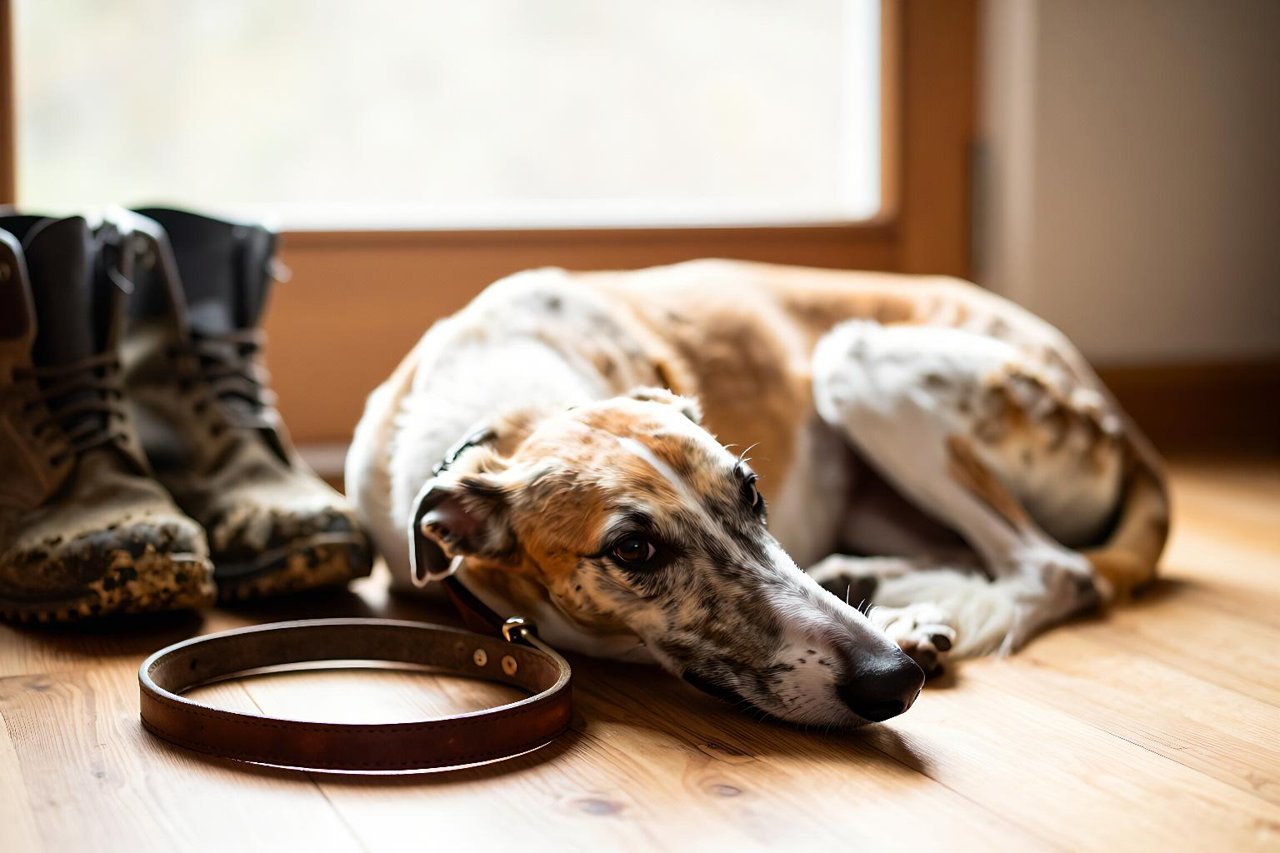
The best-kept secret in the dog world. Retired racers are often already lead-trained, crate-trained and thoroughly handled, and they’ll take a half-hour walk then go back to sleep for the afternoon. The coat is short and sheds modestly. A weekly pass with a hound mitt and you’re done, no clippers, no groomer, no brushing battles.
Two catches: thin skin, and a strong chase drive, so a securely fenced space matters more than a big one. They’re also among the calm dog breeds that suit a quiet household, which makes them a solid pick for anyone who wants company without chaos.
Whippet
If a greyhound feels too large, a whippet is broadly the same dog at around 12kg. Quiet indoors, rarely barks, almost no doggy smell, and a 40-minute walk plus a fenced sprint covers the exercise. The coat is about as low-effort as it gets. They do feel the cold, so budget for a fleece coat from October to March.
Their size and near-silence make them one of the more convincing small-space companions that genuinely thrive indoors, provided they get their daily off-lead run somewhere safe.
Boston Terrier
Roughly 7 to 11kg, short coat, light shedding, and about 30 to 45 minutes of walking a day. Bostons are people-pleasers, so training moves quickly with a bit of cheese as payment. Wipe the facial folds with a damp cloth a few times a week and the grooming box is effectively ticked.
They snore, they pass gas, and the flat face means they struggle in heat. Walk early or late in July and skip the midday. Beyond that, they’re one of the best dogs for first-time owners who want a friendly, portable companion without a grooming bill.
Border Terrier
A working terrier in a hardy 6kg package. The coat is the selling point: no clipping. Book a hand-strip twice a year, or learn to do it yourself with a stripping knife, and the rest of the time you just brush out loose undercoat. Mud dries and falls off, which matters more than any of us admit.
They still need a job. Fifteen minutes of scent games and a proper walk keeps them out of trouble. Skip them if you want a dog that lies on the sofa all day and never digs up a flower bed.
Basenji
Grooms itself like a cat, has next to no dog odour, and the short coat needs a weekly wipe rather than a brush. Basenjis don’t bark either. They yodel, which is worth knowing if you share a wall with a light sleeper. Exercise is moderate, roughly an hour a day.
The trade-off is independence. Recall is more of a suggestion than an instruction, so keep them on a long line or inside secure fencing. Not the breed for someone who wants a dog hanging on every word.
Bullmastiff
Easily the least exercise-hungry dog on this list. Two 20-minute walks and a potter around the garden does it. Short coat, minimal grooming, no professional appointments.
Then the honest part. Fifty-odd kilos means large food bills, higher anaesthetic costs, a lifespan closer to 8 to 10 years, and a fair amount of drool on your trousers. Training has to start the week you bring them home, because a 10kg puppy that jumps up is charming and a 50kg adult that jumps up is a genuine hazard. Not a beginner breed, but a truly low-energy one for the right household.
Breeds that look low-maintenance and really aren’t
- Cavalier King Charles Spaniel. Sweet, small and quiet, but the feathered coat needs brushing three or four times a week, and the breed carries well-documented heart and neurological risks.
- Doodle crosses. Marketed as low-shedding. In practice that coat needs a professional groom every six to eight weeks, for life, or it becomes a welfare problem.
- Border collie and Australian shepherd. Brilliant dogs, wrong fit for most flats. They’re the most common rehoming story at every rescue centre.
- Dachshund. Small, yes. Also stubborn to housetrain and prone to spinal surgery that costs thousands.
The easiest pick is often an adult rescue
Here’s the bit breed lists rarely mention. Predicting a puppy’s adult personality is educated guesswork. A two-year-old dog living in a foster home is a known quantity: the foster can tell you how it walks on a lead, whether it’s housetrained, how it copes at the vet, and whether it has ever eaten a sofa cushion.
You skip the chewing phase, the 3am toilet trips and the adolescent regression at 18 months. For anyone who wants a companion rather than a two-year project, that’s often the lowest-maintenance option available, breed label or not. Mixed-breed dogs also dodge some of the genetic problems that come with tightly bred lines. A settled four-year-old is usually a better fit for older owners who want manageable company than any puppy on a list.
The work that doesn’t disappear
Whatever you choose, four jobs stay on the calendar. Nails need trimming every three to four weeks, and long quicks make that harder the longer you leave it. Ears on floppy-eared dogs need a weekly look and a wipe. Teeth need brushing far more often than the once-a-year scale at the vet, because dental disease affects the majority of dogs over three.
Every dog also needs at least two walks a day, even the ones whose profile says lazy, purely for the toilet. And it’s worth putting £30 a month aside or paying for insurance before you need it. A single cruciate repair runs into the thousands. That isn’t a reason to avoid dog ownership; it’s a reason to choose a breed whose everyday costs leave room for the bad day.


