
Table of Contents
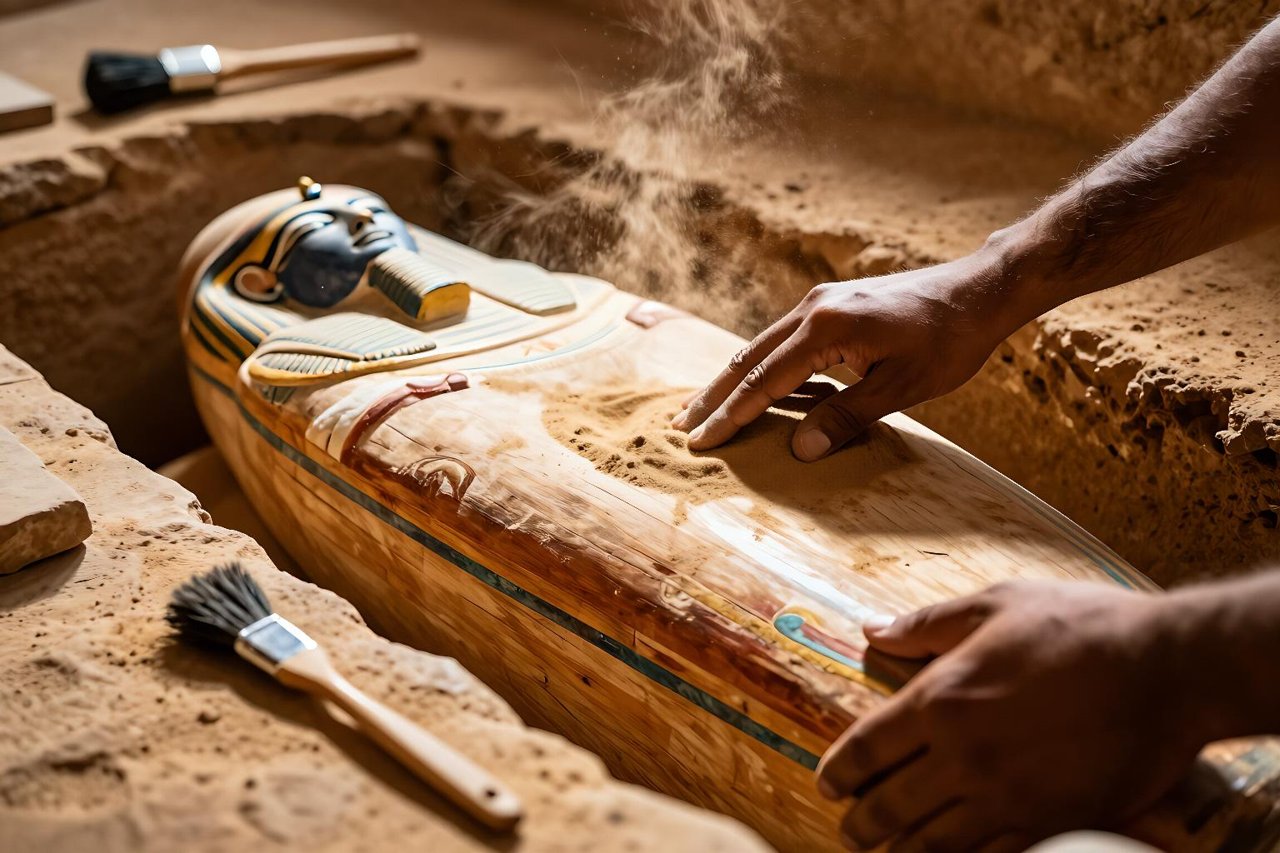
In October 2020, a team working the Saqqara necropolis lowered a camera into a sealed shaft and saw a painted wooden face looking back. The coffin had been closed for around 2,500 years. Within a fortnight there were 59 of them. By the end of the season the count had passed a hundred, stacked in tiers down the shaft like stock in a warehouse.
That is usually how archaeological discoveries in Egypt arrive: not as a single eureka moment but as a shaft that opens into a corridor that opens into a cemetery nobody knew existed, followed by years of laboratory work before anyone can say what it actually means.
The Lost Golden City Nobody Was Looking For
In September 2020, Zahi Hawass and his team were on the west bank at Luxor searching for a mortuary temple belonging to Tutankhamun. They hit mudbrick instead. Walls three metres high, then rooms full of ovens, amphorae, rings, scarabs, and a clay pot of dried meat still sealed with its lid in place.
The city, which the mission calls Aten, dates to the reign of Amenhotep III (roughly 1391 to 1353 BC) and was still occupied under Tutankhamun and his successor Ay. Its importance has little to do with gold, of which there is very little. The site was abandoned quickly and then buried by sand, which froze an ordinary working city mid-stride: a bakery, an administrative quarter, a residential zone, and a wall that may mark a zigzag defensive line. Furniture survives in some of the houses.

Finds like this are why historians keep returning to their drafts. The roster of recent archaeological discoveries that have historians rewriting the rulebook has grown crowded in the past few years, and a good share of it comes from the Nile Valley.
Nine Metres of Nothing Inside the Great Pyramid
In March 2023 a joint Egyptian, French and Japanese team announced a corridor inside the Great Pyramid of Giza: 9 metres long, 2.1 metres wide, sitting above the main entrance behind a chevron of enormous blocks.
What made the find remarkable was how it was made. The ScanPyramids researchers used muon radiography, tracking cosmic-ray particles that pass through stone and reveal density differences, along with infrared thermography. Nobody drilled. Nobody broke a block. The pyramid was scanned rather like a patient.
No one has crawled into the corridor and there is no inscription to translate. Its value is architectural, because it changes the picture of how loads inside the pyramid were managed during construction. Sometimes the headline is nine metres of empty space, and the science is in what that emptiness proves.
Saqqara, Which Is Never Finished
Saqqara has been excavated for more than 170 years and it still has not run dry. The site covers roughly seven square kilometres and contains tombs from the First Dynasty through to the Ptolemaic period, which is a polite way of saying that almost every generation of Egyptians left something in the sand there.
The coffin shafts
The Late Period burials that came up in 2020 and 2021 were the ones that made global news, but they were part of a longer campaign. Beneath the animal catacombs and the New Kingdom tombs sits a lattice of vertical shafts, some deep enough to need a winch, packed with painted coffins, wooden statuettes and funerary texts. Most were intact. For a discipline that usually works from fragments, that is close to unheard of.
The embalming workshop
In 2023 a team from Tübingen and the Max Planck Institute published the analysis of 31 ceramic vessels found near the Teti pyramid. Many still carried their contents, and several were inscribed with the names of the substances inside and where on the body they were meant to go. The results, published in the journal Nature, read like a workshop inventory:
- Cedar oil and pistachio resin imported from the Levant, showing long-distance trade in mummification materials
- Animal fats, beeswax and bitumen blended into specific recipes
- Separate preparations for washing the body, for the head, and for softening bandages
- Labelled instructions that suggest a genuine teaching environment, not a one-off workshop
That last point matters more than it sounds. Mummification has long been described as a craft learned by watching. Here was a working kit with written guidance attached.
A Pharaoh’s Tomb, Found at Last
In February 2025, a joint Egyptian-British mission led by Piers Litherland announced the identification of the tomb of Thutmose II. It sits in a wadi about 2.4 kilometres from the Valley of the Kings, an area previously dismissed as largely empty of royal burials.
The evidence was clear once the debris was cleared: alabaster jars inscribed with the names of Thutmose II and his wife and half-sister Hatshepsut. The chamber had been flooded shortly after the burial, probably within a few years, and the contents moved elsewhere in antiquity, so the tomb was largely empty. Even so, it was the first royal tomb found in the Luxor area since Howard Carter opened Tutankhamun’s in 1922, and it settled a long argument about where the early Eighteenth Dynasty kings were buried.
The Half of Egypt That Is Underwater
Egypt’s coastline has its own archaeology, and it is every bit as productive as the desert. In 2000, Franck Goddio’s team located Thonis-Heracleion in Abu Qir Bay, roughly 10 metres down and a few kilometres offshore, along with the submerged outskirts of Canopus. The site returned a stele of Nectanebo I, colossal statues, gold coins and the remains of more than 60 ships.
Much of what survives is not temple stone but cargo: amphorae in rows, anchors, hull timbers preserved in silt. Work on sunken cities and 2,400-year-old hulls has quietly done for Mediterranean trade history what Saqqara did for burial practice.
The Paper Trail at Wadi al-Jarf
In 2013, Pierre Tallet’s team working on the Red Sea coast at Wadi al-Jarf recovered the oldest inscribed papyri ever found, around 4,500 years old. They included the logbook of an official named Merer, who ran a boat crew delivering Tura limestone to the construction site at Giza.
Merer’s entries are dull in the best possible way. They record inspections, rations of bread and beer, the names of work gangs, and days lost to weather. There is no Pharaoh-worship in them, no grand narrative. It is a delivery schedule written by a middle manager who was very probably tired, and it puts the Great Pyramid in the hands of ordinary labour rather than slaves.
The Lab Work Nobody Sees
Some of the most consequential finds never make a press conference. Analysis of a dagger from Tutankhamun’s tomb in 2016 confirmed what had been suspected since the 1920s: the blade is meteoric iron, with about 10.8 percent nickel and traces of cobalt, consistent with a meteorite rather than smelted metal. It was made from something that fell out of the sky.
Residue analysis, pigment study and CT scanning now do work that excavation alone cannot. And there is the small matter of custody, since a great many of these objects are extraordinary by any measure. A look at the archaeological artifacts that are effectively priceless explains why objects like the golden death mask have no meaningful market value at all.
What Comes Out of the Sand Next
Less than a third of Egypt’s registered archaeological sites have been properly excavated, and new ones keep being added to the register. In 2024, work at Tell al-Deir in Damietta uncovered 63 tombs containing gold foil figurines and imported pottery, revealing a Bronze Age port that had barely been documented. Egyptian-led missions now outnumber foreign ones, which is a real change from the pattern of the last century and has shifted who controls the narrative.
The unglamorous truth is that most digging days produce pottery. Sherds, silt, bone, and the occasional mudbrick wall that has to be photographed and drawn before it crumbles. The work is sieving and recording and washing finds in a bucket at the end of the afternoon. Every so often, someone’s trowel hits a sealed shaft, and the schedule goes out of the window for the next decade.


