
Table of Contents
A cat that never goes outside isn’t living a half-life. It’s living in a world you built for it, one shelf and window ledge at a time. Every cardboard box left on the floor, every perch at head height, every ten minutes of chasing a feather is either enrichment or dead space in that world.
Get those pieces right and an apartment cat can be as settled, playful and content as any cat that patrols a garden. Get them wrong and you end up with a cat that chews cables, screams at 3 a.m., or parks itself on your chest every time you sit down. The fix is rarely complicated. It’s just more deliberate than most of us start out.
Indoor Life Isn’t the Problem, Boredom Is
Cats in the wild spend a huge chunk of their day working: watching, stalking, creeping, pouncing, eating, grooming, patrolling. Fourteen or fifteen hours of that involves resting, but the active hours are full. An indoor cat still has the same wiring and a fraction of the inputs.
Boredom in cats doesn’t look like boredom in humans. It looks like overgrooming, a bald patch on the belly, a fixation on doorways, ambushing ankles, or yowling at the empty hallway around sunset. If any of that sounds familiar, the answer isn’t a second cat or a bigger flat. It’s giving the cat more to do inside the one they’ve got.

Think in Three Dimensions, Not Floor Space
We measure a flat in square metres. A cat experiences it in layers, and vertical space is worth triple what floor space is worth. When a cat can climb, it stops feeling cornered. It gets a choice about how close to you it wants to sit, and where to retreat when the doorbell goes.
Build a route, not a random shelf
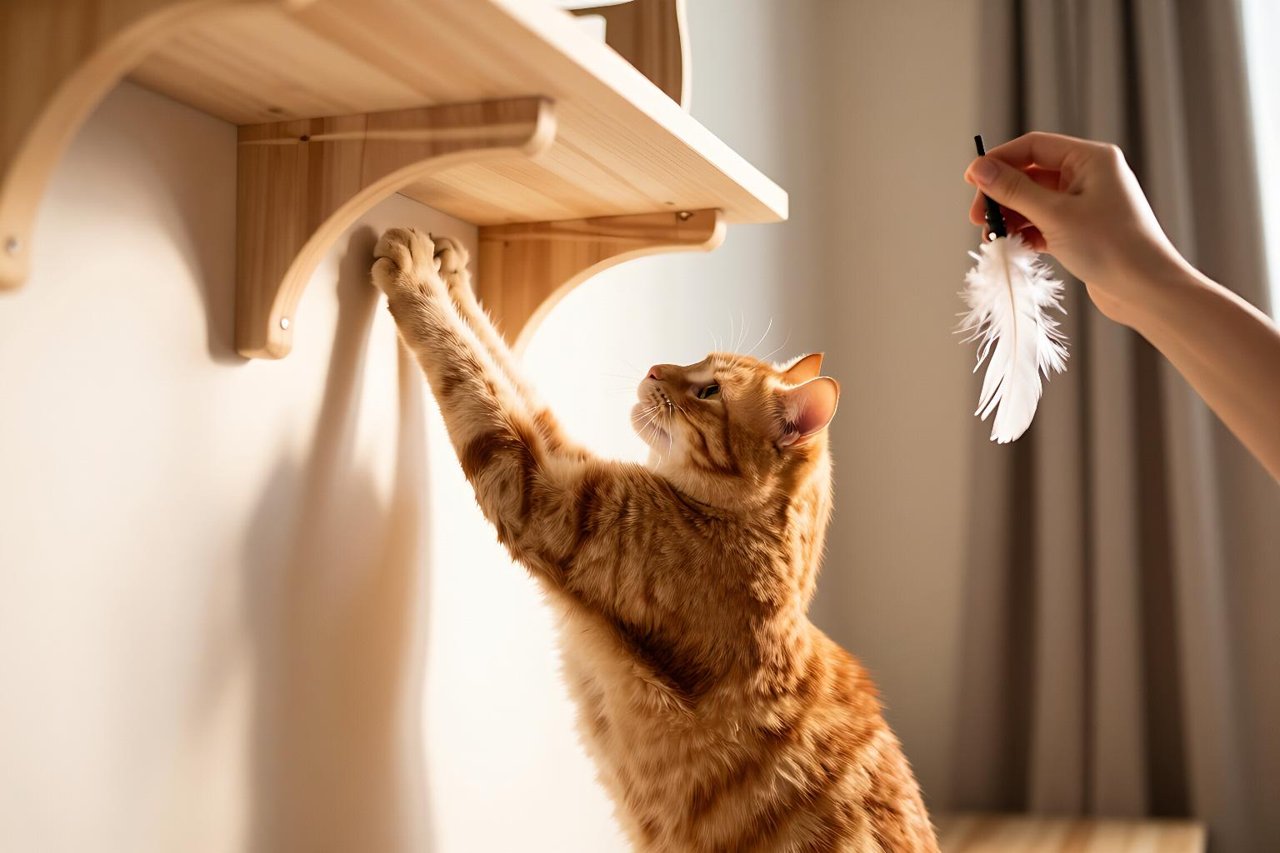
A single cat tree in the corner is a start, but the real win is a connected route. Think: sofa back to a side table, table to a wall shelf, shelf to the top of a bookcase, all in steps of about 30 to 40cm that a cat can hop without hesitation. Wall-mounted shelves, a cleared top shelf in a cupboard, even a sturdy stack of boxes gives them a pathway around the room at eye level.
The window is the best screen in the house
A windowsill with a view of a hedge, a car park or a busy pavement is live television, and it never repeats. Clear the sill, add a padded perch that clips over the frame, and make sure the window opens or the glass stays clean enough to actually see through. If your flat looks onto nothing, a wall-mounted bird feeder does the job for the price of a takeaway. Cats will spend hours twitching at the sparrows.
Play Like a Predator, Not a Person
Waving a wand toy in lazy circles teaches a cat that chasing isn’t worth the effort. Play works when it imitates prey: start slow, hide the toy behind a chair leg, let it peek out, then dart it away. Cats are drawn to movement that behaves like something trying to escape.
Run the full hunt sequence
Big cats and small ones follow the same script: hunt, catch, kill, eat, groom, sleep. You can trigger all of it in one sitting. Ten to fifteen minutes of committed play, then let them actually catch the toy and hold it for a few seconds, then feed them while they’re still a bit out of breath. That order matters far more than most people realise. A cat that hunts and eats in sequence settles for the evening instead of pacing.
Keep four toys, not fourteen
A pile of toys on the floor stops registering after a week. Keep a small box and swap three or four items out every few days. A crinkle tunnel that disappears on Monday is a brand-new tunnel come Thursday. Rotating beats buying.
Make Meals a Puzzle
Fast eating and post-dinner begging are usually signs that food arrives too easily. Scatter a portion of dry food across the floor for them to forage, or use a puzzle feeder, a treat ball, or a scrunched-up paper parcel. A cat will happily spend ten minutes knocking a ball around to get eight kibbles out of it.
Good nutrition sits alongside that. Cats need moisture, so wet food should do most of the heavy lifting, with dry kibble for foraging games and a bit of crunch. If you’re unsure what to put in the bowl, these expert picks for cat and dog food are a solid starting point. Keep water bowls away from food too, and put one in a separate room. Cats tend to drink more when water isn’t next to their dinner.
- Scratching: Both horizontal cardboard and a vertical sisal post, near the sofa and near their sleeping spot. Cats scratch to mark territory and stretch, not to be naughty.
- Hiding: At least one covered spot where they can see out but not be seen, such as under a bed or inside a cat tent.
- Grooming: A two-minute brush with a soft slicker removes loose fur and mimics the social grooming cats do with each other.
- Down time: A quiet, warm place nobody disturbs, especially if you have children or a lot of guests.
Company and Routine Do a Lot of the Work
Cats are creatures of pattern. Same feeding time, same play session, same bit of sun on the rug. Small irregularities are fine, but a chaotic household with unpredictable comings and goings wears on them. If you’re out for ten hours a day, consider a timed feeder and a mid-day puzzle, or think carefully about whether a companion cat is right.
Temperament matters here too. Some cats genuinely prefer their own company, while others wilt without chatter and movement. If you’re choosing rather than adapting, it’s worth looking at indoor cat breeds that thrive without a garden. For flats with thin walls and neighbours, this guide to cats that cope with small flats covers the breeds with quieter voices and calmer bodies. And if this is your first cat, breeds that suit first-time owners is a gentler place to start than picking on looks alone.
The Fifteen-Minute Rule
If you only change one thing this week, change this: two proper play sessions a day, morning and evening, of about fifteen minutes each, using a wand toy worked like escaping prey, followed by a small meal or a few treats. Set a timer if you need to. Most cats will go from wild-eyed to flat on their side in that window, and the difference in the following six hours is noticeable within a few days.
The rest stacks up from there. Add one high perch, swap the toys around, move a water bowl away from the food, and put a perch on the window. None of it costs much and none of it takes long. What you’re really doing is giving an indoor cat a working territory with a job to do, and that’s most of what happiness looks like for a cat.


